
Development and Design
Designed by the bureau led by Chefkonstrukteur Dipl.-Ing. Richard Vogt, the BV 142 was conceived in 1937 as a landplane derivative of the Ha 139 long-range seaplane. Originally designated as the Ha 142, it was developed for the Reichsluftfahrtministerium (RLM) and Deutsche Lufthansa (DLH) to serve as a transatlantic postal aircraft. The design goal was to transport 500 kg of mail on the route between Stuttgart, Germany, and Natal, Brazil. The aircraft featured a cantilever "Rohrholmflügel" (tube-spar wing) and a low-wing monoplane configuration with an inverted gull wing. Its tail unit consisted of a high-mounted horizontal tailplane and twin vertical fins, while the landing gear utilized an oleo-hydraulic retractable system with two twin-wheel main units.
Production and Manufacturer
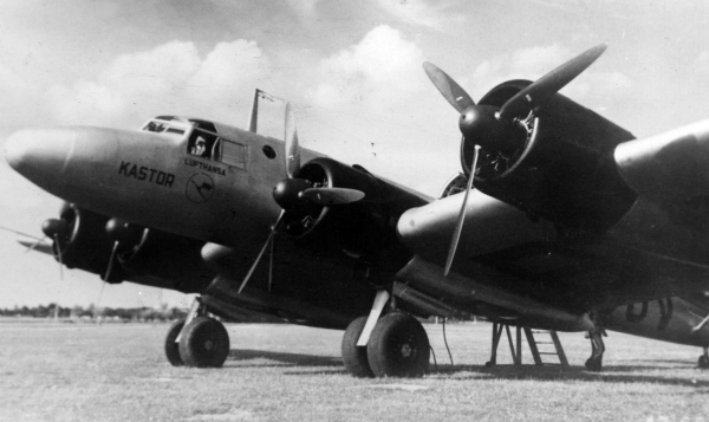
The aircraft was produced by Hamburger Flugzeugbau, the aviation arm of the Blohm & Voss shipyard located at Steinwerder, Hamburg. In 1938, the division was reorganized, and the "Ha" designation was replaced by "Blohm & Voss (BV)." Production was limited to four prototypes (V1–V4) built between 1938 and 1940. The V1 prototype, named "Pollux" (WNr 218), first flew on 11 October 1938. The V2, named "Kastor" (WNr 219), flew in 1939, while the V3 ("Burgenland", WNr 437) and V4 (WNr 438) were completed in 1940.
Technical Specifications
The BV 142 was powered by four BMW 132 H/H1 nine-cylinder air-cooled radial piston engines, each producing a take-off rating of approximately 880 PS (647 kW). These engines drove three-bladed variable-pitch propellers. In its reconnaissance configuration (V2/U1), the aircraft had a wingspan of 29.53 m, a length of 20.48 m, and a maximum take-off weight of up to 16,560 kg. It achieved a maximum speed of 373 km/h at sea level and a cruising speed of 325 km/h at 2,000 m, with a service ceiling of 9,000 m and a range of 3,900 km.
Service History
Due to technical problems during testing, Deutsche Lufthansa never took delivery of the aircraft. At the onset of World War II, the RLM assumed control of the prototypes and ordered their conversion into long-range reconnaissance aircraft (Fernaufklärer). The military versions were equipped with five 7.92 mm MG 15 machine guns and could carry up to four 100-kg bombs. In the summer of 1940, the V1 and V2 were deployed with the 1.(F)/AGr Ob.d.L. for maritime and strategic reconnaissance over the North Sea and Atlantic. The V3 was utilized by the Erprobungsstelle Travemünde but crashed near Neustadt/Holstein in September 1940, resulting in five civilian fatalities. Because of poor suitability for the reconnaissance role, the BV 142 was quickly retired and the remaining airframes were scrapped; no examples survive today.