
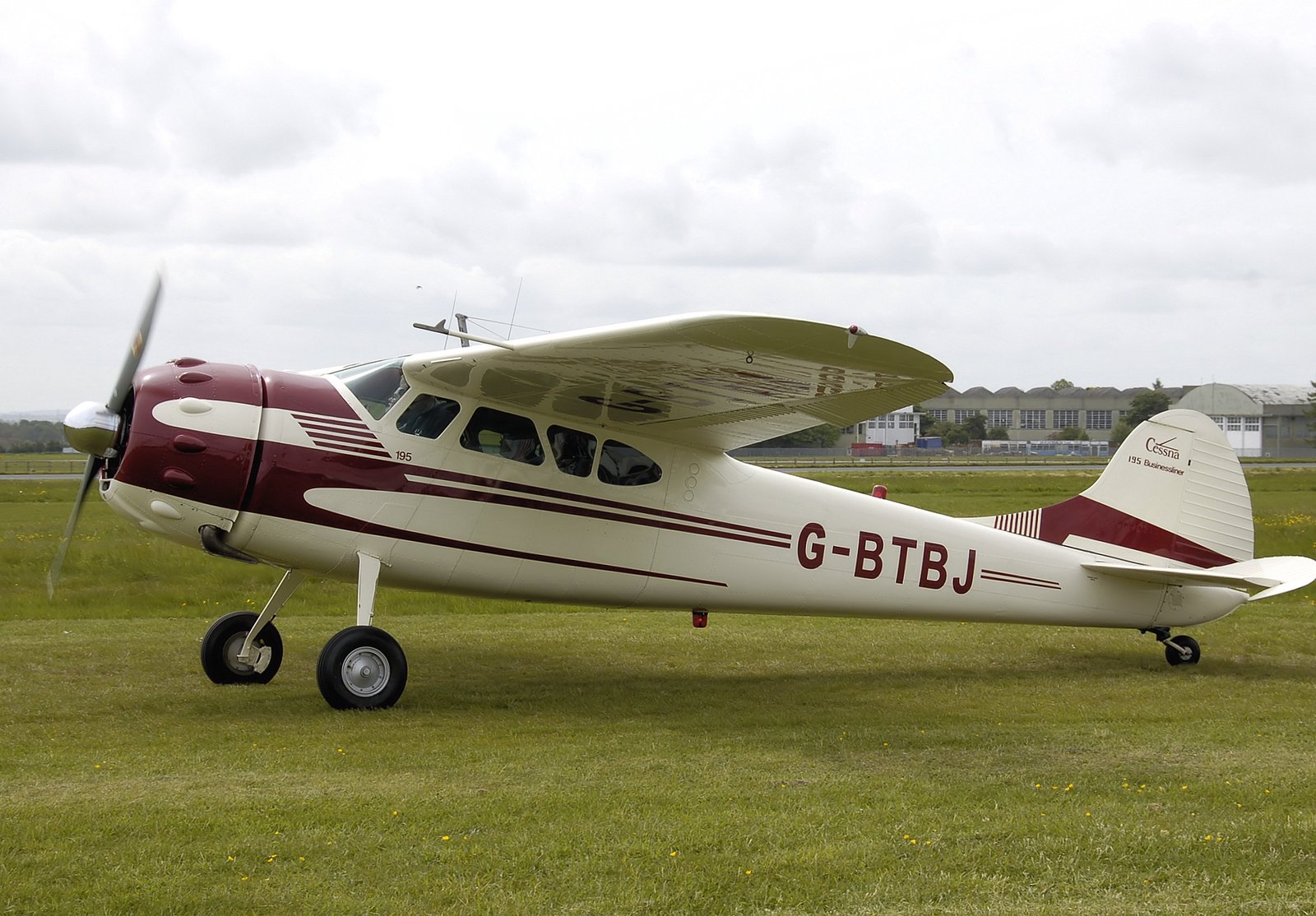
Design and Development
The Cessna 195 evolved from wartime prototypes developed in the mid-1940s, with design work beginning on the 190 prototype in 1944 and the 195 variant following in 1945. Test pilot Mort Brown conducted the maiden flight of the first production 195 (registration NC41690) on July 15, 1947, marking the beginning of a seven-year production run that would establish Cessna's reputation in the business aviation market.
Cessna's engineers designed the aircraft as a five-place light transport, targeting affluent business owners who demanded both speed and reliability. The company marketed it as the "Businessliner," positioning it as a premium alternative to smaller aircraft like the Cessna 140. The 195 featured an all-aluminum construction with a distinctive strutless high wing, large engine cowling, and gleaming spinner that became hallmarks of the design.
Engine Variants and Performance
Four distinct variants emerged during the production run, each powered by different radial engines. The original 195 used the Jacobs R-755-A2 seven-cylinder radial producing 300 horsepower, certified on June 12, 1947. The 195A, certified January 6, 1950, featured the reduced-power Jacobs L-4MB generating 245 horsepower for improved fuel efficiency.
The 195B, certified March 31, 1952, became the most popular variant with its 275-horsepower Jacobs R-755-B2 engine and significantly improved handling characteristics. This model incorporated flaps 50 percent larger than earlier versions, dramatically improving low-speed performance. The engine consumed approximately two quarts of oil per hour from its five-gallon capacity system, with a minimum operating level of three gallons.
Cessna also produced the 190 variant, powered by the Continental W670-23 seven-cylinder radial generating 240 horsepower. This model utilized war-surplus engines paired with Hamilton Standard constant-speed propellers, receiving certification on July 1, 1947.
Military Service
The United States Air Force, Army, and Army National Guard adopted the 195 for utility and light transport duties under the military designation LC-126, later redesignated U-20. Military deliveries spanned from 1949 to 1952, totaling 83 aircraft including variants A, B, and C. These military versions retained the civilian aircraft's versatility, maintaining approval for operation on wheels, floats, and skis under Type Certificate A-790.
Military variants served exclusively in non-combat roles, primarily as utility transports and liaison aircraft during the early Cold War period. The armed forces valued the aircraft's reliability and operational flexibility, particularly its ability to operate from unprepared airstrips and water surfaces.
Commercial Success and Pricing
The 195 commanded premium pricing throughout its production life, reflecting its position as a luxury business aircraft. In 1947, the base model cost $12,750, equivalent to approximately $179,545 in 2024 dollars. By 1954, the improved 195B reached $24,700, or roughly $289,207 in current value, compared to just $3,495 for the smaller Cessna 140.
This pricing strategy targeted successful business owners and operators who required reliable transportation for distances beyond the practical range of smaller aircraft. The 195's five-seat capacity and radial engine reliability made it particularly attractive for North American business travel, where its speed advantage over contemporary aircraft justified the premium cost.
Manufacturing and Production
Cessna manufactured all 190/195 series aircraft at its Wichita, Kansas facilities. Production began with serial number 7003 in July 1947 and continued through serial number 7999, then resumed with numbers 16,000 through 16,183. Total production reached 1,180 aircraft, comprising 233 Cessna 190s, 866 Cessna 195s, and 83 military LC-126 variants.
The Cessna Aircraft Company, founded by Clyde Cessna in 1927, had established itself as a pioneer in all-metal light aircraft construction. The 190/195 series represented the company's only postwar radial-engine design, bridging wartime technology with civilian aviation needs. Following various ownership changes, including acquisition by General Dynamics in 1986 and subsequent sale to Textron Inc. in 1992, the company continues operations today as Textron Aviation.
Pilot Experience and Handling
Pilots consistently praise the 195 as "a real pilot's airplane," requiring genuine skill and attention compared to later tricycle-gear designs. The conventional landing gear configuration and powerful radial engine demand respect during ground operations and landing approaches. The 195B's enlarged flaps significantly improved low-speed handling, making it more forgiving during critical phases of flight.
The aircraft's performance capabilities exceeded most contemporary light aircraft, offering cruise speeds and climb rates that made it competitive with much larger aircraft. Its approval for float and ski operations expanded its utility beyond conventional airports, appealing to operators requiring access to remote locations.
Legacy and Preservation
More than 500 of the original 995 Cessna 195s remain airworthy today, testament to the aircraft's robust construction and enduring appeal. The Golden Age Air Museum displays a 1949 Cessna 195, representing the type's significance in post-war aviation development.
Production ended in 1954 primarily due to the depletion of war-surplus radial engines, which had provided cost-effective powerplants during the early production years. The 195 marked the end of an era in general aviation, as manufacturers subsequently shifted toward tricycle landing gear configurations exemplified by aircraft like the Cessna 172, introduced in 1956. Today, the 195 remains a coveted classic aircraft, valued for its distinctive styling and connection to aviation's golden age.