
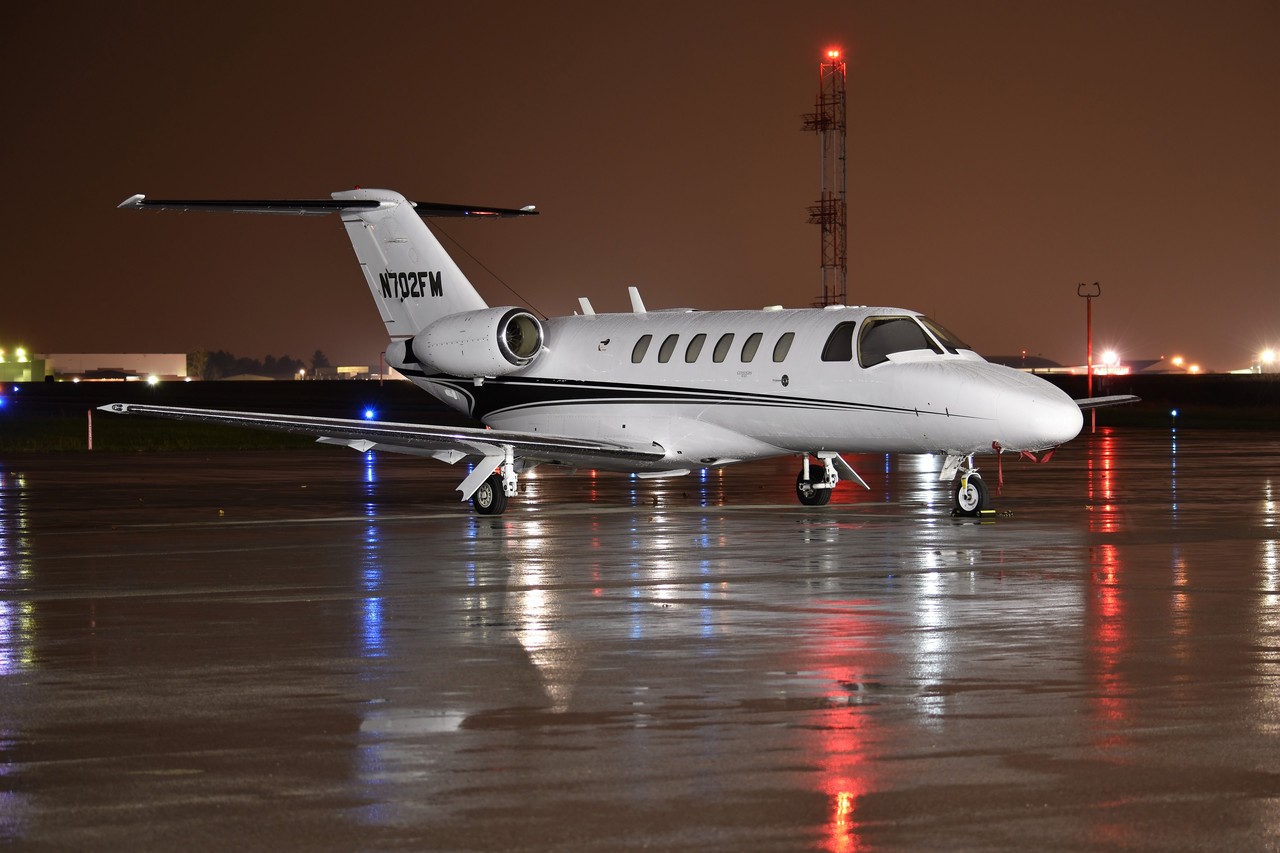
Market Dominance and Innovation
The Citation CJ2 emerged as Cessna's answer to growing demand for larger light jets capable of single-pilot operation. By December 2019, the CJ2 had captured significant market share with 91% of aircraft changing hands through the pre-owned market, demonstrating strong resale value and operator satisfaction. The aircraft's success stemmed from its strategic positioning between smaller entry-level jets and mid-size aircraft, offering enhanced cabin space without compromising operational efficiency.
Cessna Aircraft Company Legacy
Founded in 1927 and headquartered in Wichita, Kansas, Cessna Aircraft Company established itself as one of the world's largest general aviation manufacturers through decades of innovation in both piston-powered aircraft and business jets. The company underwent significant ownership changes, with General Dynamics acquiring Cessna in 1985, followed by Textron's purchase in 1992. In March 2014, Cessna ceased operating as an independent subsidiary, becoming one of three aviation brands under Textron Aviation alongside Beechcraft and Hawker.
Advanced Engineering and Design
The CJ2's development centered on stretching the proven Model 525 CitationJet platform, adding two additional cabin windows and increasing overall dimensions for improved passenger comfort. The most significant technical advancement came through a four-year collaboration with NASA to develop a natural laminar flow wing design. This innovation reduced airflow separation and improved the lift-to-drag ratio by 10-15% compared to conventional straight-wing configurations, directly translating to enhanced fuel efficiency and performance.
Powerplant and Performance
Two Williams FJ44-2C turbofan engines, each producing 2,400 pounds of thrust, powered the original CJ2. These engines consumed 139 gallons per hour combined and featured 5,000-hour overhaul intervals, contributing to the aircraft's reputation for reliability and cost-effective operation. The powerplant selection enabled single-pilot certification while providing sufficient power for a maximum cruise speed of 410 knots and a service ceiling of 45,000 feet.
The aircraft demonstrated impressive climb performance with an initial rate of 3,870 feet per minute on both engines and 629 feet per minute with one engine inoperative. Takeoff distance requirements of 3,420 feet and landing distance of 2,589 feet allowed operation from shorter runways typically associated with smaller aircraft.
Operational Characteristics
With a maximum takeoff weight of 12,500 pounds and fuel capacity of 3,930 pounds, the CJ2 could carry up to 1,500 pounds of payload. The cabin measured 14.1 feet long, 4.8 feet wide, and 4.8 feet tall, providing 248 cubic feet of passenger space. Standard seating accommodated six to nine passengers plus one pilot, though the aircraft's single-pilot certification allowed for cost-effective operations in commercial charter and corporate flight departments.
The CJ2's range of 1,505 nautical miles under NBAA IFR reserves with four passengers enabled nonstop flights between major business centers across North America, making it particularly attractive to corporate operators requiring reliable point-to-point transportation.
Production Evolution
Cessna delivered 243 CJ2 aircraft between November 2000 and 2006, with 2002 marking the peak production year when 86 units were completed. The 100th aircraft, registered N170TM, was delivered to TitleMax Aviation on August 27, 2002, representing a significant production milestone.
In 2005, Cessna introduced the enhanced CJ2+ variant, also designated Model 525A, featuring upgraded Williams FJ44-3A-24 engines producing 2,490 pounds of thrust each. The CJ2+ achieved maximum cruise speeds of 418 knots and extended range to 1,613 nautical miles. Production continued through 2014 with 226 CJ2+ aircraft manufactured.
Contemporary Operations and Legacy
As of 2020, fleet statistics revealed exceptional longevity with 236 of 243 original CJ2 aircraft remaining active, while 223 of 226 CJ2+ variants continued in service. Only seven original CJ2s and three CJ2+ aircraft had been retired from active use, demonstrating remarkable fleet utilization rates exceeding 97%.
The CJ2 family's significance extends beyond production numbers, establishing design principles and operational standards that influenced subsequent light jet development. The aircraft successfully bridged the gap between entry-level jets like the original CitationJet Model 525 and larger mid-size aircraft, creating a market segment that competitors continue to target today. Primary operations remain concentrated in private ownership and corporate flight departments, where the combination of single-pilot capability, reasonable operating costs, and enhanced cabin space continues to meet evolving transportation requirements.