
Business Aviation Leadership
The Citation CJ3 emerged during a golden era for business aviation, capturing a substantial share of the light jet market between 2004 and 2015. As part of the broader Citation family that achieved over 8,000 deliveries by 2022, the CJ3 contributed to Cessna's dominance in corporate aviation. The CitationJet series alone reached 2,000 deliveries by June 2017, establishing itself as the backbone of the global business jet fleet with more than 41 million flight hours logged across all Citation variants.
Corporate flight departments and charter operators embraced the CJ3 for its ability to access shorter runways while maintaining transcontinental range capabilities. The aircraft's 3,180-foot takeoff distance and 2,770-foot landing distance opened up thousands of airports unavailable to larger business jets, making it particularly valuable for accessing smaller cities and private airfields.
The Manufacturer's Evolution
Cessna Aircraft Company developed the CJ3 during a period of significant corporate transformation. Originally an independent manufacturer, Cessna was acquired by General Dynamics in 1985, then purchased by Textron in 1992. By March 2014, during the CJ3's final production year, Cessna ceased operating as a standalone subsidiary and became one of three brands under the newly formed Textron Aviation, alongside Beechcraft and Hawker.
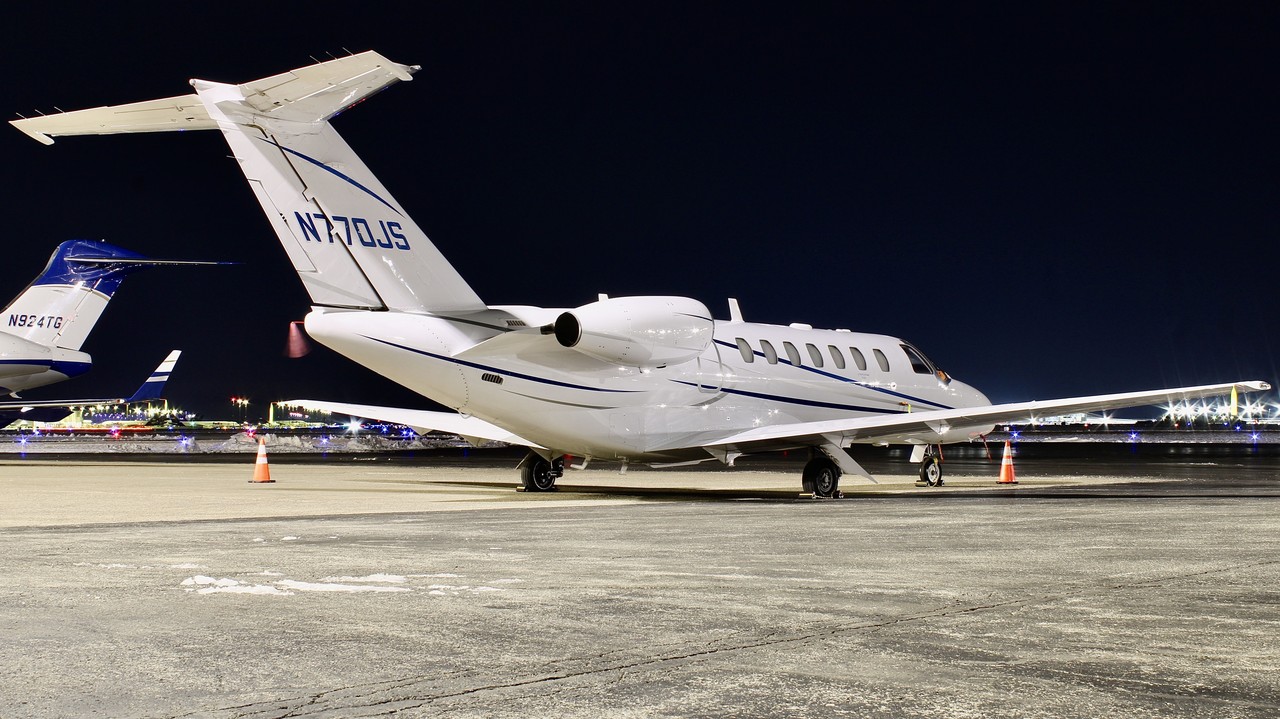
The CJ3 program built upon Cessna's strategy of evolutionary design improvements. Engineers extended the CJ2's fuselage and incorporated the Citation II's proven forward fuselage design with a new carry-through wing section and T-tail configuration. This approach minimized development costs while maximizing reliability, a formula that had served Cessna well since launching the original CitationJet program in October 1989.
Engine Technology and Performance
Powering the CJ3 were two Williams FJ44-3A turbofan engines, each producing 2,820 pounds of thrust. These engines featured Full Authority Digital Engine Control (FADEC) systems, representing a significant technological advancement over earlier CitationJet variants. The FADEC system automated engine management tasks, reducing pilot workload and improving fuel efficiency to 149 gallons per hour.
The engine installation enabled the CJ3 to achieve a service ceiling of 45,000 feet and a rate of climb exceeding 4,400 feet per minute. Even with a single engine failure, the aircraft maintained a service ceiling of 26,250 feet and could climb at 1,090 feet per minute, providing substantial safety margins for operations over mountainous terrain or congested airspace.
Pilot and Passenger Appeal
Pilots appreciated the CJ3's straightforward systems and forgiving flight characteristics. The aircraft required a two-pilot crew for most operations, though later variants would eventually offer single-pilot certification. The cockpit featured modern avionics that simplified navigation and weather management, critical capabilities for business aviation where schedule reliability remained paramount.
The passenger cabin typically accommodated five travelers in individual seats, with an optional sixth seat available in the lavatory area. This configuration struck an optimal balance between comfort and operating costs, allowing companies to transport small executive teams efficiently while maintaining the aircraft's light jet economics.
Weight and Balance Characteristics
With a maximum gross weight of 13,870 pounds and empty weight of 8,300 pounds, the CJ3 offered a useful load of 5,570 pounds. Maximum payload reached 1,925 pounds, while fuel capacity of 703 gallons provided the range flexibility demanded by business operators. These specifications allowed the aircraft to carry full passenger loads on most missions while retaining sufficient fuel for alternate airports and weather contingencies.
Production Legacy and Continued Evolution
Cessna manufactured the original CJ3 through 2015, when it transitioned to the improved CJ3+ variant offering extended range of 2,040 nautical miles. The success of the CJ3 design prompted Cessna to continue development, with Citation Gen2 announced in 2021 and Citation Gen3 scheduled for 2026 service entry. The Gen3 variant features single-pilot operation capability, reflecting ongoing industry trends toward reduced crew requirements.
Today, hundreds of CJ3 aircraft remain in active service worldwide, operating from corporate flight departments, charter companies, and private owners. The type's combination of reliability, performance, and operating economics ensures its continued relevance in the light jet market, while newer variants carry forward the fundamental design principles established with the original 525B model. The CJ3's eleven-year production run demonstrated Cessna's ability to create enduring designs that meet evolving market demands while maintaining the operational characteristics that made the Citation family the world's most successful business jet series.