
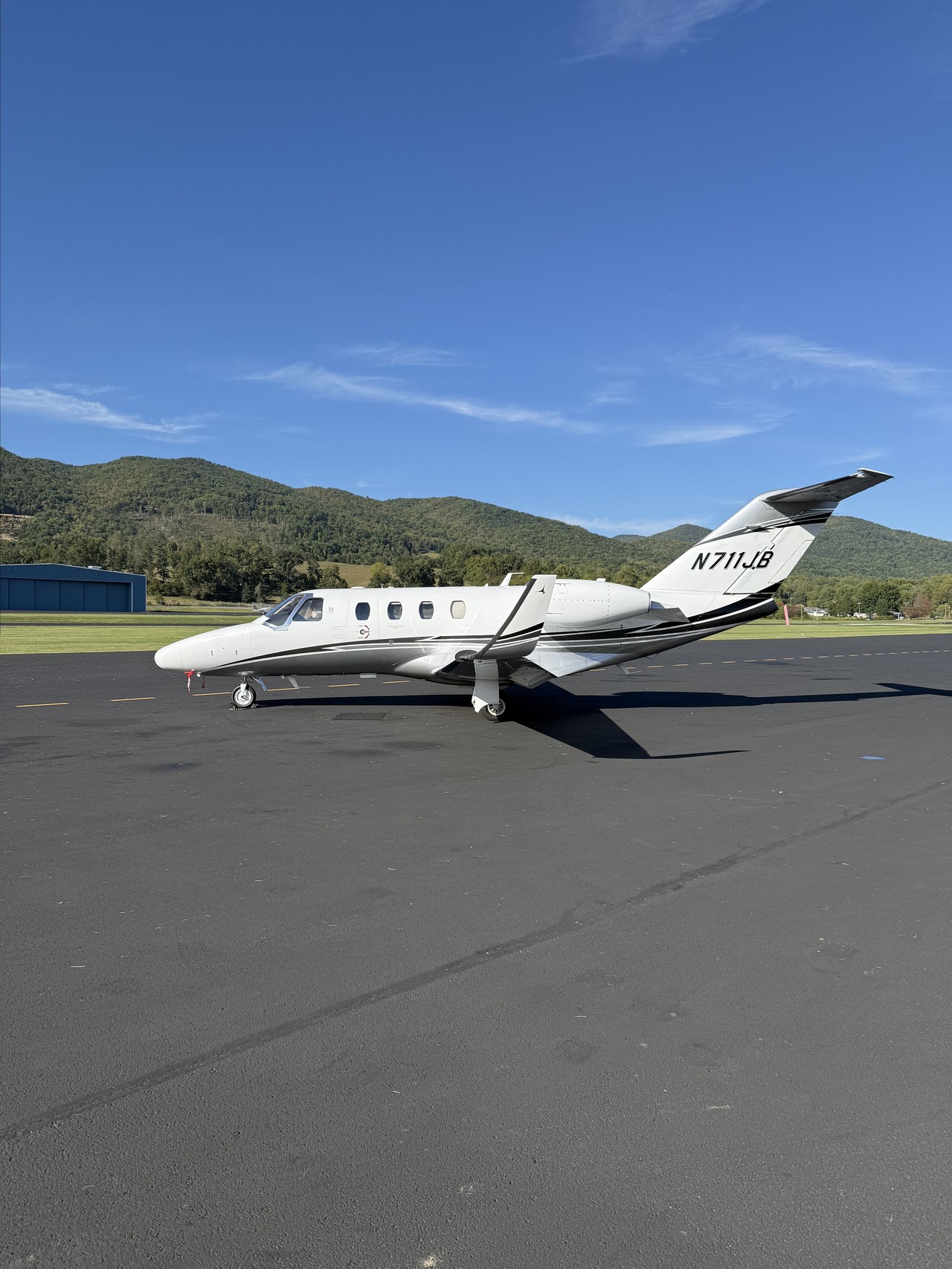
Market Dominance and Role
The Citation M2 became Cessna's primary entry-level business jet after the Citation Mustang ended production in May 2017, capturing a significant portion of the light business jet charter and private aviation market. By June 2020, Cessna had delivered 250 M2s, reaching 302 total units produced by the end of 2021. The aircraft's single-pilot certification distinguishes it from larger business jets requiring two-pilot operations, substantially reducing operating costs for charter companies and private owners.
Development and First Flight
Cessna launched the M2 program in September 2011 as an evolution of the earlier CJ1+ design, addressing market demands for an updated entry-level business jet. Engineering test pilot Peter Fisher conducted the initial prototype's maiden flight on March 9, 2012, departing from Wichita Dwight D. Eisenhower National Airport. The development team focused on creating low operating costs, docile flying characteristics, and short runway performance capabilities that would appeal to operators transitioning from turboprops or piston aircraft.
The Manufacturer Legacy
Cessna Aircraft Company, founded in 1927, developed the Citation M2 as part of its broader Model 525 CitationJet family launched in October 1989. The company originally estimated demand for 1,000 aircraft over ten years when introducing the CitationJet concept, but this forecast proved conservative as 2,000 units of all variants had been delivered by June 2017. Following various corporate acquisitions, Cessna became part of Textron Aviation Inc., a division of Textron, which continues M2 production at the original Wichita, Kansas manufacturing facility.
Engine and Technical Innovation
Two Williams International FJ44-1AP-21 turbofan engines power the Citation M2, each generating 1,965 pounds of thrust. The Williams FJ44 engine series was specifically engineered for light business jets, making the original CitationJet concept feasible when introduced in 1989. Continuous updates to the FJ44 family produced variants including the FJ44-2C and FJ44-3A-24 used across different Citation models, establishing Williams International as the primary engine supplier for Cessna's light jet lineup.
Design Improvements and Cabin Features
The M2 incorporated significant improvements over its CJ1+ predecessor, including an additional 50 pounds of luggage capacity and 3 inches of extra legroom in the copilot position. The cabin measures 4.75 feet in height and 4.83 feet in width, accommodating 4-5 passengers with a rear toilet facility. Engineers redesigned the cabin layout for improved passenger comfort while maintaining the aircraft's ability to operate from short runways previously limited to twin piston-engined aircraft.
Performance Specifications
With a maximum takeoff weight of 10,700 pounds and fuel capacity of 3,296 pounds, the M2 delivers a maximum payload of 1,410 pounds. The aircraft achieves cruise speeds comparable to the CJ2+ variant's 413 knots, with an NBAA IFR range of 1,550 nautical miles. These performance figures position the M2 competitively in the light business jet market, offering transcontinental range capability for its passenger capacity.
Production Evolution and Current Status
Cessna announced the M2 Gen2 in 2021, receiving certification in 2022 with deliveries beginning shortly thereafter. The Gen2 variant features enhanced avionics systems, including a Garmin autothrottle system available starting in mid-2025. Production continues at the Wichita facility, with Cessna planning the Citation Gen3 for service entry in 2026, representing the next evolutionary step in the Citation family lineage.
Operational Impact
The Citation M2's success stems from filling a crucial market segment between turboprops and larger business jets, offering jet performance with relatively modest operating costs. Its single-pilot certification appeals to owner-operators and smaller charter companies seeking to minimize crew expenses. The aircraft serves charter operations and private ownership equally, providing reliable transportation for business travelers requiring point-to-point connectivity at smaller airports unsuitable for commercial airline service.