
Market Dominance
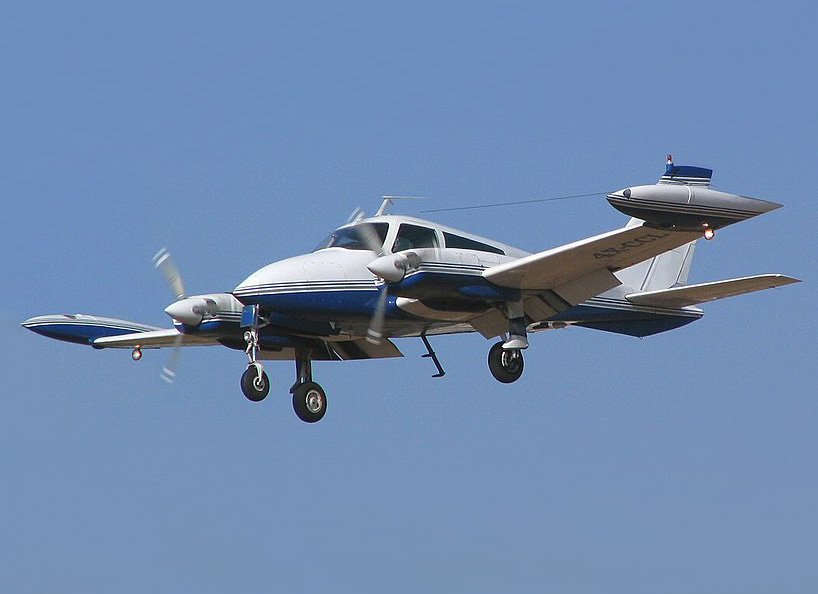
The Cessna 310 revolutionized light twin-engine aviation by offering airline-like performance in a package affordable to corporations and affluent private owners. Between 1954 and 1980, Cessna produced approximately 5,400 examples, making it one of the most successful light twins ever manufactured. The aircraft carved out a substantial market niche, competing directly with the Piper PA-23 Apache, Beechcraft Twin Bonanza, and Aero Commander 520, ultimately outselling most rivals through its combination of speed, reliability, and operational economy.
Military Service
The United States Air Force recognized the 310's utility potential, ordering 160 examples of the 310A variant designated L-27A, later redesignated U-3A and nicknamed "Blue Canoe." These military versions, powered by Continental O-470-M engines producing 240 horsepower each, served in utility and liaison roles with a maximum takeoff weight of 4,830 pounds. While the U-3A saw no combat service, it provided valuable training and transport capabilities for Air Force personnel throughout the 1960s and 1970s.
Cessna Aircraft Company Legacy
Cessna Aircraft Company, founded in 1927 by Clyde Cessna in Wichita, Kansas, had established itself as a major manufacturer following World War II success with the T-50 "Wooden Wonder" twin. The 310 represented a crucial step in Cessna's post-war expansion, arriving alongside other successful models like the 172, 182, and 210 series during the 1950s. General Dynamics acquired Cessna in 1969, later selling to Textron in 1992, where it continues operations today as a subsidiary of Textron Aviation.
Engineering Innovation
The Cessna engineering team, led by chief engineer Dwight Wallace, designed the 310 as an evolution of wartime twin-engine technology. Key innovations included distinctive "tuna tank" wingtip fuel tanks holding 50 gallons each, placing fuel weight away from the passenger cabin while providing 102 gallons of total capacity. The aircraft featured tight aerodynamic engine cowlings, split flaps without external brackets, and electromechanical landing gear systems that contributed to its clean, efficient design.
Engine Evolution
Continental Motors provided powerplants throughout the 310's production run, beginning with carbureted O-470-M engines producing 240 horsepower in early models. The 1959 310C introduced fuel-injected IO-470-D engines rated at 260 horsepower, improving power-to-weight ratios and reliability. Later variants like the 310R incorporated turbocharged Continental TSIO-520-B engines producing 285 horsepower, enabling operation at altitudes exceeding 25,000 feet with known-icing certification.
Performance Characteristics
Pilots praised the 310 for its stable handling qualities and impressive performance figures. Early models achieved cruising speeds around 200 mph with a service ceiling of 20,000 feet and range approaching 1,000 nautical miles. The final 310R variants improved these numbers significantly, delivering 260 mph true airspeed, 1,200-plus nautical mile range, and climb rates exceeding 1,800 feet per minute. Maximum takeoff weights grew from 4,600 pounds in early models to 5,500 pounds in later variants.
Design Evolution
Cessna continuously refined the 310 throughout its production run, introducing swept vertical stabilizers in 1960 and additional wing fuel tanks in 1967. The aircraft evolved from five-seat to six-seat capacity, with cabin length increasing from approximately 27 feet to 29.3 feet in final variants. These modifications maintained the 310's competitive edge against newer twin-engine aircraft entering the market during the 1960s and 1970s.
Production Legacy
Manufacturing concluded in 1980 with the 310R variant, though some sources indicate limited 1981 model year production. Base prices rose from $49,950 for the original 1954 model to $259,915 for the final 310R, reflecting both inflation and substantial equipment improvements. The 310's success enabled Cessna to develop related models including the pressurized 320 Skyknight in 1962 and the push-pull Skymaster in 1964.
Contemporary Operations
Approximately 2,600 Cessna 310s remained on the FAA registry as of 2012, testament to the type's durability and continued utility. Market values ranged from $30,000 for older, high-time examples to $180,000 for well-maintained later models, with 310Q and 310R variants commanding premium prices. The aircraft remains popular among owners seeking reliable twin-engine performance for cross-country business and personal transportation, maintaining active type clubs and parts support networks decades after production ended.