
Business Aviation Innovation
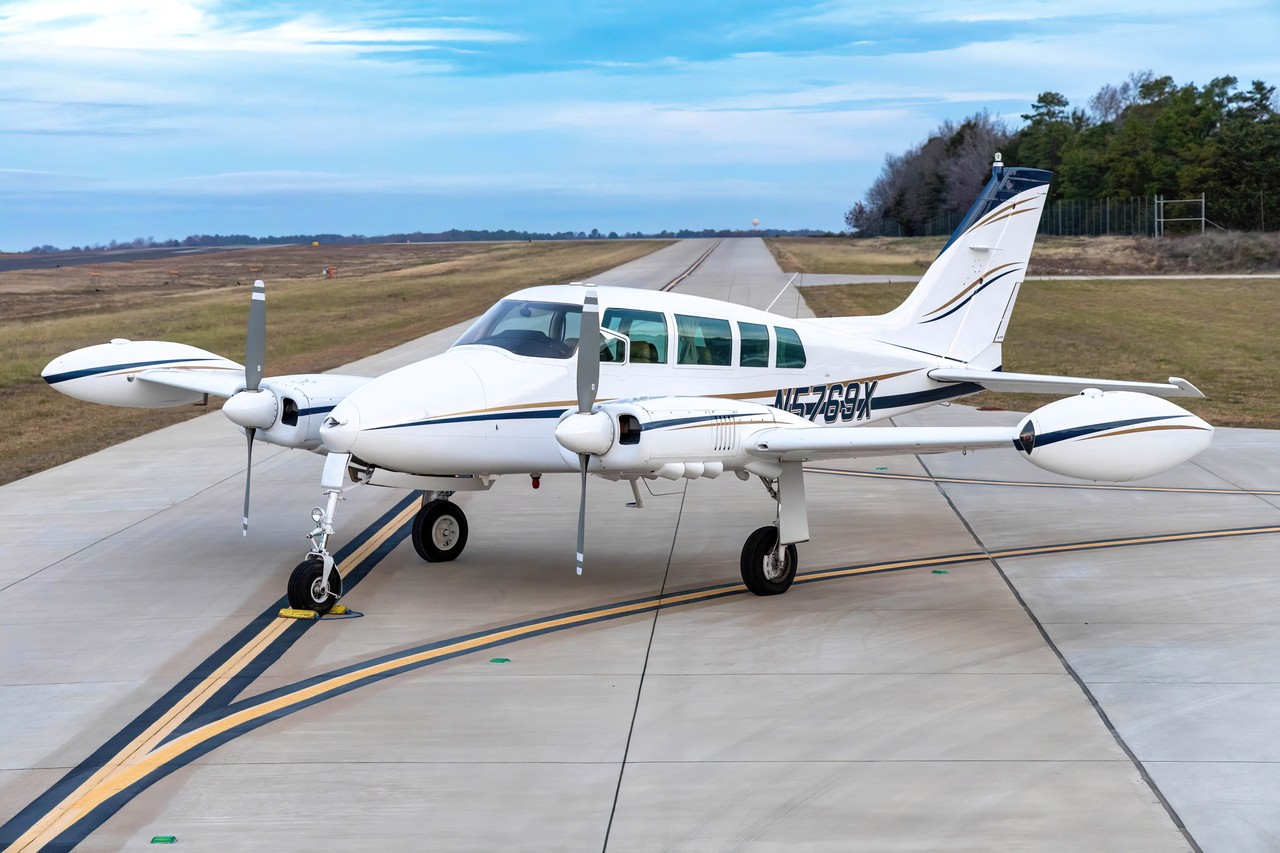
The Cessna 320 Skyknight dominated the high-performance twin-engine executive market throughout the 1960s by offering unprecedented altitude capability for its class. During its six-year production run, the aircraft captured a significant portion of the business aviation market seeking turbocharged performance, with 575 units serving corporate operators across North America. The Skyknight's innovative turbocharged design allowed business travelers to cruise above weather systems that grounded naturally aspirated competitors.
The Cessna Aircraft Company
Cessna Aircraft Company, founded in 1927 by Clyde Cessna in Wichita, Kansas, had established itself as America's premier general aviation manufacturer by the 1960s. The company pioneered numerous innovations in light aircraft design, from the revolutionary cantilever wing of the early Model A series to the mass-production techniques that made private aviation accessible to thousands of pilots. Today operating as part of Textron Aviation following Textron's 1992 acquisition, Cessna continues manufacturing aircraft from the same Wichita facilities where the 320 Skyknight was built. The company's other notable designs include the ubiquitous Model 172 trainer, the twin-engine Model 310 series, and the Citation business jet family.
Engine Technology and Performance
The Skyknight's Continental TSIO-470-B turbocharged engines represented cutting-edge technology for 1962, each producing 260 horsepower through sophisticated exhaust-driven turbocharging systems. Continental Motors, founded in 1929 and later acquired by Teledyne Technologies, manufactured these inline six-cylinder powerplants specifically for high-altitude operations. The final 320F variant received upgraded TSIO-520-B engines generating 285 horsepower each, providing even greater performance margins. These turbocharged installations enabled the aircraft to maintain sea-level power output up to its 28,700-foot service ceiling, a capability that naturally aspirated twins of the era could not match.
Pilot Experience
Pilots praised the Cessna 320 for its docile handling characteristics and impressive high-altitude performance, though the turbocharged engines demanded more careful management than naturally aspirated powerplants. The aircraft cruised at 256 mph while maintaining comfortable cabin pressurization equivalents through its high operational ceiling. Flight crews appreciated the tricycle landing gear configuration, which eliminated the ground handling challenges associated with tailwheel designs. However, the turbocharging systems required vigilant monitoring of manifold pressures and cylinder head temperatures, particularly during climb and descent phases. The 320's range of nearly 1,200 nautical miles made it ideal for cross-country business travel.
Production Evolution
Cessna methodically improved the Skyknight through six distinct variants, each incorporating lessons learned from operator feedback and advancing technology. The original 320 of 1962 saw 110 units completed, while the 320A introduced in 1963 featured canted fuel tanks and structural reinforcements in 47 examples. Subsequent variants expanded baggage capacity, enhanced cabin appointments, and improved soundproofing. The 320D Executive Skyknight of 1966 marked a significant upgrade with 285-horsepower engines and three-blade propellers in 130 aircraft. Production peaked with the 320E in 1967 at 110 units, featuring the distinctive pointed nose and one-piece windshield that became hallmarks of later Cessna twins.
Market Impact and Legacy
The Cessna 320 Skyknight established the template for high-performance turbocharged twins that influenced aircraft design for decades. Its success demonstrated strong market demand for business aircraft capable of operating above 25,000 feet, leading competitors to develop their own turbocharged offerings. The 320F variant, with only 45 examples completed in 1968, remains the most sought-after model among collectors and operators seeking vintage high-performance twins. Production ceased in 1969 when Cessna replaced the Skyknight with the Turbo 310, which offered similar performance in a more economical package. Today, several hundred Cessna 320s remain active in private hands, testament to the robust design and enduring appeal of this pioneering turbocharged executive aircraft.