
Design Innovation and Development
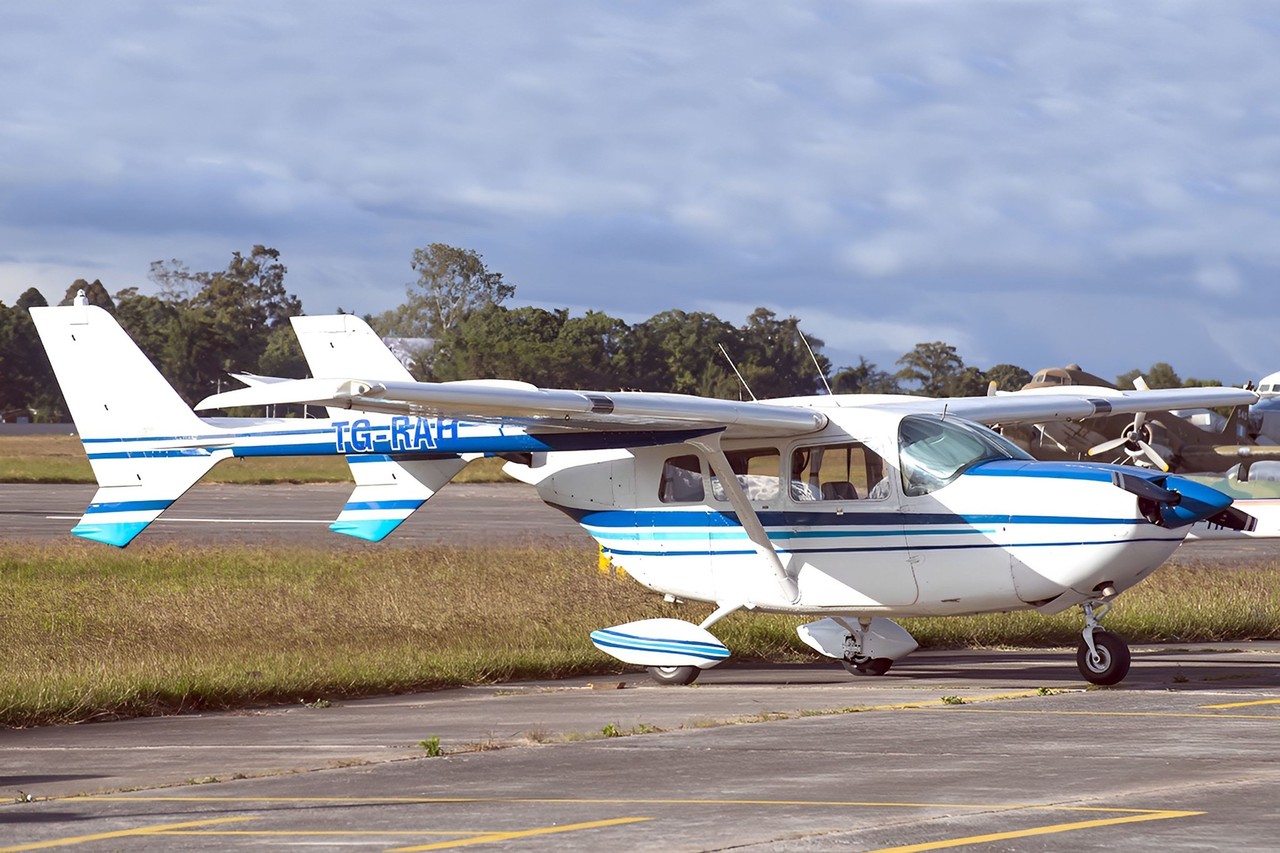
The 336 Skymaster emerged from Cessna's engineering team as a bold solution to the inherent dangers of traditional twin-engine aircraft. When one engine failed on a conventional twin, asymmetric thrust could cause uncontrollable yaw, leading to numerous fatal accidents. Cessna's innovative push-pull design placed both engines on the aircraft's centerline—one pulling in the nose, one pushing from the rear—eliminating critical engine considerations that had claimed countless lives.
The prototype, bearing registration N34273 and construction number 633, initially flew with two 175-horsepower Continental GO-300-C geared engines. However, production aircraft received significant improvements, including upgraded 210-horsepower Continental IO-360-A fuel-injected engines, an enlarged cabin, and enlarged tail surfaces for enhanced stability and performance.
Production and Manufacturing
Cessna manufactured exactly 195 Skymaster 336s at their Wichita, Kansas facilities between May 1963 and mid-1964. This brief production run reflected the aircraft's role as a stepping stone to the more advanced Model 337 Super Skymaster, which featured retractable landing gear and entered production in February 1965.
The Cessna Aircraft Company, founded by Clyde Cessna in 1927, had established itself as a general aviation leader following World War II with successful models like the 172. The company's ownership evolved significantly over the decades—General Dynamics acquired Cessna in 1986, followed by Textron Inc. in 1992. Today, the company operates as the Cessna division of Textron Aviation, continuing to manufacture aircraft from the same Wichita headquarters.
Technical Specifications and Performance
The 336's twin Continental IO-360-A engines, manufactured by Continental Motors (now Continental Aerospace Technologies), delivered reliable performance with their fuel injection systems and 1,800-hour time between overhauls. These engines powered the aircraft to cruise speeds between 195 and 200 miles per hour, with a range approaching 1,000 miles and a service ceiling near 20,000 feet.
The aircraft's all-metal construction featured a distinctive pod-and-boom fuselage design, with the passenger cabin housed in the central pod and twin booms extending aft to support the tail surfaces. Fixed tricycle landing gear provided stable ground handling, while the high-wing configuration offered excellent visibility for the pilot and passengers.
Military Evolution
While the 336 itself served purely civilian roles, its descendant, the Model 337, became the foundation for the military O-2 Skymaster program during the Vietnam War. The U.S. Air Force procured 513 O-2 aircraft between 1967 and 1973, with O-2A variants serving forward air control and reconnaissance missions, while O-2B models conducted psychological operations using loudspeakers and leaflet dispensers over Laos and Cambodia.
The military success of the Skymaster design validated Cessna's centerline thrust concept, proving that the configuration could handle demanding operational environments while maintaining the safety advantages that motivated the original design.
International Production
Beyond Cessna's American production, Reims Aviation in France manufactured additional Skymaster variants. Reims, originally Avions Max Holste founded in 1933, partnered with Cessna when the American company acquired a 49 percent stake on February 16, 1960. Reims ultimately produced 94 additional Skymasters, including 61 FTB337 Miniroles, some assembled from kits and others built from scratch.
Commercial Impact and Pricing
The 336 targeted the growing business and personal aviation markets, offering six-passenger capacity in a safety-focused package. When the improved 337 successor reached market in 1965, it carried a price tag of approximately $39,950, positioning it as a premium option for operators requiring twin-engine safety without the complexity of conventional multi-engine aircraft.
Legacy and Survival
The Skymaster family's total production exceeded 3,000 aircraft when including all variants and international production. The entire 336/337 series concluded in 1980 after manufacturing 2,058 standard aircraft plus 332 pressurized versions and over 500 military O-2 variants.
Today, fewer than 100 Cessna 336s remain on the FAA registry, making the original fixed-gear variant a rare sight compared to its retractable-gear successors. The aircraft's historical significance lies not in production numbers, but in proving that centerline thrust could work in a practical, production aircraft—paving the way for future push-pull designs and demonstrating that innovative thinking could solve aviation's deadliest problems.