
Service History
The 337 Super Skymaster carved out a significant niche in general aviation by addressing one of twin-engine flying's greatest hazards: engine failure on takeoff. Unlike conventional twins where losing one engine created dangerous asymmetric thrust, the Skymaster's centerline thrust design allowed pilots to maintain control more easily during single-engine operations. This safety advantage made it particularly popular among owner-pilots stepping up from single-engine aircraft who wanted twin-engine redundancy without the complex handling characteristics of traditional twins.
Cessna produced 2,993 Skymasters across all variants during the aircraft's 17-year production run, with the 337 specifically accounting for 239 units in its initial 1965 production year. The aircraft found favor with corporate operators, flight training schools, and private owners who valued its forgiving handling characteristics and spacious six-seat cabin.
Military Adaptation
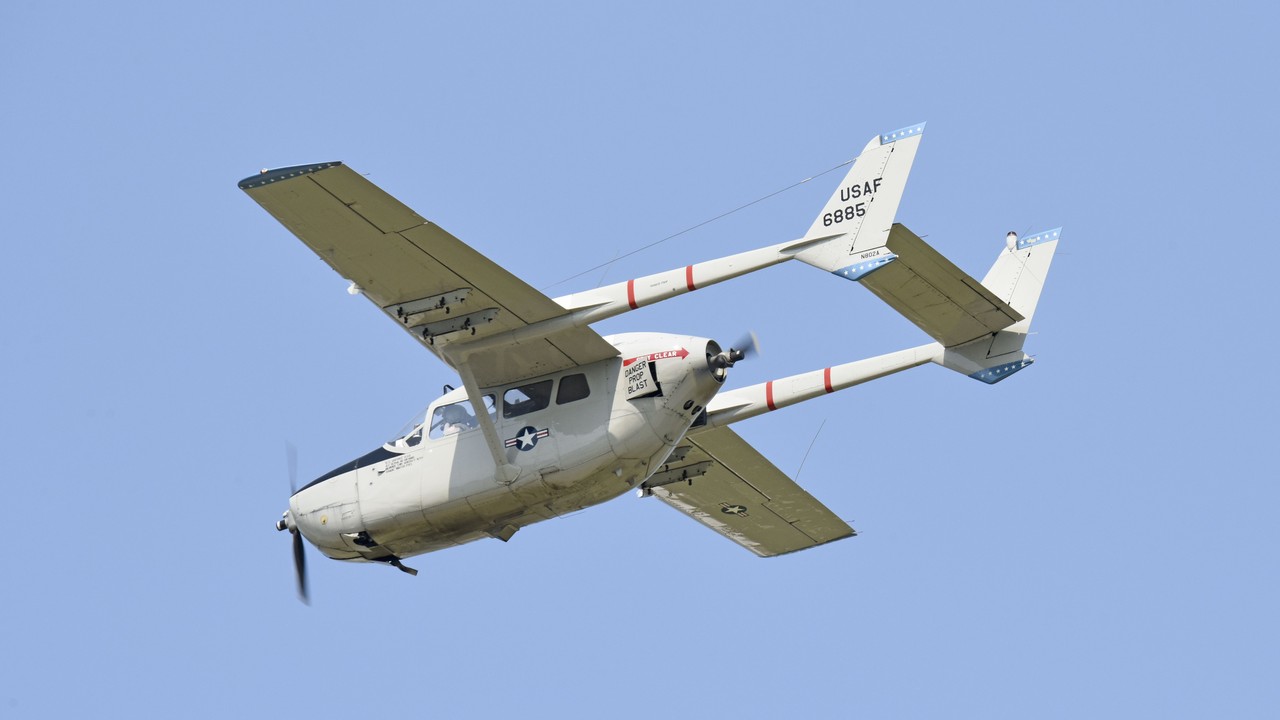
The U.S. Air Force recognized the Skymaster's potential for forward air control and reconnaissance missions, ordering 513 aircraft designated as the O-2. The military variant, based on the M337B, served extensively during the Vietnam War as the O-2A Skymaster. These aircraft replaced the single-engine O-1 Bird Dog in the dangerous forward air control role, where the redundancy of twin engines proved invaluable over hostile territory.
The O-2's mission involved flying low and slow to mark targets for fighter-bombers, coordinate close air support, and conduct battlefield reconnaissance. The aircraft's excellent visibility, stable flight characteristics, and ability to loiter for extended periods made it ideally suited for these demanding roles. A total of 479 O-2A aircraft served with the Air Force, primarily in Southeast Asia.
The Manufacturer
Cessna Aircraft Company, founded in 1927 by Clyde Cessna in Wichita, Kansas, developed the Skymaster as part of its expansion into the twin-engine market during the 1960s general aviation boom. The company had established itself as the world's leading manufacturer of light aircraft, producing everything from two-seat trainers to business jets.
Today, Cessna operates as part of Textron Aviation, following Textron's acquisition of the company. The Wichita facility continues producing aircraft, though the company has shifted focus toward turboprop and jet aircraft rather than piston twins like the Skymaster. Cessna's other notable aircraft include the ubiquitous Model 172, the Citation business jet series, and the Twin Otter utility aircraft.
Engine and Technical Innovation
The heart of the Skymaster's design lay in its two Continental IO-360 engines, horizontally-opposed four-cylinder powerplants producing 210 horsepower each. Continental Motors Corporation's fuel-injected engines provided reliable power, with the forward engine driving a conventional tractor propeller while the rear engine pushed the aircraft through a propeller mounted behind the tail.
This centerline thrust arrangement eliminated the critical engine concept that plagued conventional twins. In a standard twin-engine aircraft, losing the engine farther from the center of gravity creates more adverse yaw, making that the "critical" engine. The Skymaster had no critical engine since both powerplants operated along the aircraft's centerline.
Later variants offered turbocharged Continental TSIO-360 engines, with the T337B achieving a service ceiling of 30,000 feet and cruise speeds of 233 mph. The pressurized P337G, introduced in 1973, featured a cabin altitude of just 8,000 feet when flying at 20,000 feet, greatly improving passenger comfort on high-altitude flights.
Pilot Perspective
Pilots praised the Skymaster's docile handling characteristics and forgiving nature during single-engine operations. Unlike conventional twins that required immediate and precise pilot input following engine failure, the Skymaster typically continued flying straight ahead, giving pilots time to diagnose problems and execute appropriate procedures.
The aircraft cruised at approximately 200 mph in standard configuration, with a range exceeding 1,000 miles. The spacious cabin, accessed through split airstair doors on later models, provided comfortable seating for six occupants. However, pilots noted that the rear engine's location made pre-flight inspection more challenging and required careful attention to cooling, as the pusher configuration relied on a dorsal air scoop for engine cooling air.
Production Legacy
Production continued beyond Cessna's 1982 cessation when Reims Aviation in France manufactured additional variants, including the FTB337 STOL version and military FTMA Milirole models. The French production extended the Skymaster's manufacturing life and introduced specialized variants for specific mission requirements.
The T337G turbocharged variant proved most popular among the later models, with 332 units built, while the pressurized P337H attracted 64 buyers despite its higher price point. An experimental Model 327, a reduced-scale version built in 1967, later served NASA as a wind tunnel research platform.
Today, many Skymasters remain active in civilian service, with approximately 80 of the original fixed-gear 336 models still registered with the FAA. The type's reputation as "one of the best push-pull aircraft in the world" endures among aviation enthusiasts, though rising maintenance costs and parts availability have reduced the active fleet from its peak numbers. Several examples are preserved in aviation museums, representing an innovative chapter in general aviation history.