
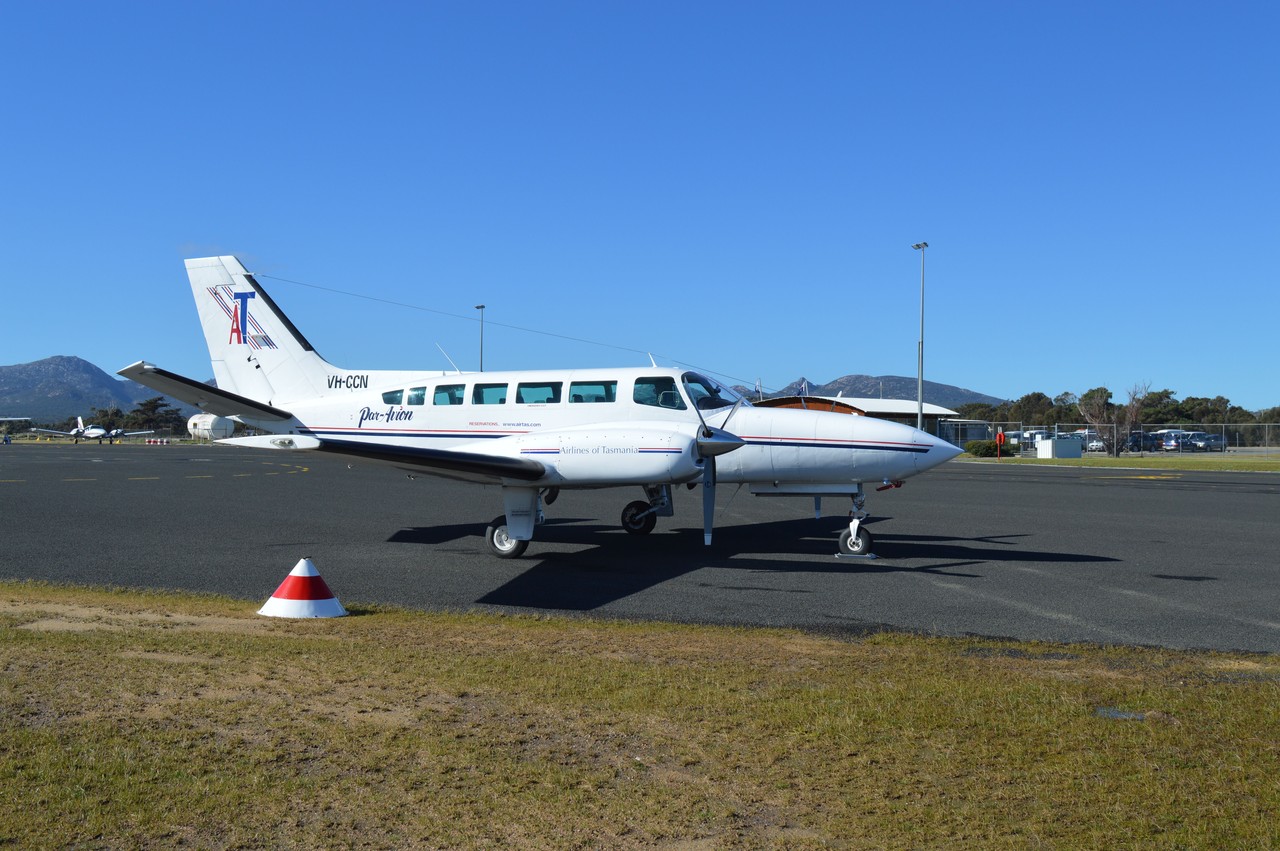
Development and Design Philosophy
The Cessna 404 Titan emerged from strategic discussions initiated by Cessna executives in 1973, who identified a market gap for a high-payload unpressurized piston twin capable of serving airlines, freight operators, and corporate customers. The design brief called for an aircraft that could takeoff from a 770-meter airstrip while carrying a 1,560-kilogram payload, targeting operators who needed turbine-like capacity without the operating costs of turboprop engines.
Cessna's engineering team developed the 404 as an evolution of the successful Model 402, incorporating structural elements from the pressurized 441 Conquest. The design featured an enlarged vertical stabilizer for improved directional stability, a completely new fuselage offering greater internal volume, and the wing and landing gear systems borrowed from the 441, though without the wingtip fuel tanks. The prototype, registered N5404J, achieved first flight on February 26, 1975, with the Federal Aviation Administration issuing Type Certificate A25CE in July 1976.
Production and Market Reception
Customer deliveries commenced in October 1976 from Cessna's manufacturing facilities in the United States. Despite initial optimism, the Titan encountered challenging market conditions as the aviation industry increasingly favored turboprop aircraft over complex piston twins. The aircraft's sophisticated turbocharged Continental engines, while powerful, required more maintenance expertise than many operators preferred.
Cessna offered three distinct variants to maximize market appeal. The Titan Ambassador featured an executive configuration accommodating two crew members plus six to ten passengers in a corporate layout. The Titan Courier served as a convertible passenger-cargo aircraft optimized for charter and commuter operations with seating for nine passengers plus one pilot. The Titan Freighter variant eliminated passenger amenities entirely, incorporating a reinforced floor structure, dedicated cargo doors, and impact-resistant polycarbonate interior surfaces for pure freight operations.
Production ceased in early 1982 after just 378 aircraft had been completed, making the 404 one of Cessna's less commercially successful designs despite its technical capabilities.
Powerplant and Performance
The Titan's performance centered on its twin Teledyne Continental GTSIO-520-X engines, each developing 375 horsepower through turbocharging systems that enabled efficient high-altitude operations. These six-cylinder horizontally-opposed powerplants drove fully-feathering three-bladed constant-speed propellers and provided the aircraft with exceptional short-field performance characteristics.
The turbocharged installation allowed the 404 to maintain sea-level power output to significant altitudes, contributing to its service ceiling of approximately 26,000 feet. This capability proved particularly valuable for operators flying over mountainous terrain or seeking to avoid weather at lower altitudes. The aircraft demonstrated remarkable fuel efficiency, achieving 30 percent better ton-mile-per-gallon performance compared to the smaller 402.
In 1980, Cessna implemented design improvements including extended wingspan and restructured wingtips, enhancing the aircraft's aerodynamic efficiency and handling characteristics during the final production years.
Operational Service
Commuter and regional airlines represented the 404's primary market, with operators including Southern Australia Airlines, East Coast Airlines, Southern Sky Airlines, and Eastern Airlines incorporating the type into their fleets. The aircraft proved particularly valuable for routes requiring substantial payload capacity on shorter runway facilities where larger aircraft could not operate effectively.
East Coast Airlines operated several examples in Australia, including VH-SON (construction number 404-0653) based at Taree, New South Wales. The type also found employment in specialized roles such as air ambulance operations, where its spacious cabin and ability to operate from smaller airfields provided operational advantages over competing aircraft.
The Titan received limited military recognition with the designation C-28 in United States service and Tp 87 with the Swedish Air Force, though no significant military procurement programs materialized.
The Cessna Legacy
Cessna Aircraft Company, founded in 1927 by Kansas farmer and mechanic Clyde V. Cessna, had established itself as the world's leading manufacturer of general aviation aircraft by the time the 404 entered production. The company's evolution from assembling French Bleriot kits with water-cooled engines to producing sophisticated business aircraft demonstrated remarkable adaptability to changing market demands.
During World War II, Cessna had proven its manufacturing capabilities by delivering T-50 trainers to the United States Army and Canadian Air Force. The company's expansion into corporate jets, particularly the Citation series, positioned it as a major player in business aviation by the 1970s.
General Dynamics acquired Cessna in 1985, followed by Textron's purchase in 1992. Today, Textron Aviation continues operating the Cessna brand alongside Beechcraft and Hawker, maintaining production of turboprops, piston aircraft, and business jets for civilian, government, and military customers worldwide.
Current Status and Legacy
While exact numbers remain uncertain, several Cessna 404 Titans continue operating in 2024, with examples like the former N6765T (later registered as HK-2591P and YV-721P) built in 1981 still maintaining active registrations. The aircraft's robust construction and reliable powerplants have enabled extended service lives despite the relatively small production run.
The 404 Titan occupies a unique position in aviation history as Cessna's largest piston-powered twin-engine aircraft, bridging the gap between the company's traditional light twins and its emerging turboprop offerings during a crucial transitional period in general aviation. Despite its commercial disappointment, the aircraft demonstrated Cessna's engineering capabilities and willingness to explore new market segments, contributing valuable experience that influenced subsequent designs.