
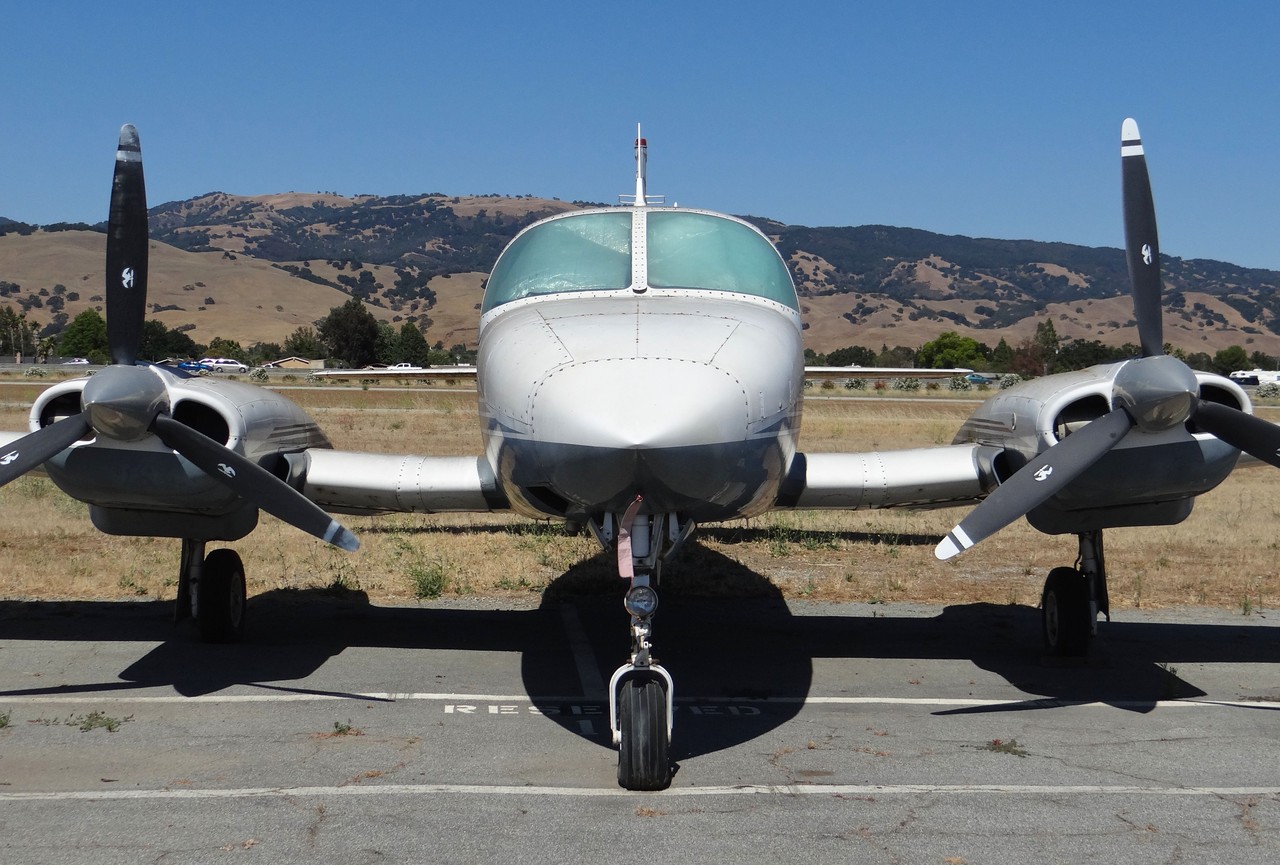
Market Position and Development
When the Cessna 411 entered production, it represented Cessna's most ambitious business aircraft to date. The company developed the 411 specifically to compete against the established Beechcraft Queen Air and Aero Commander series in the executive transport market. Built on experience gained from the successful Cessna 310, the 411 featured a spacious cabin separated from the cockpit and an airstair entrance door that eliminated the need for ground support equipment.
The aircraft's design emphasized passenger comfort and operational flexibility. Standard configuration seated six passengers, though the cabin could accommodate up to eight occupants depending on the interior arrangement. The non-pressurized cabin featured large windows and generous headroom, making it attractive to corporate flight departments seeking to transport executives in comfort.
Production and Variants
Cessna manufactured 302 Model 411 aircraft during its six-year production run at the company's Wichita facility. Production began with the basic Model 411, which received type certification in 1964 and accounted for 252 of the total aircraft built. The improved Model 411A variant, introduced in 1967, featured a redesigned nose section with increased baggage capacity and optional fuel tanks in the engine nacelles. Only 50 Model 411A aircraft were completed before production ceased in 1968.
The Royal Thai Armed Forces operated the 411A under the military designation B.PhTh.1, representing one of the few military applications of the civilian-designed aircraft. Most operators used the 411 for corporate transportation and charter services.
Engine Performance and Characteristics
The Continental GTSIO-520-C powerplants gave the 411 impressive performance for its era, but also contributed to higher operating costs than competitors. These air-cooled, geared, turbocharged flat-six engines drove three-bladed constant-speed propellers measuring 7 feet 4 inches in diameter. The geared reduction drives allowed the engines to operate at optimal RPM while maintaining efficient propeller speeds.
Pilots appreciated the 411's performance capabilities, including a service ceiling exceeding 20,000 feet and cruise speeds approaching 250 miles per hour. However, the Continental engines earned a reputation for being fuel-hungry and requiring careful maintenance. The geared drives, while beneficial for performance, added complexity and maintenance costs that some operators found prohibitive.
The Cessna Aircraft Company Legacy
Cessna Aircraft Company, founded by Clyde Cessna in 1927, established itself as a major manufacturer of light aircraft before World War II. The company's Wichita headquarters became one of America's largest aircraft production facilities during the war years. By the 1960s, Cessna dominated the single-engine market and sought expansion into twin-engine business aircraft.
The 411 program represented Cessna's commitment to challenging established competitors in the executive aircraft market. While the 411 never achieved the commercial success of the company's single-engine models, it provided valuable experience that influenced subsequent designs. Today, Cessna operates as part of Textron Aviation following Textron's 1992 acquisition.
Market Reception and Commercial Impact
Despite its advanced features, the 411 faced stiff competition and market timing challenges. The aircraft's introduction coincided with Cessna's development of the Model 402, which offered similar capabilities at lower cost. Many potential customers chose the less expensive 402, limiting 411 sales in key markets like Australia where only a few examples were imported.
The 411's high operating costs, driven primarily by fuel consumption and engine maintenance requirements, made it less attractive than competitors for many operators. Charter companies and corporate flight departments often found the aircraft's performance advantages insufficient to offset the additional expense compared to alternatives.
Technical Innovation and Design Influence
The 411 introduced several design elements that became standard features on subsequent Cessna twin-engine aircraft. The cabin-class configuration, with its walk-through aisle and separate baggage compartment, established the template for the entire 400-series line. The aircraft's electrical system, environmental controls, and avionics installations served as the foundation for later models.
Cessna engineers incorporated lessons learned from 411 operations into the design of the Models 401, 402, and 414. The pressurized Model 421, which shared many structural elements with the 411, became one of Cessna's most successful business aircraft. These derivatives achieved the commercial success that eluded the original 411.
Current Status and Preservation
Production ended in 1968 as Cessna focused resources on the more commercially viable Model 414, which offered pressurization at a competitive price point. The 411's brief production run and relatively small numbers mean that surviving examples are uncommon in today's general aviation fleet.
Most remaining 411 aircraft continue in private ownership, with some maintained by collectors who appreciate the type's historical significance as the progenitor of Cessna's cabin-class twin-engine line. The aircraft's robust construction and reliable Continental engines have enabled many examples to remain airworthy more than five decades after production ended.