
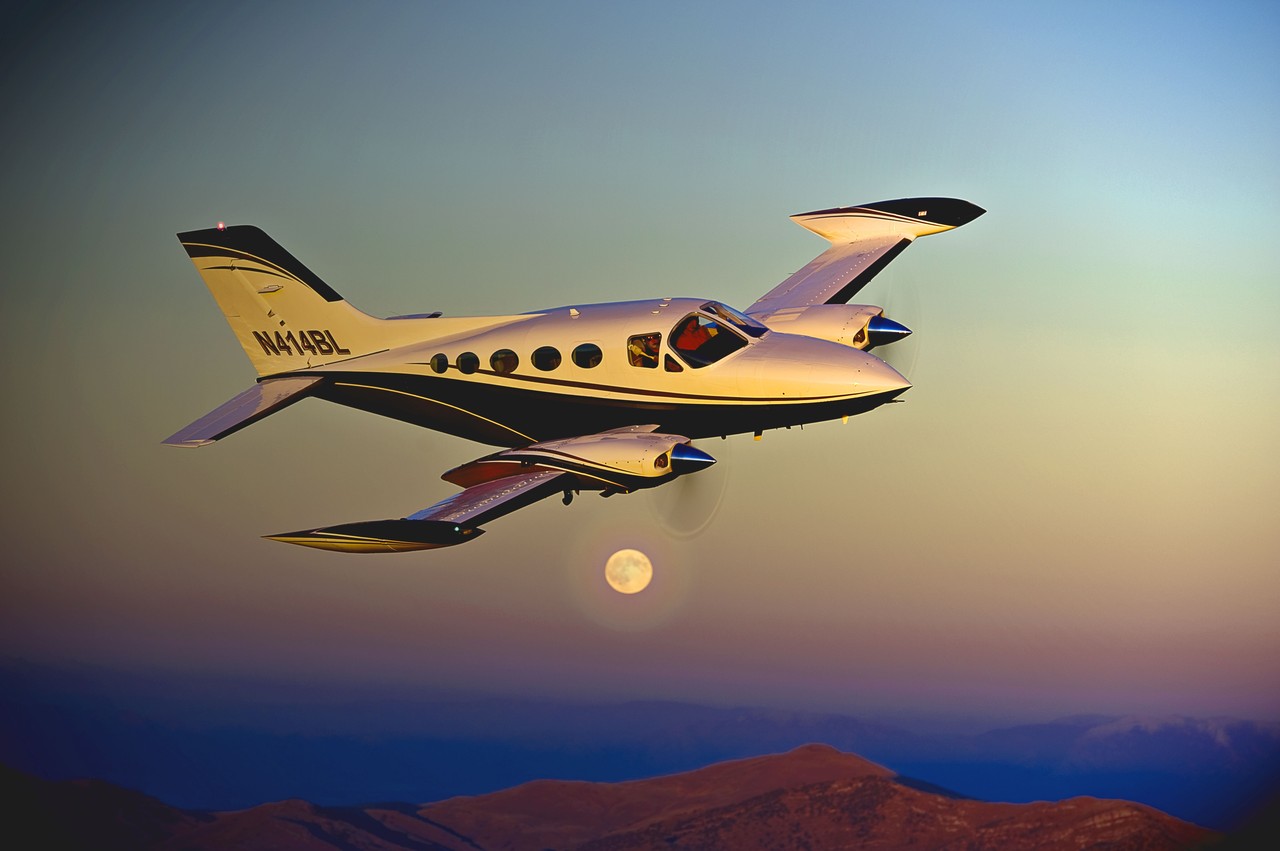
Corporate Aviation Workhorse
The Cessna 414 Chancellor carved out a significant niche in corporate aviation during the 1970s and 1980s, filling the gap between unpressurized twins and more expensive turbine aircraft. Despite being discontinued nearly four decades ago, many of the 1,067 aircraft built remain active today, testament to their enduring utility in business and charter operations.
Development and Design Philosophy
Cessna's engineers took a hybrid approach when developing the 414, combining proven components from existing aircraft to create an economical pressurized twin. The aircraft utilized the fuselage and pressurization system of the larger 421 Golden Eagle but incorporated the wings of the 402 Businessliner, paired with less powerful 310-horsepower Continental TSIO-520-J engines. This design strategy achieved Cessna's objective of offering pressurized flight capability at a lower acquisition and operating cost than their flagship 421.
The original 414 featured a 4.2 psi pressurization differential, allowing comfortable flight at altitudes where passengers could avoid weather and turbulence. Early models incorporated distinctive wingtip fuel tanks, giving the aircraft its characteristic appearance and providing fuel capacity for respectable range performance.
The Chancellor Transformation
In 1978, Cessna introduced the significantly redesigned 414A Chancellor, representing a major evolution of the original design. The most dramatic change involved replacing the tip tanks with a bonded wet wing design, extending the wingspan by 4.5 feet and increasing usable fuel capacity to 206 gallons stored in integral wing tanks. This modification not only improved the aircraft's appearance but also enhanced fuel management through a simplified system with on/off/crossfeed valves and an integrated fuel flow computer.
The Chancellor featured an extended nose providing additional baggage compartment space, crucial for business travel missions. Engineers upgraded the pressurization system to 5.0 psi differential and redesigned the landing gear for improved reliability. A narrower vertical tail completed the aerodynamic refinements, while gross weight increased by 400 pounds to accommodate the improvements.
Powerplant Evolution
All 414 variants relied on Continental's TSIO-520 series turbocharged engines, though specific models evolved throughout production. The original 414 used TSIO-520-J powerplants, while early Chancellor models switched to TSIO-520-N engines, both rated at 310 horsepower per side with 1,400-hour time between overhaul intervals.
In 1979, Continental introduced the improved TSIO-520-NB engines featuring enhanced crankshafts for greater durability. Four years later, in 1983, Continental implemented additional improvements to cylinders, valve lifters, and piston pins, extending the recommended TBO from 1,400 to 1,600 hours. These reliability enhancements made the Chancellor more attractive to operators concerned with maintenance costs and aircraft availability.
Cessna Aircraft Company Heritage
Cessna Aircraft Company, founded in 1927 by Clyde Cessna in Wichita, Kansas, established itself as America's premier manufacturer of light aircraft. By the time the 414 entered production, Cessna had built a comprehensive lineup ranging from single-engine trainers to pressurized twins. The company positioned the 414 strategically between the pressurized 340 and the more powerful 421 Golden Eagle, creating a logical step-up path for growing flight departments.
Cessna's business aircraft division understood that corporate operators needed reliable, economical transportation that could operate from shorter runways while providing airline-like comfort through pressurization. The 414 Chancellor fulfilled this mission requirement effectively, becoming one of the company's most successful pressurized twins.
Operational Characteristics
Pilots appreciated the 414's straightforward systems and predictable handling characteristics. The aircraft typically cruised at 224 mph at altitude, with a service ceiling exceeding 30,000 feet and range of approximately 1,099 miles with standard fuel. Three-bladed constant-speed propellers with full-feathering capability provided excellent single-engine performance, crucial for overwater and mountainous terrain operations.
The spacious cabin accommodated various seating configurations, from executive layouts with facing club seats to high-density arrangements for charter operations. Generous baggage compartments, particularly in Chancellor models, made the aircraft practical for extended business trips requiring substantial luggage capacity.
Production Legacy
Production split almost evenly between the two major variants, with 516 original 414s built from 1970 to 1978, followed by 554 Chancellor models manufactured from 1978 to 1985. When Cessna discontinued the 414 line in 1985, the company had established a solid foundation of operators who valued the aircraft's combination of performance, reliability, and operating economy.
Today, the majority of 414 Chancellors remain in active service worldwide, primarily with corporate flight departments, charter operators, and private owners. Their continued popularity stems from reasonable maintenance requirements, parts availability through Cessna's extensive support network, and performance capabilities that remain competitive in the pressurized twin market segment.