
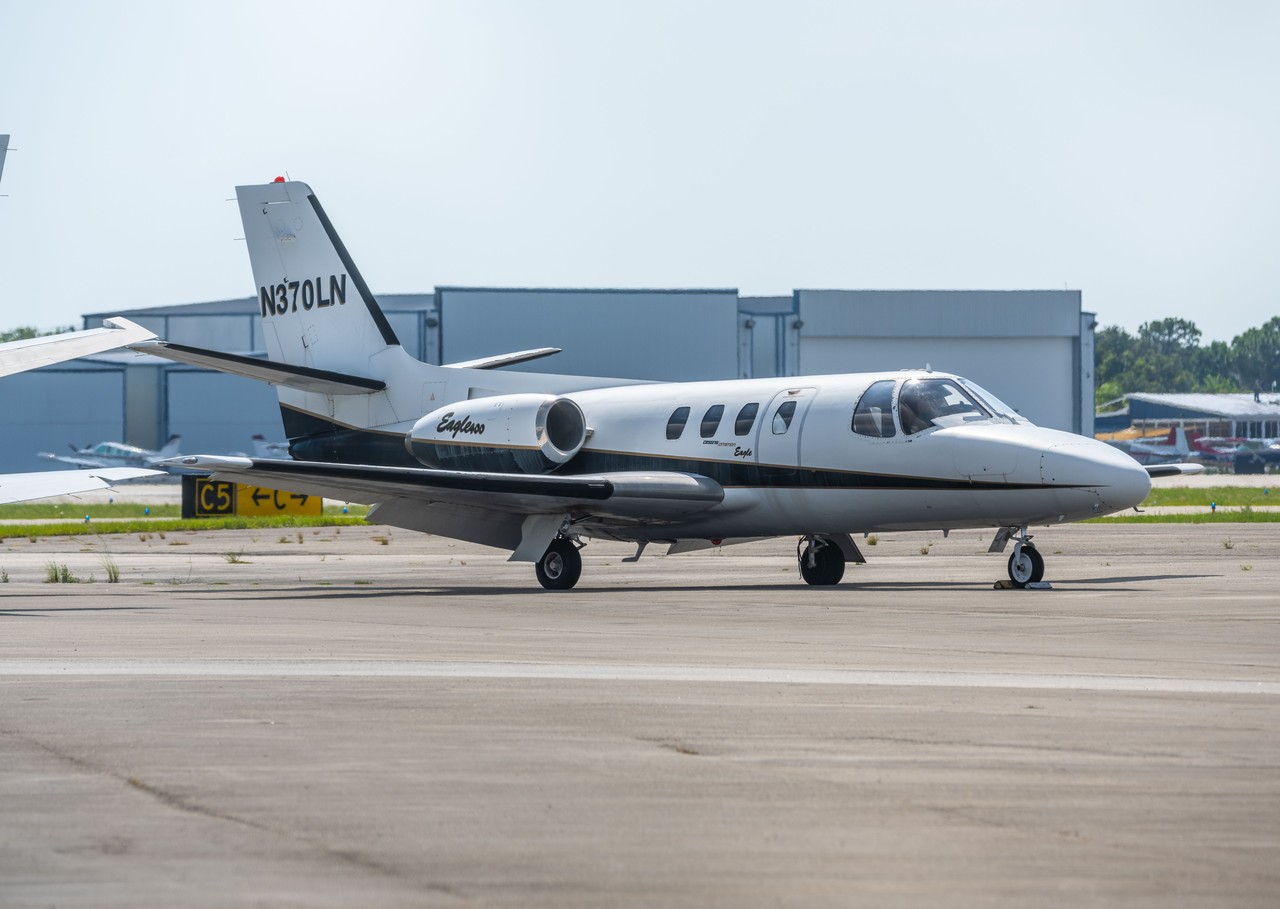
Service History
The Citation I transformed business aviation by capturing market share from established competitors through strategic positioning. Rather than competing directly with high-performance jets like the Learjet, Cessna targeted the twin-turboprop market with a slower but more economical jet priced initially at $695,000. This approach proved successful despite industry ridicule that earned the aircraft nicknames like "Slowtation" and "Nearjet." The strategy worked brilliantly - the Citation I outsold its faster competitors and established Cessna as the dominant force in business aviation.
Typical missions included short-haul routes such as New York to Atlanta or London to Madrid, carrying four to seven passengers in corporate shuttle service. Private owners and businesses embraced the aircraft as an entry-level jet that provided the prestige and weather capability of turbine power without the operating costs of larger aircraft.
The Manufacturer
Cessna Aircraft Company, founded in 1927 by Clyde Cessna, had built its reputation on reliable piston-engine aircraft like the ubiquitous Model 172 before venturing into jet propulsion. The company's decision to enter the business jet market represented a significant gamble, requiring substantial investment in new manufacturing techniques and certification processes.
Financial difficulties in the late 1980s and early 1990s temporarily halted aircraft production, but the company resumed operations under new ownership. In 1992, Textron Inc. acquired Cessna, and today the manufacturer operates as Textron Aviation while maintaining the Cessna brand. The company continues producing Citation jets from its original Wichita facilities, validating the foresight of the original Citation I program.
Engine & Technical Innovation
Two Pratt & Whitney Canada JT15D-1A/B turbofan engines, each producing 2,200 pounds of thrust, powered the Citation I. These engines provided superior fuel efficiency compared to pure turbojets while delivering adequate performance for the aircraft's mission profile. The powerplants enabled operations from short airfields and, in later models, included thrust reversers for improved stopping performance.
The aircraft's straight-wing design set it apart from swept-wing competitors. While this configuration limited top speed, it provided excellent short-field performance and benign handling characteristics. The wing area of 278.5 square feet and aspect ratio of 7.83:1 optimized the aircraft for the lower-speed, shorter-range missions Cessna envisioned.
A significant innovation came in 1977 with the Citation I/SP variant, certified for single-pilot operation. This capability reduced operating costs and expanded the potential pilot pool, making jet ownership accessible to more operators. The aircraft could accommodate up to seven passengers plus one crew member in the I/SP configuration.
Performance Characteristics
Despite criticism of its modest performance, the Citation I delivered exactly what its market demanded. Maximum speed reached 411 mph at lower altitudes, increasing to Mach 0.705 (approximately 465 mph) above 28,000 feet. The service ceiling of 41,000 feet allowed flight above most weather, while the range of 1,528 miles covered the majority of business missions without fuel stops.
With an empty weight of 6,631 pounds and maximum takeoff weight of 11,850 pounds (increased from the original 10,850 pounds through modifications), the Citation I struck an optimal balance between capability and operating economics. Usable fuel capacity of 564 gallons provided adequate range while keeping acquisition and operating costs reasonable.
Production & Legacy
Production ran from 1969 to 1985, with deliveries beginning in 1970. Cessna built exactly 689 Citation I aircraft, comprising 395 original Citation/Citation I models and 296 Citation I/SP single-pilot variants. This production total exceeded many industry predictions and validated Cessna's market strategy.
The Citation I's success launched what became the best-selling business jet family in aviation history. Subsequent models including the Citation II, Citation V, and modern variants trace their lineage directly to the original design. The aircraft proved that reliability, economy, and ease of operation could triumph over raw performance in the business jet market.
Dozens of Citation I aircraft remain in service today, their longevity testament to sound engineering and construction. Many have received avionics upgrades and modifications that extend their operational life well beyond original projections. While exact numbers of airworthy examples vary, the type maintains an active presence in general aviation.
The Citation I's cultural impact extends beyond mere sales figures. It democratized jet travel by making turbine aircraft ownership financially accessible to smaller businesses and individual entrepreneurs. The aircraft established Cessna's reputation in business aviation and created the foundation for a product line that continues to dominate market share decades after the last Citation I rolled off the production line.