
Market Revolution
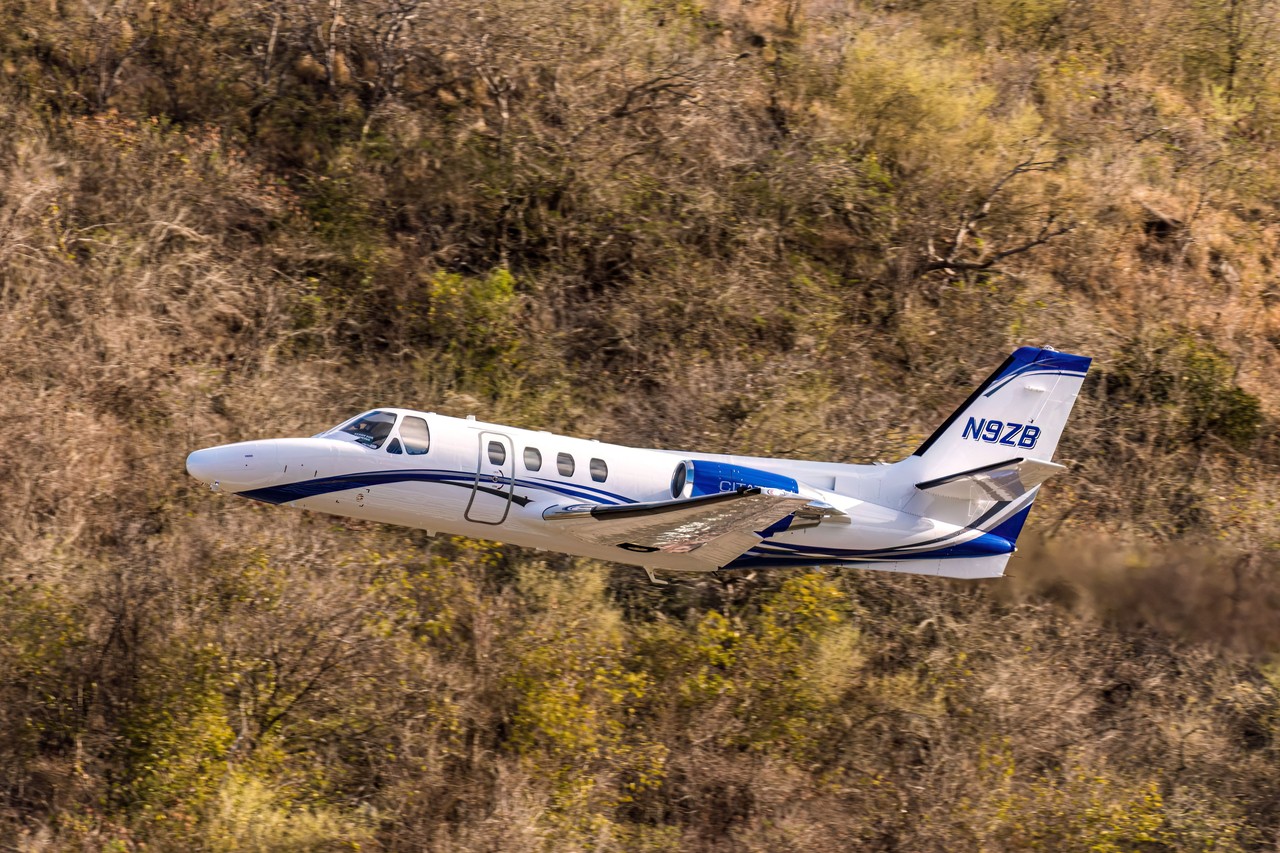
The Citation I/SP fundamentally transformed business aviation by making corporate jet ownership accessible to smaller companies and owner-operators. Between 1977 and 1985, Cessna produced 312 Citation I/SP aircraft, part of nearly 700 total Citation I family deliveries. The single-pilot certification addressed the original Citation I's limitation of requiring a two-pilot crew, dramatically reducing operating costs and expanding the potential market.
Development and Design Philosophy
In October 1968, Cessna announced its ambitious plan to build an eight-place business jet capable of operating from shorter airfields, targeting the light-to-medium twin turboprop market rather than competing directly with existing business jets. The prototype, initially designated FanJet 500, made its maiden flight on September 15, 1969. After an extended development program that included design changes and a name revision to Citation 500, the aircraft received FAA certification in September 1971.
Cessna's design team made deliberate choices that prioritized efficiency and operational flexibility over raw speed. The aircraft featured straight wings rather than swept wings, combined with turbofan engines instead of the turbojet engines used by competitors. This configuration made the Citation approximately 120 knots slower than the competing Learjet 25, earning it unflattering nicknames like "Slowtation" and "Nearjet" in aviation publications. However, these design decisions delivered superior fuel efficiency, lower noise levels, and exceptional short-field performance that proved more valuable to operators than outright speed.
Cessna Aircraft Company
The Citation's success established Cessna as the first of the "big three" American aircraft manufacturers alongside Piper and Beechcraft to achieve dominance in business aviation. Founded in Wichita, Kansas, Cessna Aircraft Company built all Citation I/SP aircraft at their Kansas facility. The company's strategic focus on the entry-level business jet market proved prescient, as the Citation I became the springboard for some of the most successful business jets in history, including the Citation II/Bravo and Citation V/Ultra/Encore series. Today, Cessna operates as part of Textron Aviation, continuing the Citation legacy that began with the original model.
Technical Specifications and Performance
Powered by two Pratt & Whitney Canada JT15D-1/A/B turbofan engines producing 2,200 Newtons of thrust each, the Citation I/SP achieved a maximum speed of 402 mph and a best cruise speed of 357 knots indicated airspeed. The aircraft's service ceiling reached 41,000 feet, with a single-engine service ceiling of 21,000 feet. Rate of climb performance measured 2,719 feet per minute with both engines operating and 826 feet per minute on a single engine.
The Citation I/SP's cabin measured 11.3 feet long, 4.7 feet wide, and 4.3 feet tall, providing 205 cubic feet of total volume. While configured for a maximum of seven passengers, the cabin was most comfortable with five passengers. The aircraft's maximum takeoff weight ranged from 10,850 to 11,850 pounds, with an empty weight of 6,631 pounds and fuel capacity of 3,807 pounds.
Operational Capabilities
The Citation I/SP excelled in short-haul business missions, capable of completing routes such as London to Madrid or New York to Atlanta with four passengers onboard. Its takeoff distance of 2,930 feet and landing distance of 2,270 feet allowed operations from airports inaccessible to larger business jets, fulfilling Cessna's original vision of an aircraft suitable for shorter airfields.
With a maximum range between 1,215 and 1,325 nautical miles, the Citation I/SP served the regional business travel market effectively. The aircraft's ability to accommodate approximately eight bags in its baggage compartment made it practical for typical corporate missions.
Lasting Legacy
The Citation I/SP's impact extended far beyond its production numbers. As of 2026, at least 13 Citation I/SP aircraft remain available for charter operations, demonstrating the airframe's durability decades after production ended. Many examples have received interior and performance upgrades, extending their operational lives well beyond original expectations.
The aircraft created an entirely new market segment that continues to thrive today. By proving that single-pilot business jet operations were both safe and economically viable, the Citation I/SP established operational patterns that influenced subsequent business jet designs. The success of this pioneering aircraft validated Cessna's approach to business aviation and laid the foundation for the company's continued dominance in the corporate jet market, making the Citation name synonymous with business aviation excellence.