
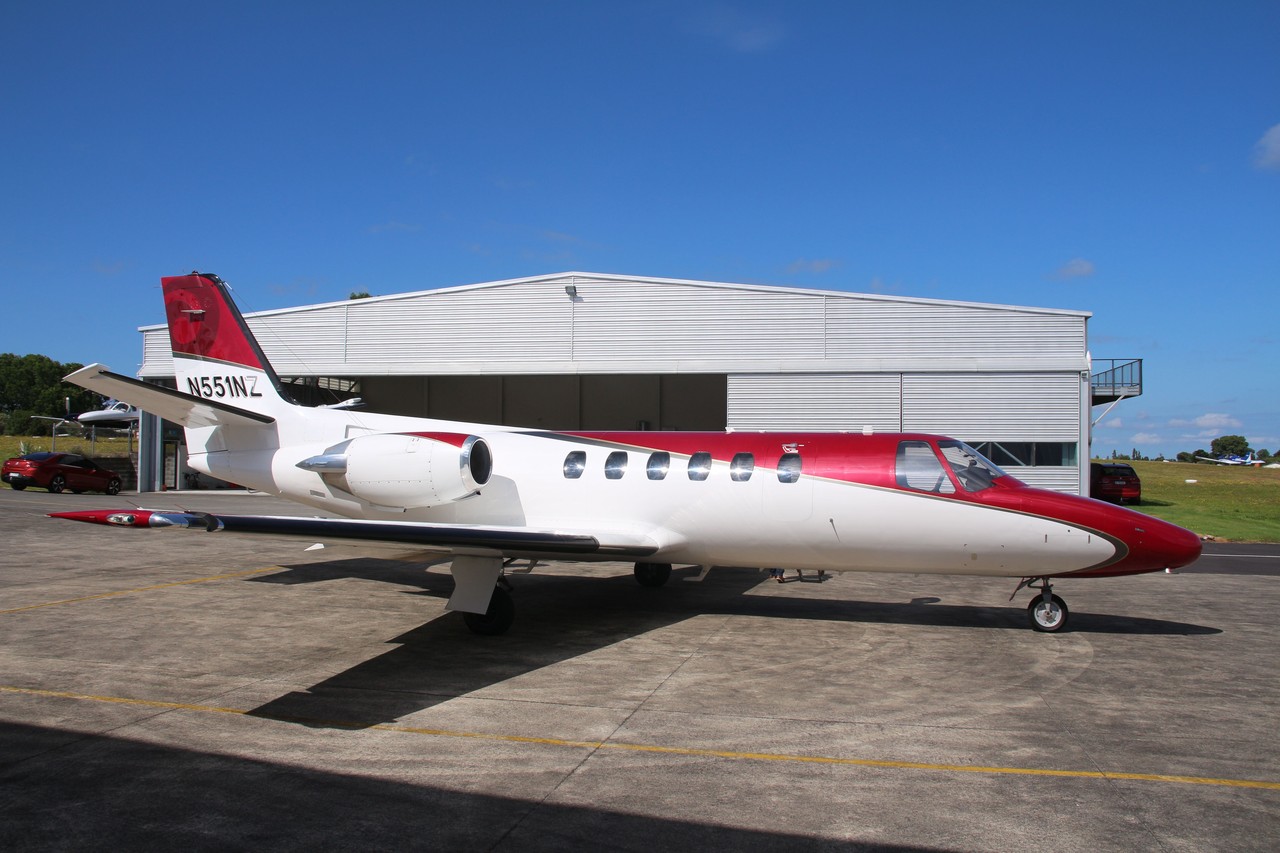
Corporate Aviation Revolution
The Citation II/SP emerged during a pivotal period in business aviation when corporate operators demanded the prestige and performance of turbofan jets without the operating costs of multi-crew aircraft. When Cessna achieved FAA type certification for the II/SP variant in July 1978, just four months after the standard Citation II received approval in March, it created an entirely new market segment. The aircraft was specifically engineered to compete against turboprop aircraft while offering true jet performance, certified under the slightly less stringent FAR Part 23 standards rather than the transport category requirements of larger business jets.
Manufacturing Success
Cessna Aircraft Company, now part of Textron Aviation, built the Citation II/SP during an eleven-year production run that demonstrated remarkable market acceptance. The broader Citation II family sold over 1,000 units within its first four years on the market, establishing it as Cessna's best-selling private jet to date. Of the 1,184 total Citation II variants delivered before production ended in 2006, the single-pilot SP model represented a significant portion, with over 600 aircraft built during the 16-year production span from 1978 to 1989.
The Citation family became Cessna's flagship business jet line, ultimately comprising the largest business jet fleet worldwide with more than 8,000 units delivered over five decades. This success stemmed from Cessna's design philosophy of creating reliable, efficient aircraft that could access shorter runways while providing airline-quality performance.
Design Innovation
Engineers stretched the Citation II fuselage by 3 feet 9 inches compared to the original Citation I, increasing both passenger capacity and baggage space while maintaining the aircraft's ability to operate from relatively short airfields. The takeoff distance requirement of just 2,990 feet and landing distance of 2,017 feet allowed corporate operators to access thousands of airports unavailable to larger business jets.
The aircraft's low-wing configuration housed integral fuel tanks with a total capacity of 4,970 pounds, providing a maximum range of 1,520 nautical miles. Despite its compact dimensions, the Citation II/SP achieved a maximum gross weight of 14,100 pounds while maintaining an empty weight of only 8,059 pounds, resulting in a useful load of 6,041 pounds.
Powerplant Performance
Two Pratt & Whitney Canada JT15D-4 turbofan engines, each producing 2,500 pounds of thrust, powered the Citation II/SP to impressive performance figures. The engines provided a maximum rate of climb of 3,625 feet per minute and maintained single-engine performance with a climb rate of 1,170 feet per minute to a service ceiling of 27,200 feet on one engine. Normal operations allowed the aircraft to reach 43,000 feet, well above most weather and air traffic congestion.
Fuel consumption averaged 165 gallons per hour during cruise operations, making the Citation II/SP economically competitive with high-performance turboprops while delivering significantly higher cruise speeds. The inspection interval of 3,500 hours for the JT15D-4 engines contributed to lower maintenance costs compared to other turbofan powerplants available during the late 1970s and 1980s.
Military Applications
The United States Navy adapted the Citation II design as the T-47A radar systems trainer, designated Model 552. These military variants featured shortened wingspans, strengthened windshields, cockpit roof windows, and more powerful JT15D-5 engines producing additional thrust. The Navy used these aircraft to train radar operators and systems specialists, taking advantage of the Citation's stable flight characteristics and spacious cabin for equipment installation.
Pilot Experience
Single-pilot certification represented the Citation II/SP's most significant advantage over competing aircraft. The aircraft's docile handling characteristics, with a stall speed of only 82 knots, made it accessible to pilots transitioning from piston twins or turboprops. The cockpit featured conventional instrumentation layouts familiar to pilots of that era, reducing training requirements and operational complexity.
Pilots appreciated the aircraft's ability to climb directly to cruise altitude without intermediate step-climbs, unlike many larger business jets of the period. The maximum payload of 2,350 pounds allowed operators to carry full passenger loads with adequate baggage on most typical corporate missions.
Continuing Legacy
More than four decades after the first Citation II/SP entered service, the majority of the 600-plus aircraft built remain operational worldwide. This exceptional service record reflects both the aircraft's robust construction and the continuing demand for single-pilot turbofan performance in corporate aviation. Many operators have upgraded their aircraft with modern avionics and interior modifications, extending operational life well beyond original projections.
The Citation II/SP established design principles that Cessna continues to employ in modern business jets, proving that the combination of single-pilot operation, turbofan reliability, and short-field performance creates lasting value in the corporate aviation market.