
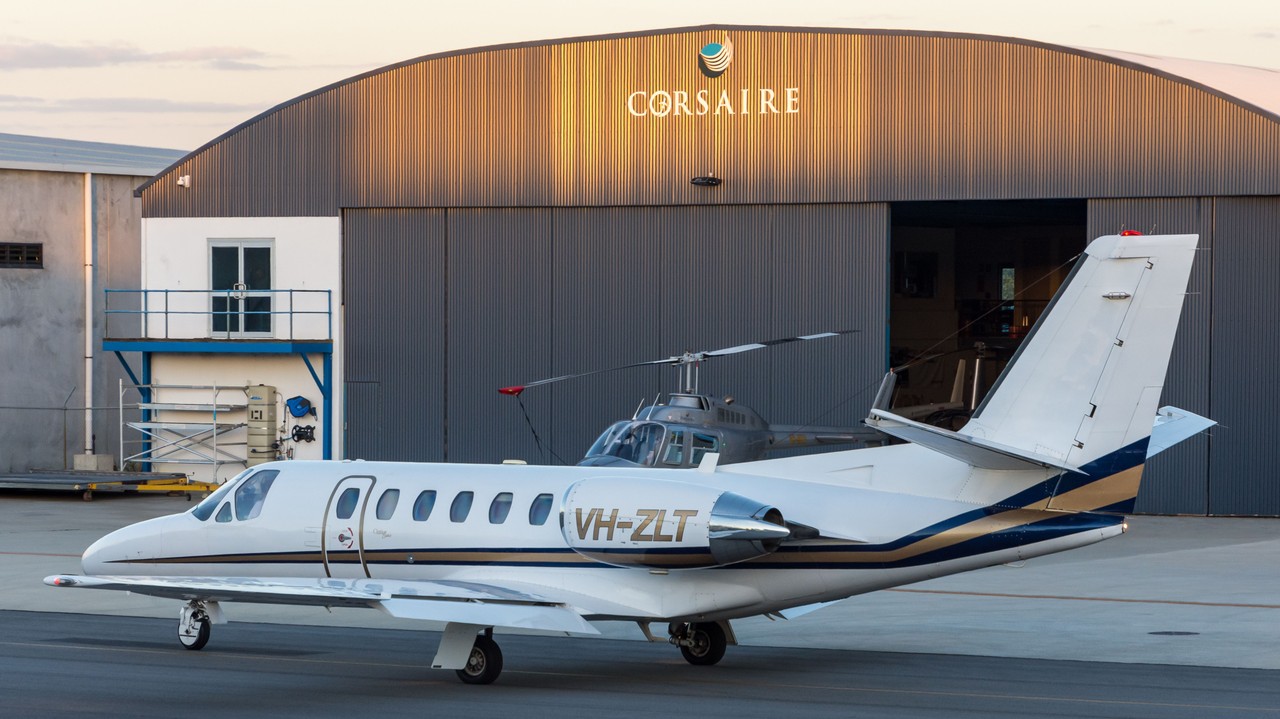
Service History
The Citation Bravo dominated the light business jet market during its decade-long production run, delivering 336 aircraft to private owners, corporations, and charter operators worldwide. The aircraft filled a crucial gap in the business aviation market, offering higher performance than its Citation II predecessor while maintaining the operational economy that made Cessna jets popular with smaller operators. More than 50 Citation Bravos remain active in charter service today, testament to their enduring utility and reliability in commercial operations.
The Manufacturer
Cessna Aircraft Company, founded by Clyde Cessna in 1927, developed the Citation Bravo during a period of significant corporate transition. The company had established itself as a leader in general aviation following World War II, but faced challenges in the 1990s that led to its acquisition by Textron Inc. in 1997, midway through the Bravo's production run. Under Textron's ownership, Cessna continued manufacturing operations at its primary facility in Wichita, Kansas, where the Citation family had been produced since the early 1970s. Today, the company operates as Textron Aviation, continuing Cessna's legacy of innovative aircraft design.
Engine & Technical Innovation
The Citation Bravo's defining characteristic was its powerplant: two Pratt & Whitney Canada PW530A turbofan engines, each producing 2,887 pounds of thrust. These engines represented the first application of this advanced turbofan design in a light business jet, delivering 15 percent more thrust than the JT15D-4B engines used in previous Citation models while consuming 13 percent less fuel. The PW530A engines featured a 4,000-hour time between overhaul interval and superior high-altitude performance, enabling the Bravo's impressive climb rate and service ceiling.
Cessna's engineering team built upon the proven Citation II airframe, incorporating a supercritical wing design and trailing-link landing gear system. The aircraft featured Honeywell Primus EFIS avionics, representing a significant advancement in cockpit technology for the mid-1990s. These innovations addressed specific design objectives: reduced acquisition costs, enhanced operational economy, improved safety margins, and the ability to operate from short runways with steep approaches.
Performance and Pilot Perspective
Pilots praised the Citation Bravo for its balanced performance characteristics and forgiving handling qualities. The aircraft could cruise at 400 knots indicated airspeed while maintaining fuel efficiency that made it economically viable for shorter trips where larger jets would be impractical. With a maximum service ceiling of 45,000 feet, the Bravo could climb above most weather and air traffic congestion, while its impressive climb rate of 3,195 feet per minute allowed rapid transit to cruise altitude.
The aircraft's short-field performance proved particularly valuable to operators serving smaller airports. With takeoff distance over a 50-foot obstacle of 3,600 feet and landing distance of 3,180 feet, the Bravo could access airports unavailable to larger business jets. Single-engine climb performance of 1,133 feet per minute provided safety margins that pilots appreciated when operating from challenging airports or in mountainous terrain.
Development and Certification
The Citation Bravo program began in the early 1990s as Cessna sought to modernize its successful Citation II design. The prototype made its maiden flight on April 25, 1995, beginning an intensive flight test program that led to FAA certification in August 1996. The first customer delivery occurred in February 1997, launching a production run that would continue for nearly a decade.
Cessna's development team focused on evolutionary rather than revolutionary changes, building upon the proven Citation II platform while incorporating lessons learned from the Citation Ultra program. The result was an aircraft that offered significantly improved performance while maintaining the reliability and ease of maintenance that had made earlier Citations successful in the marketplace.
Production and Legacy
Production of the Citation Bravo concluded in 2006 after 336 aircraft had been delivered, representing a successful program for Cessna during a challenging period in general aviation. The aircraft bridged the gap between the earlier generation of Citation jets and the more advanced models that would follow, incorporating technologies that would become standard throughout the industry.
The Bravo's legacy lies in its role as an accessible high-performance business jet that brought advanced turbofan technology to the light jet category. Its combination of improved performance, operational economy, and proven reliability helped establish market expectations for business jets that continue to influence aircraft design today. While no examples are preserved in major aviation museums, the substantial number of Citation Bravos still in active service demonstrates the enduring value of Cessna's design philosophy of practical innovation combined with operational reliability.