
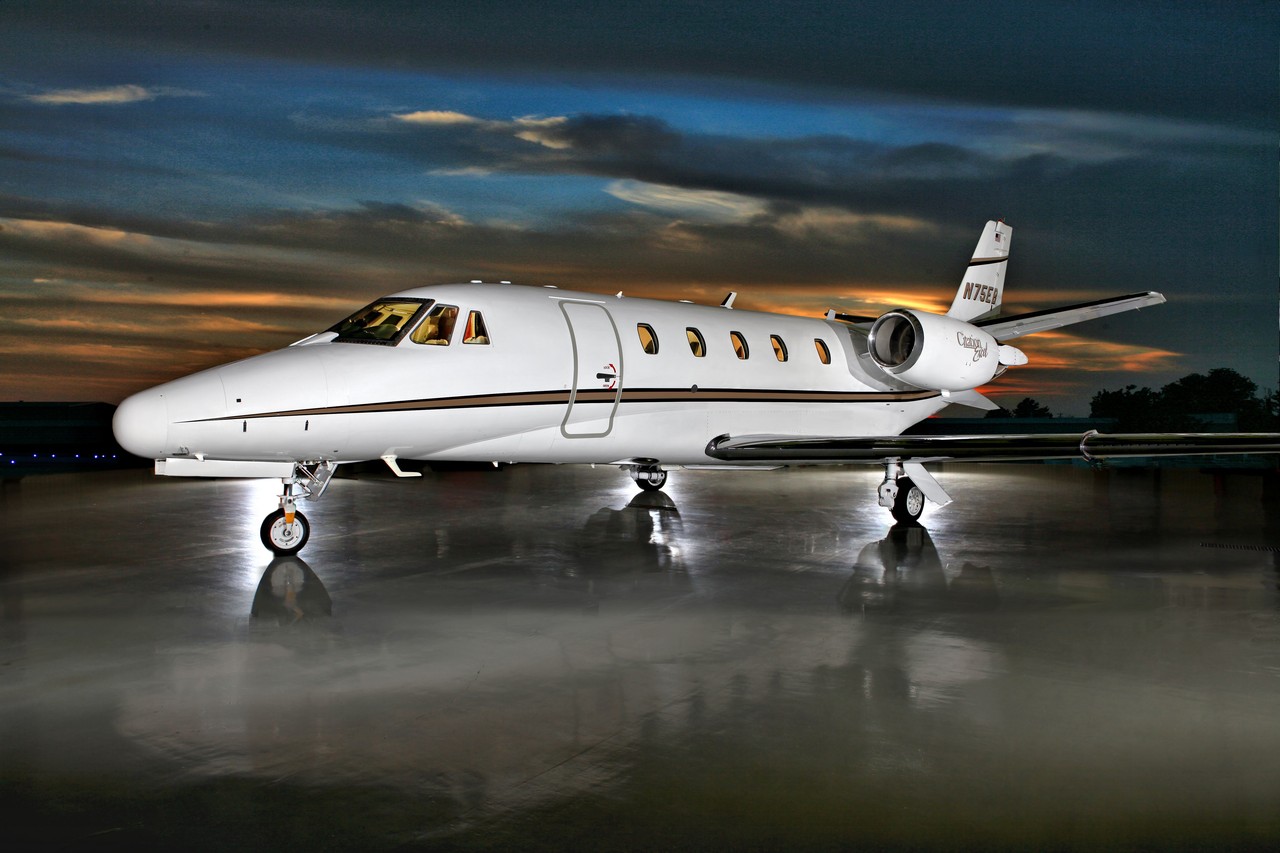
Development and First Flight
Cessna announced the Citation Excel project in October 1994 at the National Business Aviation Association convention, targeting the growing midsize business jet market. The design team combined proven elements from the Citation VII and Citation X models, creating an aircraft that delivered Citation X performance characteristics for a broader commercial market. The prototype completed its maiden flight on February 29, 1996, beginning an extensive certification program that would establish new standards in the midsize business jet category.
Certification and Early Production
The Federal Aviation Administration granted type certification in April 1998, by which time Cessna had already accumulated more than 200 firm orders. The strong pre-certification sales demonstrated the market's appetite for an aircraft that offered direct-to-altitude performance with short runway capabilities. By August 2000, when the 100th Excel rolled off the production line, Cessna had achieved a manufacturing rate of one aircraft every three days at their Wichita facility.
Engine Technology and Performance
The Citation Excel series employs twin Pratt & Whitney PW545 turbofan engines, representing advanced propulsion technology for the midsize business jet market. The original Excel utilized standard PW545 engines, while the upgraded XLS variant introduced the more powerful PW545B configuration with enhanced performance characteristics. These turbofan engines enable the aircraft to climb directly to 41,000 feet and maintain a cruise speed of 441 mph across its 2,100-nautical-mile range.
Production Evolution
Cessna manufactured 374 Citation Excel aircraft between 1996 and 2004, establishing the foundation for the series' commercial success. The company introduced the improved Citation XLS in 2003, continuing production through 2008 with 330 units delivered. The XLS featured upgraded avionics and enhanced performance specifications while maintaining the operational characteristics that made the original Excel attractive to operators. Manufacturing operations span facilities in Wichita, Kansas, and Mexico, reflecting Cessna's expanded production capacity.
Avionics Innovation
The original Citation Excel pioneered the use of Honeywell's Primus 1000 three-screen electronic flight instrument system, featuring dual primary flight displays and a multifunction display. The Citation XLS advancement introduced a comprehensive glass cockpit based on the enhanced Primus 1000 EFIS suite, eliminating traditional analog instruments in favor of all-digital flight displays. This avionics evolution positioned the aircraft at the forefront of business aviation technology.
Market Performance and Pricing
The Citation Excel carried a unit price of $8.7 million in 1999, establishing its position in the premium midsize business jet market. By 2018, ten-year-old Citation XLS models commanded approximately $4 million on the secondary market, demonstrating strong value retention. This pricing stability reflects the aircraft's reputation for reliability and operational efficiency among corporate and charter operators.
Cabin Configuration and Passenger Experience
The aircraft's cabin measures 18.7 feet in length, 5.5 feet in width, and 5.7 feet in height, providing 461 cubic feet of passenger volume. This configuration accommodates up to eight passengers in corporate layouts, making it suitable for both short-haul business trips and transcontinental flights. The cabin dimensions represent a significant advancement over light jets while maintaining operational costs below large-cabin aircraft.
The Cessna Legacy
Cessna Aircraft Company established its business jet credentials with the Citation I debut in 1969, creating the foundation for one of aviation's most successful business jet families. The company's aviation heritage traces to 1940 military contracts, including 33 T-50 aircraft for the US Army and 180 units for the Canadian Air Force. Textron's acquisition of Cessna maintained the company's position as a leading manufacturer of light and midsize general aviation aircraft.
Operational Success
With more than 1,000 aircraft delivered across all variants, the Citation 560XL series represents one of Cessna's most commercially successful programs. An remarkable 99.4 percent of delivered aircraft remain in active operation, demonstrating exceptional reliability and operator satisfaction. In 2018, Textron extended maintenance intervals for Citation XLS+ aircraft to 12 months or 800 hours, reducing operational costs and aircraft downtime for scheduled maintenance events.