
Service History
The Cessna AW dominated the early general aviation market by demonstrating that monoplanes could outperform traditional biplanes in both speed and efficiency. With its ability to cruise at 90 mph while carrying four passengers, the AW proved its commercial viability by winning the grueling 1928 transcontinental air derby. This victory showcased the aircraft's reliability on long-distance routes and helped establish Cessna's reputation for building dependable touring aircraft. Early airlines, including National Air Transport, operated the AW for mail and passenger services, with the airline's operational needs directly inspiring Clyde Cessna's design objectives.
The Manufacturer
Cessna Aircraft Company was founded by aviation pioneer Clyde Cessna in Wichita, Kansas, during the early 1920s following his successful monoplane experiments and pioneering flights. The company initially collaborated with Victor Roos in the Cessna-Roos partnership for monoplane production before resuming independent operations. During the Great Depression, Cessna faced severe financial challenges that forced production to halt temporarily, with Clyde Cessna leaving the aviation business to return to farming. His nephews revived the company and took over leadership during this difficult period. The company later underwent significant ownership changes, being acquired by General Dynamics in 1986 and subsequently by Textron in 1992. Today, Cessna continues operations as part of Textron Aviation, maintaining its position as a leading general aviation manufacturer.
Engine & Technical Details
The AW was powered by the Warner Scarab, an air-cooled radial engine manufactured by Warner Aircraft Corporation. While some records list the engine as producing 110 horsepower, most sources specify 125 hp (93 kW) output. The Warner Scarab promised reliability for touring applications but failed to achieve mass production significance among 1928-era radial engines, facing stiff competition from established powerplants like the Wright Whirlwind. Despite its limited commercial success, the Scarab proved lightweight and reliable enough to enable the AW's impressive performance capabilities. Some AW operators later modified their aircraft with Axelson engines, indicating ongoing efforts to optimize performance.
Design Innovation
Clyde Cessna's design evolved from his 1927 prototype Model AC, which first flew on August 13, 1927, into the production Model A series. The AW represented the most popular variant of this groundbreaking series, featuring a revolutionary strutless cantilever high-wing configuration. This innovative design eliminated the external wing bracing common to earlier aircraft, creating a cleaner aerodynamic profile. The aircraft combined an advanced all-metal wing structure with a mixed construction fuselage using wood and steel tubing covered in fabric. These design innovations directly influenced later Cessna models, including the Model C, the Airmaster series produced from 1933 to 1941, and the postwar 190 and 195 models manufactured from 1945 to 1953.
Performance and Pilot Perspective
The AW's performance capabilities were exceptional for a four-seat aircraft of its era, with the ability to reach 110 mph at maximum speed while maintaining a practical cruise speed of 90 mph. The aircraft's range could be extended through fuel system modifications, making it suitable for long-distance touring. However, the open cockpit configuration created significant drag that limited the aircraft's full potential. Pilots appreciated the AW's reliability and handling characteristics, which made it an ideal choice for both recreational flying and commercial passenger service. The aircraft's high-wing configuration provided excellent visibility and stable flight characteristics that would become hallmarks of Cessna designs.
Production and Legacy
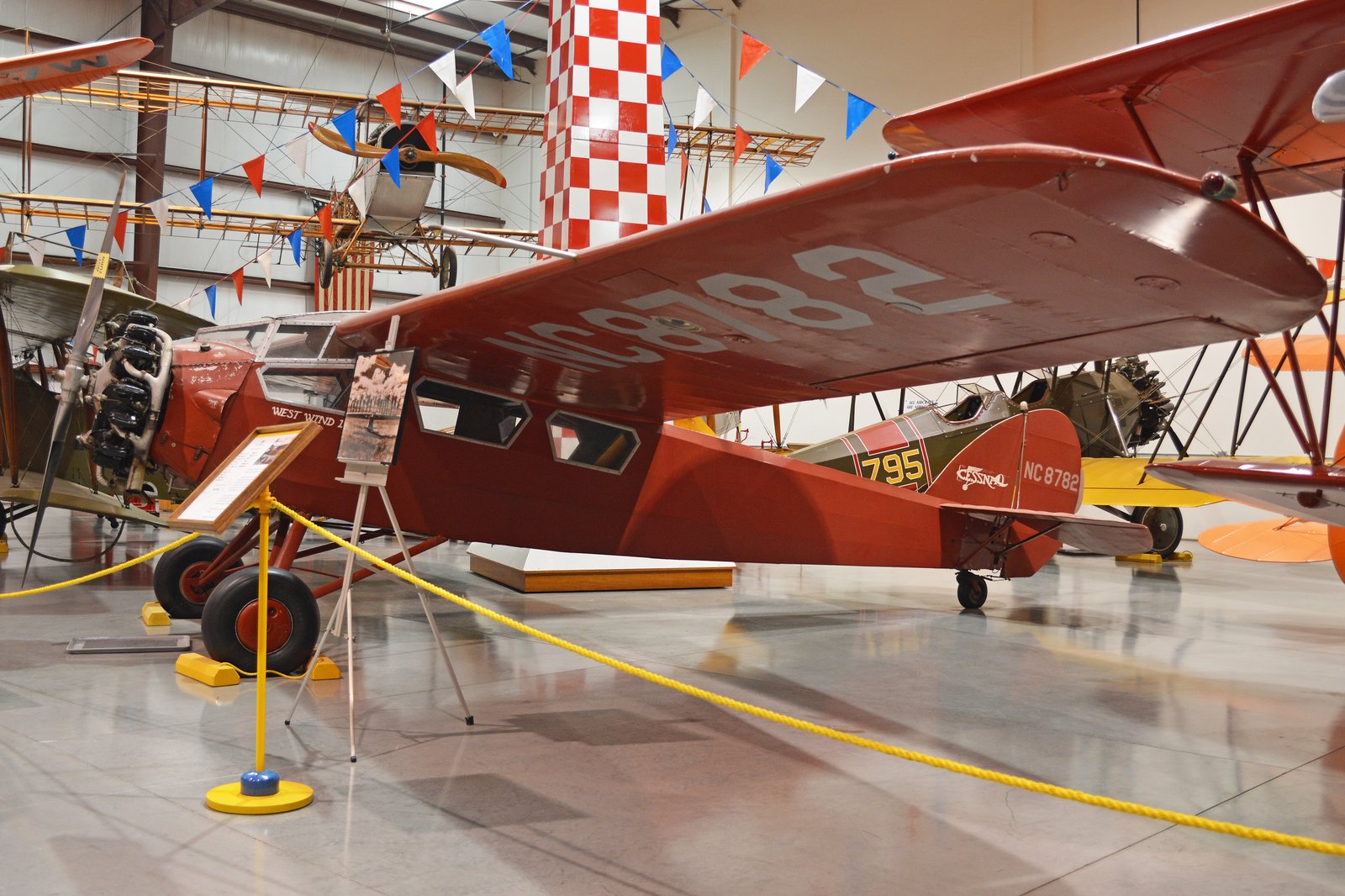
Cessna manufactured exactly 48 AW aircraft between 1928 and 1929, contributing to a total of 58 examples across all A-series variants. Today, only two Cessna AWs remain in flying condition, including one owned by E.D. "Skeeter" Carlson. A notable museum example, nicknamed "The Spar," is displayed at the Yanks Air Museum in Chino, California—this particular aircraft was among the 1928 transcontinental air derby winners. The AW's cultural significance extends far beyond its modest production numbers, as it pioneered the cantilever monoplane design that became Cessna's standard configuration for over 80 years of aircraft manufacturing. Clyde Cessna's contributions to aviation, exemplified by the AW's success, earned him posthumous recognition with induction into the National Aviation Hall of Fame in 1978 and the International Air & Space Hall of Fame in 1983, following his death on November 20, 1954. The AW serves as a crucial bridge between experimental prototypes and commercial success, demonstrating how innovative design could ensure company survival even during the economic challenges of the Great Depression.