
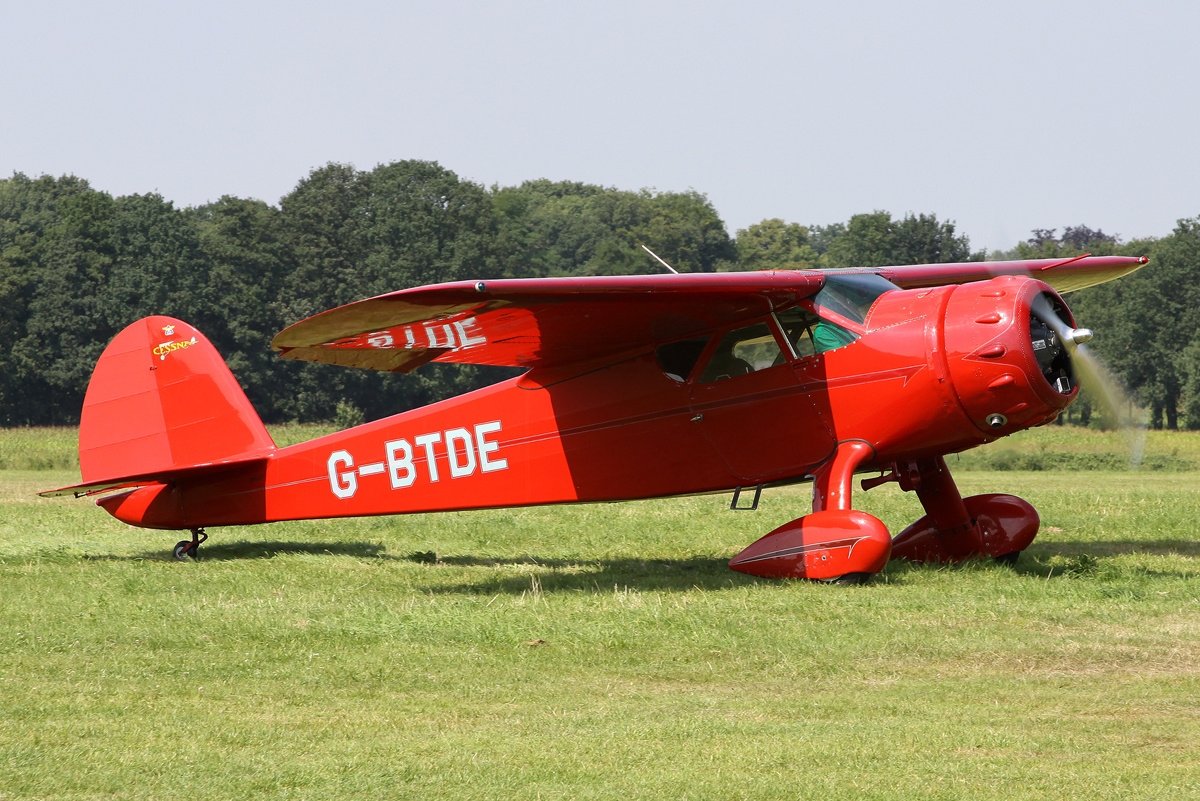
Design Revolution
The Airmaster series emerged from the innovative mind of Dwane Wallace, Clyde Cessna's nephew and a newly trained aeronautical engineer who joined the company in 1934. Wallace's original prototype first took to the skies in June 1935, receiving type certificate 573 later that summer. His design philosophy merged early Cessna characteristics with racing aircraft concepts he had developed alongside Eldon Cessna, the founder's son, during their competition work in the early 1930s.
The C-165 represented a technological leap for its era through its cantilever high-wing structure, which eliminated the external struts and braces that created drag on competing aircraft. This streamlined configuration, combined with narrow cabin windows, produced an distinctive Art Deco appearance that became the Airmaster's visual signature. The design earned Cessna the marketing claim of "World's Most Efficient Airplane" after dominating aerial competitions and trophy races throughout the late 1930s.
Company Salvation
Cessna Aircraft Company faced near-extinction during the Great Depression's early years, with operations essentially shuttered by the early 1930s. Dwane Wallace convinced the board of directors to reopen the company in 1934, securing funding and leading the engineering effort that produced the Airmaster line. This aircraft series proved instrumental in rescuing Cessna from financial ruin, establishing the foundation for the company's eventual dominance in general aviation manufacturing.
The C-165 received its type certificate approximately one year after the C-145 variant was approved on October 1, 1938. Production continued from 1939 through 1942, with the primary distinction between models being engine horsepower rather than airframe modifications.
Technical Excellence
The Warner Super Scarab seven-cylinder radial engine delivered 165 horsepower to drive the aircraft's Aeromatic propeller, typically a black two-blade Micarta construction unit that automatically adjusted pitch during flight. Takeoff operations allowed a maximum of 2,340 rpm for one minute before reducing to 2,200 rpm for normal operation. A variant designated C-165D featured an upgraded 175-horsepower Warner Super Scarab for enhanced performance.
Construction combined traditional and modern techniques, with a steel tubing fuselage reinforced by wooden stringers and formers, all-wood wing construction, and wooden tail surfaces covered in plywood. This mixed-material approach provided structural integrity while maintaining reasonable manufacturing costs during the pre-war period.
Operational Capabilities
The C-165's exceptional stability at higher altitudes made it particularly valuable for aerial photography missions. Some aircraft received factory modifications including camera ports in the floor, downward-viewing windows in the lower fuselage sections, and built-in oxygen bottle racks for high-altitude photographic work. The aircraft earned type approval for diverse operations including land, sea, photographic, freight, ambulance, and ski configurations.
Pilots praised the Airmaster's rock-steady flight characteristics and responsive handling, particularly noting its sure-footed behavior and comfort at altitude. The combination of modest power with relatively high performance created an aircraft that delivered impressive capability without excessive operating costs.
Limited Military Service
While the C-165 saw primarily civilian use, the broader Airmaster family contributed to military operations during World War II. The United States Army Air Forces impressed two Cessna C-34 Airmasters into service with the designation UC-77B, though detailed combat records for the C-165 specifically remain limited in available documentation.
The aircraft's approved multi-role capability demonstrated its versatility, though the war's end in 1945 coincided with the conclusion of Airmaster production as Cessna transitioned to postwar designs.
Production Legacy
Approximately 40 C-165 aircraft were manufactured during the four-year production run, representing roughly half of the 80 total aircraft in the combined final C-145 and C-165 Airmaster series. The Airmaster line's influence extended into Cessna's postwar development, with the classic lines carried forward into the larger Cessna 195 all-aluminum cruiser.
However, the Airmaster's 1930s technology—welded tubular steel construction, fabric covering, extensive woodwork, and maintenance-intensive radial engines—proved incompatible with modern manufacturing economics. Cessna ultimately adopted all-aluminum construction, side-by-side seating, strut-braced high-wing configuration, and reliable horizontally-opposed engines in designs like the Cessna 120, 140, 170, 152, 172, and 182 that established the company as the world's most prolific light aircraft manufacturer.
Preservation
The Mid America Flight Museum maintains a Cessna C-165 in its collection, preserving an example of this significant chapter in American aviation development. The aircraft represents both Cessna's engineering innovation during the company's financial recovery and the transitional period between traditional construction methods and the modern general aviation industry that followed World War II.