
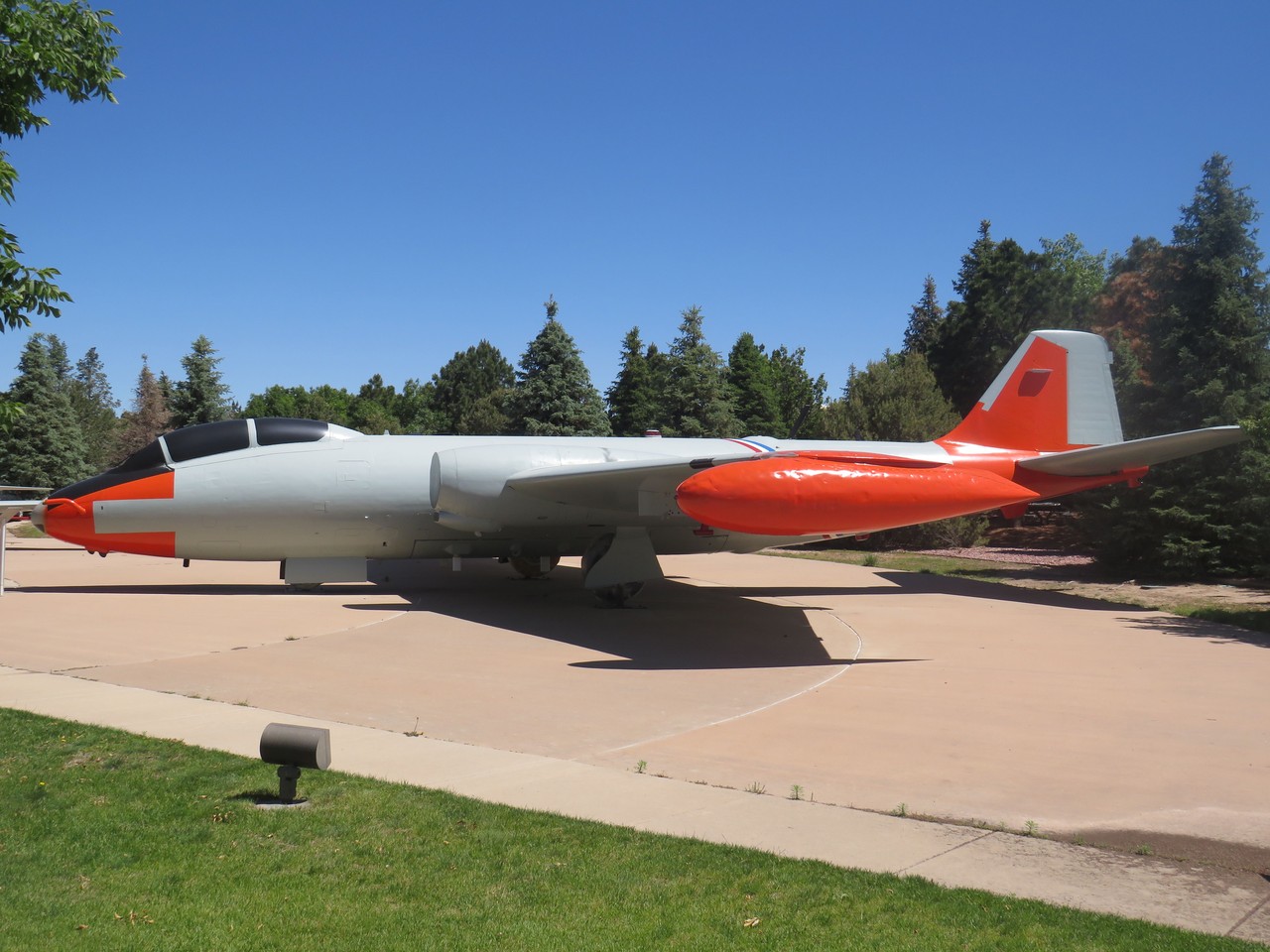
Service Dominance and Global Impact
The Canberra entered RAF service in May 1951 and quickly established itself as the backbone of British tactical bombing capability. Within months of operational service, the aircraft was setting world records for transatlantic flight duration and altitude, demonstrating performance capabilities that surpassed contemporary interceptors. The type's export success proved exceptional, with operators including the Indian Air Force, Royal Australian Air Force, and United States Air Force, where it served as the B-57 Canberra with 403 aircraft built by Martin Aircraft Company between 1951 and 1959.
Combat Operations and Military Variants
The Canberra proved its combat worthiness across multiple theaters during the Cold War era. Australian Canberras became the first RAAF jet bombers to see combat during operations over Malaya in September 1958. The aircraft's high-speed performance and exceptional altitude capability allowed it to evade early jet interceptors, providing a significant tactical advantage during the conflict's early phases.
Military variants included the B.2 tactical bomber, the PR.3 photo-reconnaissance version that first flew on March 19, 1950, and the advanced PR.9 high-altitude reconnaissance variant that took flight on July 8, 1955. The PR.9 featured upgraded Avon 208 turbojets producing 11,250 pounds of static thrust each. The B.6 variant improved upon the basic B.2 design with more powerful engines, enhanced braking systems, and increased fuel capacity for extended range missions.
Manufacturing Achievement Against the Odds
English Electric faced enormous challenges in developing the Canberra, having operated without an aircraft design office since 1923. When post-war military contracts became scarce, the company assembled a 260-person design team led by aerodynamic expert Ray Creasey and structural engineer Frederick Page. The project was directed by W.E.W. "Teddy" Petter, a protégé of jet engine pioneer Frank Whittle.
The company invested heavily in infrastructure, constructing wind tunnels and converting Warton Aerodrome into their primary flight testing facility. Breaking with traditional prototype construction methods, English Electric built the aircraft using custom jigs and tooling from the project's inception rather than hand-building individual components. This innovative approach contributed to the remarkably smooth test program completion by September 1949.
Engine Technology and Performance
The Canberra's twin Rolls-Royce Avon turbojets, mounted in the wing roots, represented cutting-edge propulsion technology for the era. These pure jet engines, without bypass systems, provided the high-altitude performance and speed necessary to fulfill the 1944 Air Ministry requirement for a de Havilland Mosquito successor. Different variants utilized various Avon engine versions, with later models like the PR.9 receiving the more powerful Avon 208 engines.
Wing Commander Roland Prosper Beamont, English Electric's chief test pilot, conducted the maiden flight from Warton on Friday, May 13, 1949, in prototype VN799. His wartime experience with the Typhoon, Tempest, and Meteor proved invaluable during the aircraft's development phase. The comprehensive test program validated the design's effectiveness with minimal modifications required.
Operational Training and Deployment
RAF Bassingbourn's 232 Operational Conversion Unit became the busiest Canberra training facility, operating more than 40 airframes and flying approximately 1,400 hours monthly. This intensive training program ensured qualified crews for the expanding Canberra fleet across multiple RAF squadrons and international operators.
Australian operations included deployment with No. 1, 2, and 6 Squadrons, plus 82 (Bomber) Wing and the Central Flying School at East Sale. Two Australian aircraft, A84-202 and A84-203, participated in the prestigious 1953 Great Air Race, generating significant public interest in the type and demonstrating its long-range capabilities.
Production Legacy and Current Status
Total production reached 949 aircraft across three manufacturing locations: approximately 900 built by English Electric in Britain, 48 manufactured by Government Aircraft Factories in Australia, and 403 produced by Martin Aircraft Company for the United States Air Force. This substantial production run reflected the design's versatility and international appeal during the early jet age.
The Canberra achieved remarkable longevity in operational service, with the Royal Air Force and Indian Air Force operating the type until 2006 and 2007 respectively. The RAAF conducted its final operational flights on June 30, 1982, when four Canberras from No. 2 Squadron performed ceremonial overflights of Brisbane. Today, approximately 10 Canberras and American-built B-57s remain airworthy in private ownership, with additional examples preserved in museums worldwide as testament to this pioneering jet bomber's historical significance.