
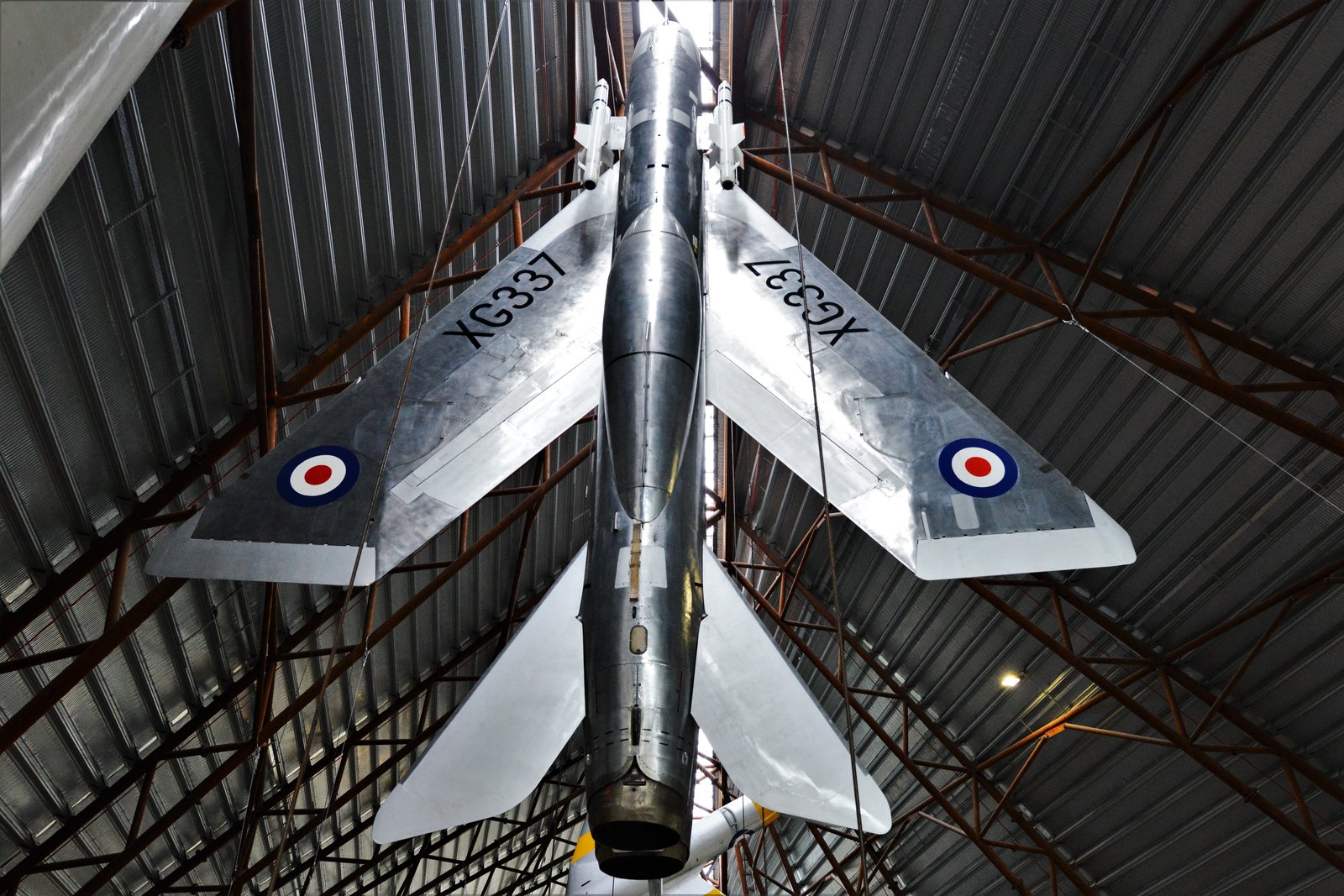
Service History
The Lightning dominated British air defense for nearly three decades, serving as the RAF's primary interceptor from 1960 to 1988. During the height of the Cold War, Lightning squadrons provided round-the-clock protection of British airspace, with aircraft maintained on constant alert status. The type equipped 11 RAF squadrons at its peak, including the famous 74 "Tiger" Squadron and 56 Squadron, both of which operated the aircraft for over two decades.
Beyond British service, the Lightning found export success in the Middle East. Saudi Arabia operated 34 F.53 variants from 1968 to 1986, while Kuwait purchased 12 F.53s that served until 1977. The export F.53 variant featured enhanced ground-attack capability with underwing and overwing pylons for rockets and bombs, expanding the aircraft's role beyond pure interception.
Development and First Flight
The Lightning's origins traced to a 1947 Air Ministry requirement for a fighter capable of unprecedented performance in the jet age. English Electric's design team, led by chief designer W.E.W. "Teddy" Petter, created the radical P.1 prototype with its distinctive vertical engine arrangement and 60-degree swept wings.
Test pilot Roland Beamont achieved the aircraft's maiden flight on August 4, 1954, at Boscombe Down. Just seven days later, on August 11, Beamont pushed the prototype through the sound barrier during level flight, making aviation history. This achievement came less than seven years after Chuck Yeager's first supersonic flight in the Bell X-1, demonstrating Britain's rapid advancement in high-speed flight technology.
By October 1958, the Lightning reached Mach 2.0 using minimum afterburner, establishing it among the world's fastest operational fighters. The aircraft's climb rate of 50,000 feet per minute in its early variants made it one of the most potent interceptors of its era.
The Manufacturer
English Electric, founded in 1918 as an electrical engineering company, entered aircraft manufacturing in 1938. The company's aviation division produced the successful Canberra bomber before tackling the Lightning project. In 1960, English Electric merged with Vickers-Armstrongs and Bristol Aircraft to form the British Aircraft Corporation (BAC), which continued Lightning production until 1988.
BAC itself merged with other British aerospace companies in 1977 to create British Aerospace, later renamed BAE Systems in 1999. Today, BAE Systems maintains the Lightning's technical heritage and supports the remaining airworthy examples through its heritage division.
Engine and Technical Innovation
The Lightning's distinctive performance came from its twin Rolls-Royce Avon turbojet engines, mounted vertically in the fuselage center. This unique configuration, with one engine above the other, allowed for a remarkably slim fuselage while providing over 16,000 pounds of thrust per engine in later variants.
Early prototypes utilized Armstrong Siddeley Sapphire engines, but the production switch to Rolls-Royce Avons proved transformational. The Avon 300 series engines featured advanced afterburning technology that gave the Lightning its exceptional climb rate and high-altitude performance.
The aircraft's kinked and cambered wing design, introduced on the F.3 variant, improved both subsonic handling and fuel capacity. This modification addressed early criticisms about the Lightning's limited range, extending combat radius from 150 to over 400 miles with external fuel tanks.
Operational Performance
Pilots praised the Lightning's exceptional climb rate and high-altitude performance, though many noted its demanding fuel consumption and complex systems. The aircraft could reach 40,000 feet in under three minutes, making it ideally suited for rapid scramble intercepts against high-altitude intruders.
With a maximum speed exceeding 1,500 mph at altitude and a service ceiling of 60,000 feet, the Lightning outperformed many contemporary fighters in vertical performance. However, its combat radius of 400 miles with external tanks limited its effectiveness in extended patrol missions.
The aircraft's advanced radar and missile systems, including the Red Top and later AIM-9 Sidewinder air-to-air missiles, provided formidable interception capability. Two 30mm Aden cannons supplemented the missile armament for close-range combat.
Production Legacy
English Electric and BAC produced 337 Lightnings between 1959 and 1988, with the F.6 representing the most numerous variant at 39 newly built aircraft plus 24 conversions. The extended 28-year production run, nearly three times the originally planned service life, testified to the design's enduring value.
During development trials, 20 F.1 aircraft conducted extensive testing from 1959 to 1969, with four aircraft lost in accidents though all pilots successfully ejected. This safety record reflected the Lightning's robust construction and reliable ejection seat systems.
Today, several Lightnings remain preserved in museums, including XR770 at RAF Manston History Museum and WG760 at the Royal Air Force Museum Cosford. At least two examples maintain airworthy status in private hands, ensuring this pioneering supersonic fighter continues to demonstrate its remarkable performance capabilities.