
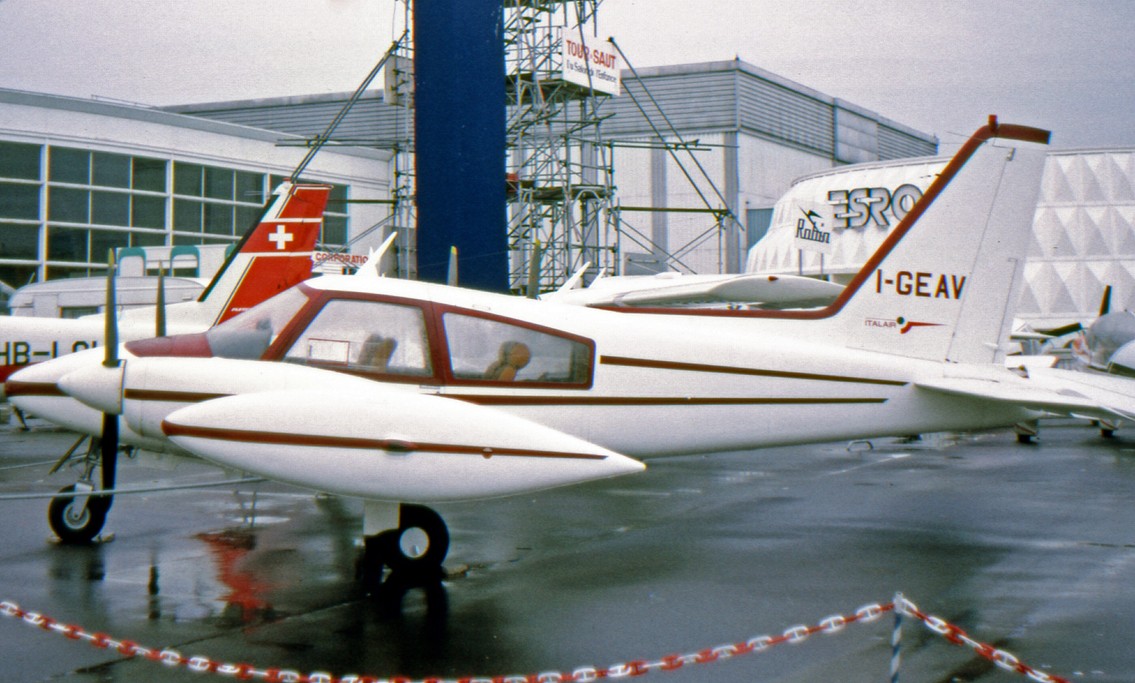
The Designer's Vision
Stelio Frati, one of Italy's most prolific aircraft designers, conceived the F.20TP Condor as an advancement of his earlier F.20 Pegaso, which had first taken to the skies in 1971. The Condor project emerged during the early 1980s when general aviation was experiencing significant technological evolution, particularly in powerplant options and aerodynamic refinement. Frati's decision to develop the F.20TP variant demonstrated his commitment to continuous improvement of successful designs rather than abandoning them for entirely new concepts.
The aircraft incorporated the low-wing configuration that had become Frati's signature design element across multiple aircraft types. This approach provided superior performance characteristics compared to high-wing alternatives, though it required more sophisticated engineering to achieve proper ground handling and stability characteristics.
Single Prototype Production
General Avia, Frati's own manufacturing company, undertook construction of the sole F.20TP Condor prototype during the early 1980s. The decision to build only one example suggests the aircraft served primarily as a technology demonstrator or proof-of-concept vehicle rather than as the foundation for a production series. This approach was common among smaller aircraft manufacturers who lacked the capital resources to commit to full production runs without confirmed orders.
The prototype's maiden flight occurred on May 7, 1983, representing years of design work and manufacturing effort. Test flights during this period would have evaluated the aircraft's handling characteristics, performance envelope, and overall airworthiness in preparation for potential certification and production decisions.
General Avia's Manufacturing Legacy
General Avia established itself as a significant player in Italian aircraft manufacturing during the 1970s and 1980s, producing several of Frati's designs beyond the F.20TP Condor. The company's portfolio included the original F.20 Pegaso from 1971, the SF.600 Canguro from 1978, and the F.22 Pinguino from 1989. This diverse range demonstrated the manufacturer's capability to handle various aircraft types and configurations.
The company's relationship with Stelio Frati provided it with access to proven designs that had undergone extensive development and testing. This arrangement benefited both parties: Frati gained a manufacturing partner capable of bringing his concepts to reality, while General Avia secured access to marketable aircraft designs without investing in independent design capabilities.
Technical Evolution
The F.20TP designation suggests significant modifications from the original F.20 Pegaso design, though specific technical details about these changes remain limited in available documentation. The "TP" suffix typically indicates turboprop powerplant installation in aircraft nomenclature, suggesting the Condor may have represented Frati's exploration of more modern powerplant options compared to conventional piston engines.
This potential powerplant upgrade would have positioned the F.20TP Condor among the more advanced general aviation aircraft of its era, when turboprop engines were becoming increasingly popular for their reliability and performance characteristics. Such an installation would have required significant structural modifications to accommodate different engine mounting requirements, fuel systems, and operational parameters.
Limited Service History
The F.20TP Condor's status as a single prototype meant it never entered commercial service or achieved the operational success of other Frati designs. This outcome was not uncommon in the general aviation industry, where numerous promising designs failed to progress beyond prototype stages due to market conditions, certification challenges, or financial constraints.
The aircraft's experimental nature likely provided valuable data for future Frati projects, even if the specific design did not achieve production status. Lessons learned from the Condor's development and testing phases could have influenced subsequent designs, contributing to the broader evolution of Italian general aviation aircraft.
Legacy and Significance
Despite its limited production run, the F.20TP Condor represents an important chapter in Stelio Frati's design legacy and Italian aircraft development during the 1980s. The aircraft demonstrated the innovative spirit that characterized the general aviation industry during this period, when designers and manufacturers were actively exploring new configurations and technologies.
The Condor's place in aviation history serves as a reminder that not all aircraft designs achieve commercial success, regardless of their technical merit or the reputation of their creators. The single prototype stands as a testament to the experimental nature of aircraft development and the risks inherent in bringing new aviation technologies to market.