
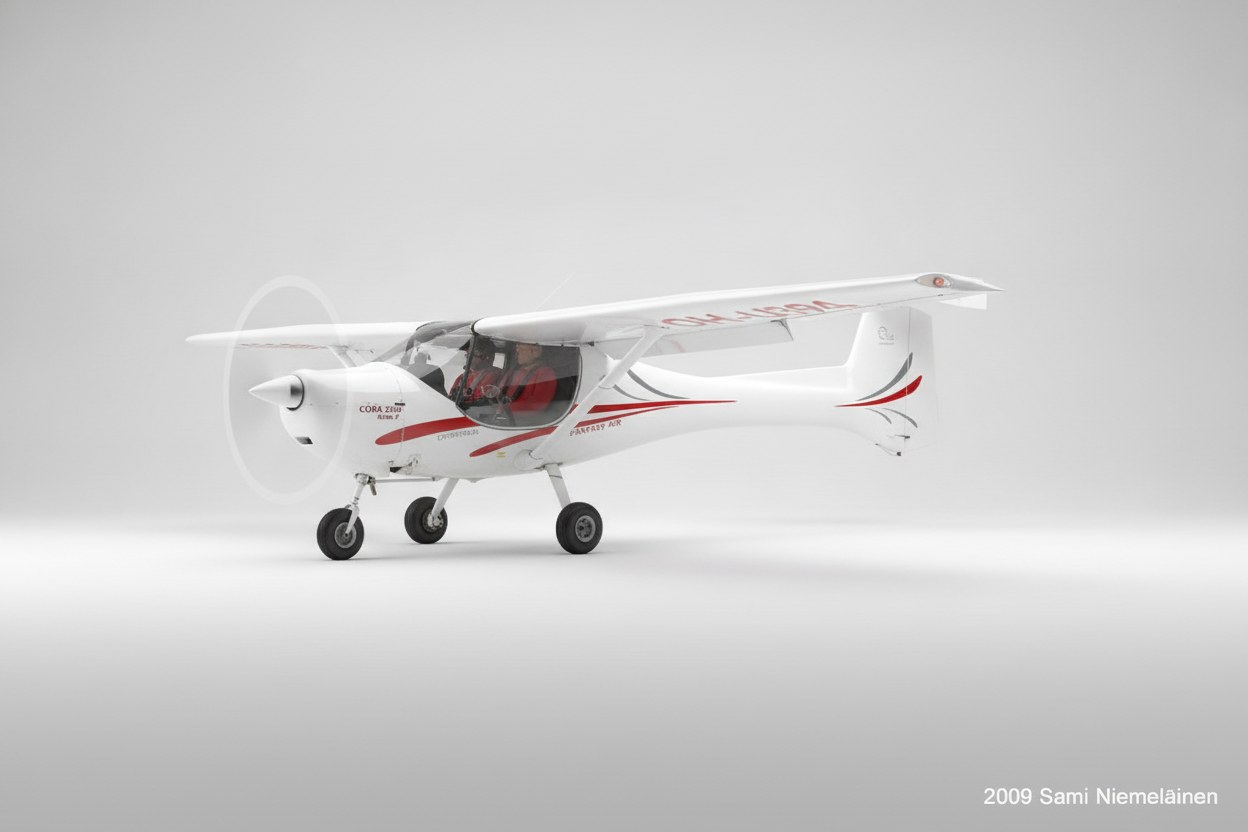
Development and Design Innovation
Oldrich Olsansky's design for the Cora 200 Arius F emerged from a broader vision to create affordable, certified ultralights that could compete internationally. The float variant evolved from the original Cora, which first flew in 1995, with the Arius F prototype designated OK-DUU 03 taking to the air on November 5, 1999. The design incorporated several advanced features unusual for ultralights of the era, including electrically actuated flaperons with three position settings (0, 15, and 48 degrees) and an optional Junkers recovery parachute system.
The aircraft's high-wing configuration utilized the SM 701 airfoil introduced in early 2003, combined with a distinctive T-tail arrangement that provided excellent control authority. Wing loading remained low at 11.4 square meters of wing area supporting a maximum gross weight of 599 kilograms, contributing to the aircraft's gentle 65 km/h stall speed and forgiving handling characteristics.
Float Operations and Certification
Float gear testing commenced in August 2001 using Full Lotus twin-float systems, with certification planned for amphibious operations. The Arius F represented one of the few factory-certified float ultralights available in Europe, filling a niche market for affordable seaplane operations. Two examples were delivered to Finland by August 1999, where the aircraft's cold-weather capabilities and reliable Rotax powerplant proved well-suited to Nordic flying conditions.
The float installation maintained the aircraft's impressive performance envelope, with pilots reporting minimal speed penalties compared to the wheeled variants. The fixed tricycle landing gear on standard models featured Kevlar main gear legs with 350mm wheels and hydraulic brakes, while the steerable nose gear provided excellent ground handling.
Powerplant and Performance
The Cora 200 Arius F utilized Rotax's proven four-stroke engines, with options including the 912 UL producing 79.9 horsepower or the more powerful 912 ULS generating 98.6 horsepower. These Austrian-manufactured engines, which entered production in the early 1990s, became the gold standard for light aircraft powerplants with over 40,000 units produced by the 2020s.
Propeller options included two-blade Junkers Profly or three-blade SportProp and VZLU V331-3NC carbon fiber units, with pilots reporting smooth operation and excellent climb performance of 5.0 meters per second. Standard fuel capacity of 55 liters provided the impressive 1,300-kilometer range, while the never-exceed speed of 219 km/h gave pilots substantial margin above the 176 km/h cruise speed.
Commercial Success and European Market
Fantasy Air achieved remarkable market penetration across Europe, with 70 aircraft registered in the Czech Republic by November 2000, growing to 75 by October 2002. France became the largest export market with 27 registered aircraft, followed by Germany with 17 units. The company achieved production rates of three aircraft per month during 2001, demonstrating strong demand for the Allegro/Cora family.
Pilots praised the aircraft's aesthetics, exceptional visibility from the side-by-side cockpit, light control forces, and wide speed range. However, some criticism emerged regarding ergonomics for tall pilots and control harmony, typical challenges for ultralight designs prioritizing affordability over refinement.
Manufacturing Transition and Company Fate
Fantasy Air, s.r.o. operated successfully through the 1990s and into the 2000s, producing exactly 92 aircraft across all Cora variants including both kits and factory-built units. The company's fortunes changed dramatically when it declared bankruptcy on November 9, 2007, though it managed to recover partially by selling Pisek Airport, which it had purchased earlier that year.
Production rights eventually transferred to international partners, with Allegro variants moving to Roseburg, Oregon under X-Air Australia in July 2009, driven by the strong Euro making European production uneconomical for US and Australian markets. Later production shifted to Sanford, North Carolina under Allegro LSA and B-Bar-D Aviation for float versions.
Technical Legacy and Influence
The Cora 200 Arius F contributed to a total production run exceeding 300 aircraft across the entire Allegro/Cora family, with Fantasy Air's 92 units representing the original Czech production. The aircraft's influence extended beyond its production numbers, helping establish design standards for modern Light Sport Aircraft categories that emerged in the 2000s.
The aircraft's certification across multiple European countries including Finland, France, Germany, Denmark, and Spain demonstrated the viability of harmonized microlight regulations. Features pioneered on the Cora family, including the SM 701 airfoil and electrically actuated flaperons, influenced subsequent ultralight designs throughout the industry.
While current airworthy numbers remain unknown, the Cora 200 Arius F represents a significant milestone in affordable aviation, proving that sophisticated systems and international certification could be achieved in the ultralight category. The aircraft's successful transition from Czech to American production illustrated the global nature of modern light aircraft manufacturing and the enduring appeal of Olsansky's original design philosophy.