
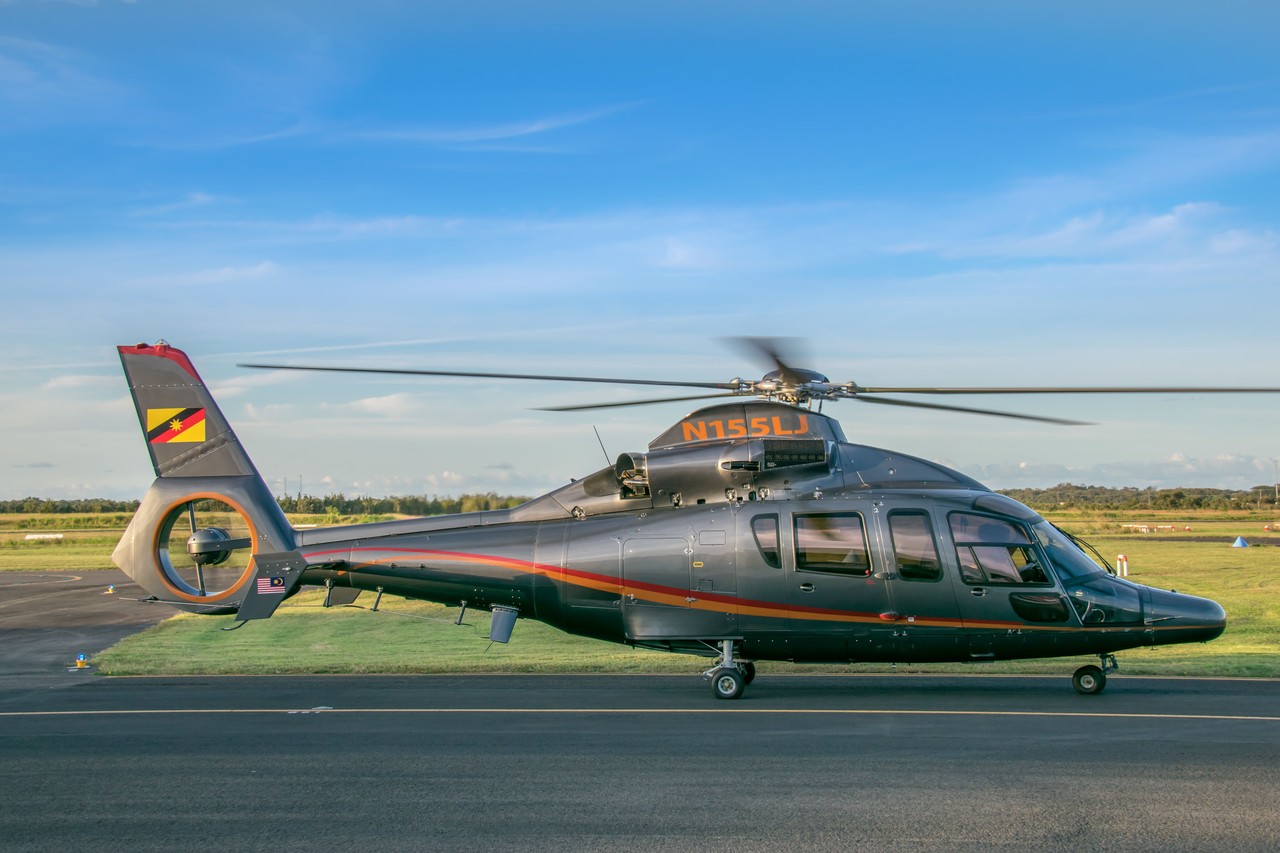
Service History
The EC-155 carved out a specialized niche in the premium helicopter market, serving government agencies, offshore oil operators, and VIP transport companies worldwide. The German Federal Police became the launch customer in March 1999, ultimately operating 15 aircraft for border patrol and law enforcement missions. Hong Kong Government Flying Service followed as the EC155B1 variant's inaugural operator in November 2002, purchasing five helicopters for government transport and emergency services.
Shell Nigeria operated six EC-155s for offshore oil platform support, while Azerbaijan Airlines incorporated four into their fleet for VIP transport. The Royal Thai Police acquired two aircraft for law enforcement operations, and Heli Air Monaco operated one for royal VIP transport duties. By 2003, approximately 50 units had been delivered to operators seeking the enhanced cabin space and improved performance over earlier medium helicopters.
The Manufacturer
Eurocopter, the original manufacturer, emerged from the 1992 merger of France's Aérospatiale helicopter division and Germany's Messerschmitt-Bölkow-Blohm. This Franco-German partnership operated for 22 years before rebranding as Airbus Helicopters in 2014 following corporate restructuring under Airbus Group. The company's heritage included the successful AS365 Dauphin series, which served as the foundation for the EC-155's development.
In 2015, Airbus Helicopters signed an agreement transferring primary EC-155 production to Korean Aerospace Industries in South Korea. This partnership enabled continued manufacturing beyond 2018, with KAI developing both civilian and military variants including the armed LAH (Light Armed Helicopter) for the South Korean military.
Design and Development
The Eurocopter engineering team designed the EC-155 as an evolutionary advancement of the AS365 N3 Dauphin 2, targeting a 40% increase in cabin volume while maintaining operational efficiency. The prototype, utilizing a modified Dauphin airframe, completed its maiden flight on June 17, 1997, at Marignane, France. The first production EC155B, registered F-WWGZ, took to the air on March 11, 1998.
Key innovations included a completely redesigned five-bladed Spheriflex rotor system, advanced glass cockpit displays, and Full Authority Digital Engine Control (FADEC) systems. These enhancements provided improved hot-and-high performance, crucial for offshore and mountainous operations. Certification was achieved in December 1998, with initial deliveries commencing three months later.
Engine and Technical Specifications
Two variants entered production, differentiated primarily by their powerplants. The baseline EC155B featured twin Turbomeca Arriel 2C1 engines, each producing 635 kilowatts (851 shaft horsepower) for takeoff power. The enhanced EC155B1 variant incorporated more powerful Arriel 2C2 engines generating 935 horsepower, enabling a higher maximum takeoff weight of 4,920 kilograms compared to the standard model's 4,800-kilogram limit.
The aircraft measured 12.83 meters in fuselage length with a rotor diameter of 12.60 meters and stood 3.55 meters high. Maximum cruise speed reached 278 kilometers per hour, with an operational range of 810 kilometers and a service ceiling exceeding 4,600 meters. The spacious cabin could accommodate 12 to 15 passengers depending on configuration, representing a substantial improvement over earlier medium helicopters.
Production and Legacy
Total production reached approximately 100 aircraft before manufacturing transitioned to South Korea. The EC-155 served as a technological testbed for future developments, contributing rotor system innovations to the experimental Eurocopter X³ high-speed helicopter, which achieved a record-breaking 255-knot flight in 2013. The helicopter's design philosophy also influenced the development of the H160, Airbus Helicopters' next-generation medium helicopter.
Korean Aerospace Industries leveraged the EC-155 platform to develop the LCH civil variant, which entered service in 2020, and the military LAH variant that achieved operational status in 2022. The armed LAH features a chin-mounted 20-millimeter cannon, rocket pods, and capacity for 6 to 10 troops, with South Korea planning to acquire 214 units to replace aging AH-1 Cobra helicopters.
As of 2017, EC-155 helicopters remained active with operators in China, Germany, Thailand, Hong Kong, the United Kingdom, and the United States. The aircraft's legacy lies in bridging the gap between the successful Dauphin series and modern medium helicopters, demonstrating that enhanced cabin space and advanced systems could create new market opportunities in the competitive helicopter industry.