
Development and Certification
The E1000 emerged from Epic Aircraft's ambitious goal to transform their successful kit-built Epic LT into a fully certified production aircraft. Founded in 2004 by Fred E. "Rick" Schrameck, Epic Aircraft initially focused on experimental amateur-built aircraft before pursuing the challenging path to FAA type certification. The certification process proved far more demanding than anticipated, stretching seven years and consuming approximately $200 million compared to initial estimates of three years and $20 million.
A significant technical setback occurred in 2018 when flight testing revealed a 10-20 knot speed shortfall from promised performance figures. Engineers traced the problem to engine intake ram air recovery issues, requiring a complete redesign of the intake system and adding six months to the certification timeline. This fix proved crucial to achieving the aircraft's target 320-knot cruise speed.
Manufacturing and Production
Epic Aircraft received FAA type certification in November 2019, marking a milestone achievement for the Bend, Oregon-based manufacturer. The first customer delivery occurred in February 2020, followed by the second aircraft in May 2020. Initial production focused on engineering support and validation, with 10 aircraft delivered by the fourth quarter of 2021.
Production ramped steadily, reaching 80 certified aircraft delivered by 2024. The company's original production forecasts called for 8-12 aircraft in 2019, 24 in 2020, 36 in 2021, and ultimately 80-90 aircraft annually. Epic Aircraft received their FAA production certificate in July 2020, enabling scaled manufacturing operations at their Oregon facility.
Corporate Evolution
Epic Aircraft's path to success included significant financial turbulence. The company filed for Chapter 11 bankruptcy in 2009 during the economic downturn, temporarily halting development. Russian businessman Vladislav Filev, owner of S7 Airlines, acquired the company's assets in 2012 through his Cyprus-based investment firm MVF Key Investments Ltd. This acquisition provided the capital necessary to pursue type certification and expand the workforce to 250 employees by 2018.
In 2024, ownership changed hands again when Tanya Eves acquired a majority stake in the company, ensuring continued production and development of the E1000 series.
Technical Innovation
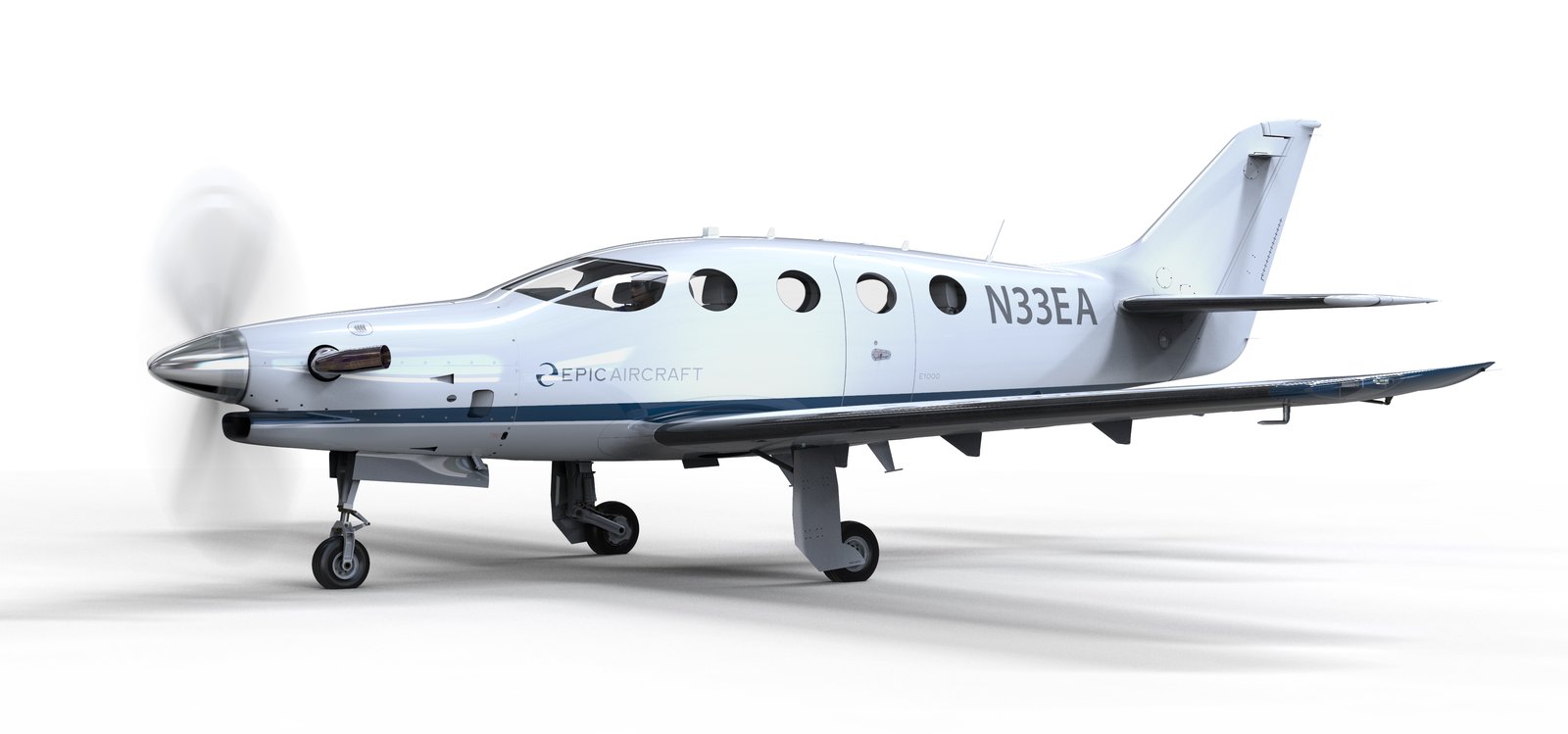
The E1000 showcases advanced composite construction throughout its airframe, utilizing carbon-fiber materials for optimal strength-to-weight ratios. The aircraft features a 6.5 psi pressurized cabin with an integrated airstair door, retractable tricycle landing gear, and sophisticated systems integration.
Powering the E1000 is a single Pratt & Whitney Canada PT6-67A turboprop engine, rated at 1,825 horsepower but derated to 1,200 horsepower for the application. This derating strategy enhances reliability and extends engine life while providing ample power for the aircraft's performance requirements. The engine drives a five-blade composite propeller in tractor configuration.
Avionics and Equipment
Standard avionics center around the Garmin G3X Touch glass cockpit system, providing pilots with integrated flight displays, engine monitoring, and navigation capabilities. The aircraft accumulated over 1,000 flight test hours during certification, validating systems integration and performance characteristics.
A significant capability enhancement arrived in December 2023 with Known Icing (FIKI) certification, earned after 450+ flight test hours in icing conditions. The FIKI system includes pneumatic de-ice boots, heated windshield, and optical ice detection systems. This certification became standard equipment for 2024 production aircraft, with retrofit packages available for earlier aircraft by early 2025.
Market Position and Recognition
The E1000 earned the 2020 Innovation Award, recognizing its successful transition from experimental to certified aircraft status. Pricing evolved from $3.25 million in 2017 to $4.45 million for equipped aircraft in 2023, reflecting the substantial development investment and advanced systems integration.
The aircraft serves primarily private owners seeking turbine performance in a single-engine platform. Its combination of 320-knot cruise speed, pressurized comfort, and advanced avionics positions it uniquely in the high-performance general aviation market.
Current Operations
As of 2024, all 80 delivered E1000 aircraft remain airworthy, representing the complete fleet of this relatively new design. The aircraft continues in production at Epic's Bend facility, with the company also offering the E1000 GX variant certified in July 2021. This evolution demonstrates Epic Aircraft's commitment to continuous improvement and market responsiveness in the competitive turboprop segment.