
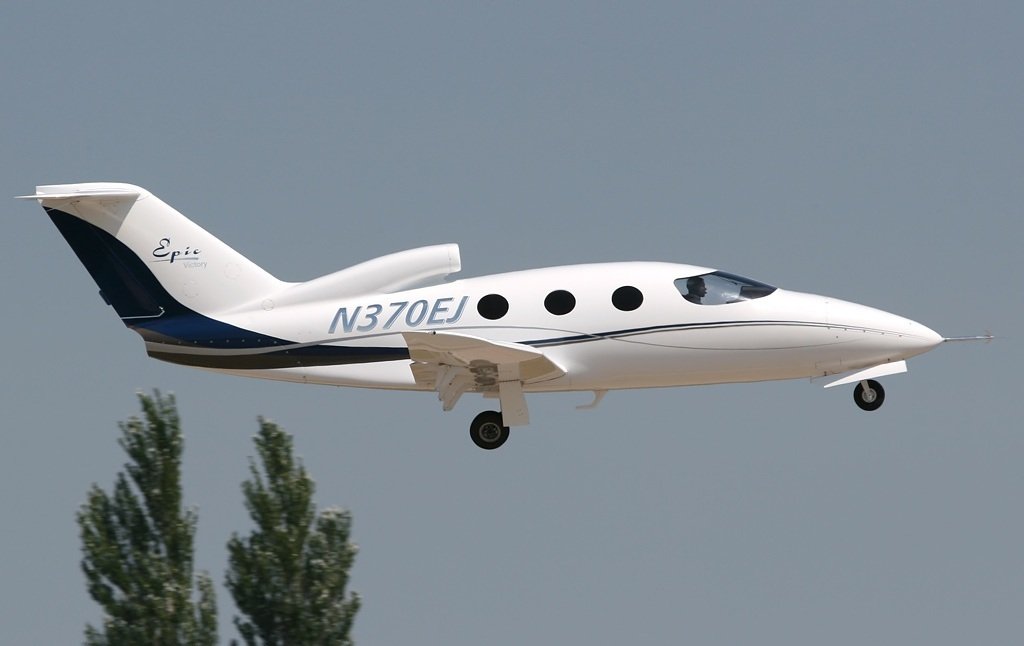
Development and Design Philosophy
The Epic Victory emerged from Epic Aircraft's ambitious vision to democratize jet aviation through affordable pricing and rapid development. Under CEO Rick Schrameck's leadership, the design team established aggressive targets: a $1 million price point, 365-knot cruise speed, and 1,200-nautical-mile range in a single-pilot aircraft. The project launched with unprecedented urgency, achieving first flight in just six and a half months—a record for clean-sheet jet development that highlighted both the team's capabilities and the pressures of the competitive very light jet market.
The Victory's configuration reflected practical owner-pilot priorities. Engineers arranged seating for one pilot plus three to four passengers in either 2+2 or 2+1+2 configurations, while the Garmin G1000 glass cockpit and S-TEC 5000 autopilot reduced single-pilot workload. Short-field performance capability, including 457-meter landing distance, addressed the reality that owner-pilots would operate from smaller airports than airline jets.
Flight Testing and Performance
The sole prototype, operating from Roberts Field in Redmond, Oregon, exceeded initial performance projections during its brief flight test program. Early flights demonstrated over 340 knots true airspeed, surpassing the 330-knot specification, while maintaining the ability to climb to 14,000 feet in under 10 minutes even at maximum weight. The aircraft accumulated 48 flight hours by April 2008, when Epic displayed it at the Sun 'n Fun airshow.
The Williams FJ33-4A turbofan proved capable during testing, though production aircraft were planned to use the Pratt & Whitney Canada PW600 series engine. Flight testing validated the concept of single-engine jet operations, with the prototype demonstrating takeoff capability within 10 minutes of engine start even with full fuel loads exceeding 408 kilograms.
The Manufacturer's Rise and Fall
Epic Aircraft, founded in 2004, represented the ambitious expansion of kit aircraft manufacturing into certified jets. The company initially succeeded with its Epic LT turboprop kit, achieving first delivery in 2006, before launching the Victory as its second experimental project. Based in Bend, Oregon, Epic operated an owner-assisted build center where customers could participate in aircraft assembly—a model that worked for simpler aircraft but proved challenging for jet-level complexity.
The 2008 financial crisis devastated the very light jet market just as Epic targeted 2009 certification for the Victory. By late June 2009, Epic declared bankruptcy, laid off staff, and scaled back operations dramatically. The company's legal troubles deepened when it sued Williams International in July 2009 over alleged engine supply defaults, highlighting the cascading effects of the market collapse.
Ownership Changes and Continued Legacy
Epic Aircraft's assets underwent multiple ownership changes following bankruptcy. In 2010, the Aviation Industry Corporation of China and LT Builders Group acquired the company with plans to restart Victory production, but these plans never materialized. Russian businessman Vladislav Filev, owner of S7 Airlines, purchased Epic through Cyprus-based MVF Key Investments Ltd in 2012. Most recently, Tanya Eves acquired majority ownership in 2024.
Despite the Victory's failure, Epic Aircraft survived and refocused on certified aircraft development. The company's E1000 turboprop, which first flew on December 19, 2015, achieved FAA certification in November 2019 and received production certification in July 2020. By 2024, Epic had delivered 80 E1000 aircraft, validating the market demand that the Victory had attempted to address through different means.
Technical Innovation and Market Reality
The Victory showcased several innovations that would influence later very light jet development. The integration of advanced avionics typically found in much larger aircraft, combined with single-pilot certification goals, pointed toward the democratization of jet aviation. The rapid prototyping approach, while impressive, also revealed the challenges of compressing traditional development timelines without compromising safety or certification requirements.
The project's failure illustrated the harsh realities of aircraft certification economics. While the prototype proved the aerodynamic and performance concepts, the path from flying prototype to certified production aircraft required resources that Epic's business model could not sustain during the market downturn.
Final Chapter
The Victory prototype was deregistered by the FAA on May 31, 2017, marking the formal end of the program. No examples survive in museums, and no additional aircraft were built beyond the single prototype. The Victory's legacy lives on primarily as a cautionary tale about the challenges of very light jet development and as a testament to the engineering capabilities of small aircraft manufacturers when market conditions align with ambitious visions.