
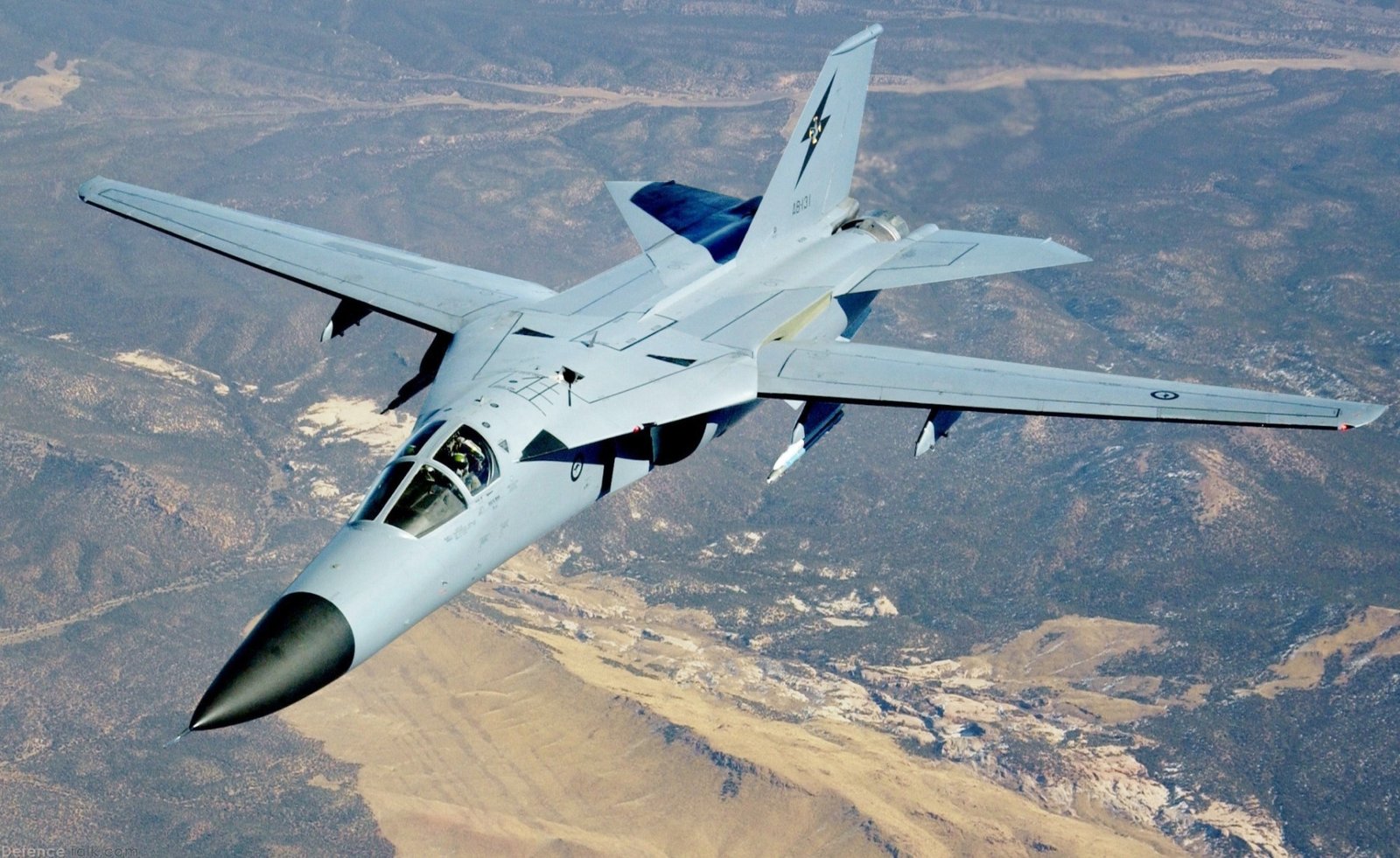
Revolutionary Design Philosophy
The F-111 emerged from Secretary of Defense Robert McNamara's ambitious attempt to create a single aircraft serving both Air Force tactical strike and Navy fleet defense requirements. General Dynamics won the hotly contested TFX (Tactical Fighter X) competition in February 1961, beating Boeing's proposal despite initial Navy preference for the Boeing design. The program's joint-service approach ultimately failed when the Navy's F-111B variant proved too heavy for carrier operations, leading to its cancellation in 1968 after only seven aircraft were built.
Groundbreaking Technologies
General Dynamics equipped the F-111 with three revolutionary systems that defined modern strike aircraft design. The variable-sweep wings automatically adjusted from 16 degrees for takeoff and landing to 72.5 degrees for supersonic flight, optimizing performance across all flight regimes. Twin Pratt & Whitney TF30 afterburning turbofans, producing up to 25,100 pounds of thrust each in later variants, powered the aircraft to speeds exceeding 1,650 mph. Most significantly, the terrain-following radar system enabled automatic low-level flight at 200 feet altitude and 600 mph, allowing the aircraft to penetrate enemy airspace beneath radar coverage.
Combat Proving Ground
The F-111's combat debut in Vietnam proved initially disastrous, with three aircraft lost during the first six missions in March 1968. However, after technical modifications, the aircraft returned for Operation Linebacker II in 1972, where it demonstrated exceptional effectiveness in nighttime precision strikes against heavily defended North Vietnamese targets. The F-111's true combat vindication came during Operation Desert Storm in 1991, when 110 aircraft flew nearly 5,000 sorties with zero losses. Armed with laser-guided bombs and equipped with Pave Tack targeting systems, F-111Fs destroyed more than 1,500 Iraqi tanks and armored vehicles in operations dubbed "tank plinking."
The Longest Fighter Mission
On April 14-15, 1986, F-111F aircraft participated in Operation El Dorado Canyon, the retaliatory strike against Libya that military historians consider the longest and most complex fighter mission ever flown. Eighteen F-111Fs from RAF Lakenheath flew 2,800 miles around France and Spain, conducted precision strikes on five Libyan targets, and returned safely to England after 13 hours airborne. The mission demonstrated the F-111's unique capability to deliver tactical firepower at strategic distances without forward basing or extensive tanker support.
Manufacturing Legacy
General Dynamics produced 566 F-111s at its Fort Worth, Texas facility between 1964 and 1976, with the final aircraft costing $10.3 million in 1973 dollars. The production run included 159 F-111As, 94 F-111Es, 106 F-111Fs, and 76 FB-111A strategic bombers, along with smaller numbers of specialized variants. When Lockheed Martin acquired General Dynamics' aerospace division in 1994, it inherited the F-111's technical legacy, which influenced design elements in subsequent aircraft including the F-22 Raptor's thrust vectoring and stealth characteristics.
International Operations
The Royal Australian Air Force operated 24 F-111Cs longer than any other service, from 1973 until December 3, 2010. Australian F-111s underwent extensive modifications including new avionics, improved engines, and structural upgrades that extended their service life beyond that of American aircraft. The RAAF used their F-111s primarily for long-range maritime strike and reconnaissance missions across the vast Pacific theater, taking advantage of the aircraft's 3,200-mile range and ability to carry Harpoon anti-ship missiles.
Technical Supremacy
Powered by Pratt & Whitney TF30 engines generating 18,500 to 25,100 pounds of thrust depending on variant, the F-111 achieved a service ceiling of 66,000 feet and climb rates exceeding 25,000 feet per minute. The aircraft's internal weapons bay carried up to 31,500 pounds of ordnance, including nuclear weapons, conventional bombs, or specialized munitions. Advanced systems included side-by-side crew seating in a detachable escape module, computerized flight controls, and inertial navigation systems that provided unprecedented accuracy for 1960s technology.
Final Chapter
The United States Air Force retired its last F-111F in 1996 and final EF-111A electronic warfare variant in 1998, replaced by F-15E Strike Eagles and specialized electronic warfare aircraft. Australia's final F-111 flight occurred on December 3, 2010, when aircraft A8-125 landed at RAAF Amberley, ending 46 years of operational service. Today, surviving F-111s are preserved in museums worldwide, including the National Museum of the United States Air Force and Australia's Aviation Heritage Museum, where they represent a pivotal chapter in military aviation's technological evolution.