
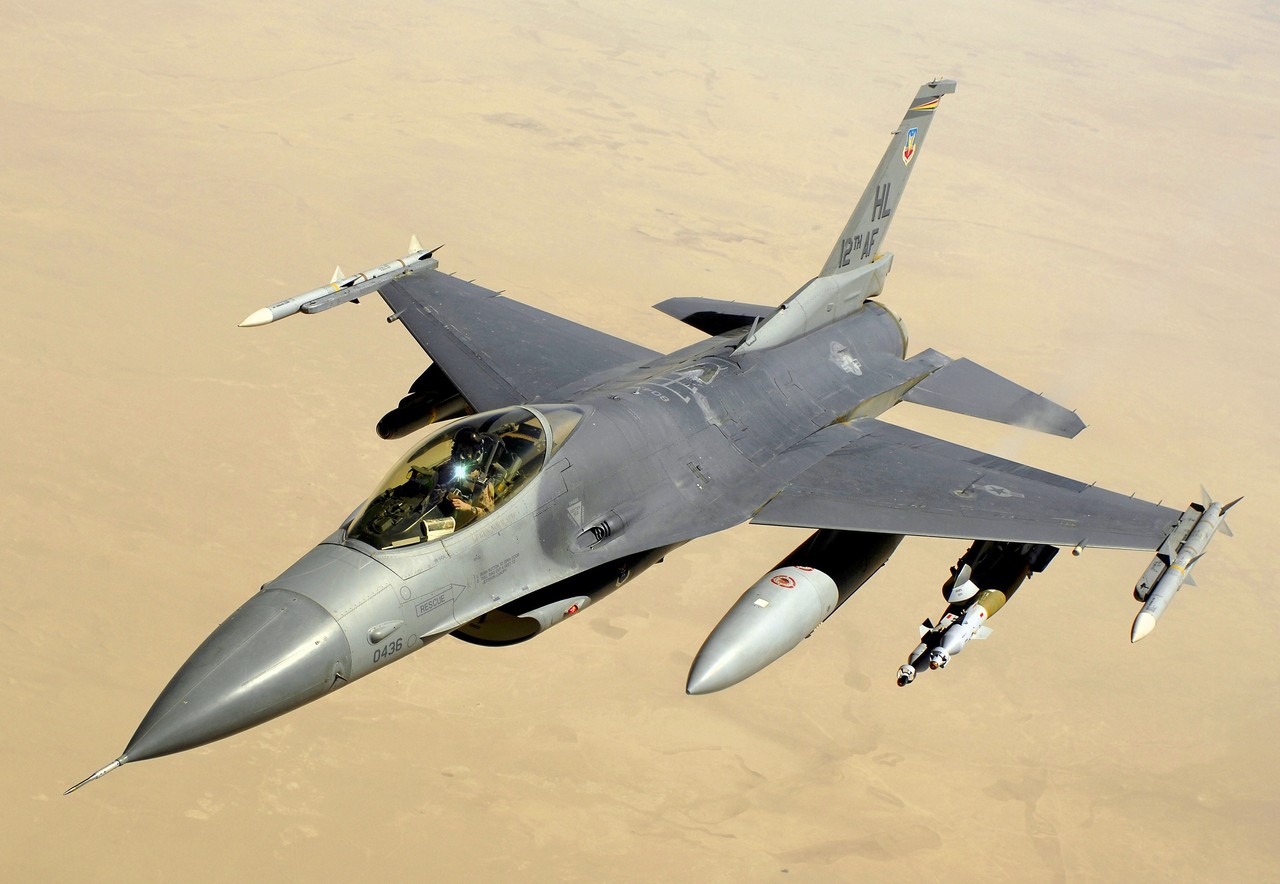
Service History
The F-16D entered operational service with the United States Air Force on October 1, 1980, when the 34th Tactical Fighter Squadron of the 388th Tactical Fighter Wing at Hill Air Force Base, Utah, received its first aircraft. What began as a lightweight day fighter had evolved into the backbone of modern air forces worldwide. By the program's peak, over 4,600 F-16s of all variants served with more than 30 nations, making it the most widely exported American fighter aircraft in history.
The two-seat F-16D variant proved indispensable both as an advanced trainer and operational combat aircraft. Unlike many trainer variants that sacrifice capability for instruction, the F-16D maintained full combat effectiveness while providing the essential second seat for training new pilots or accommodating specialized mission roles.
Combat Operations
The F-16D has participated in virtually every major conflict since the 1990s. During the Gulf War of 1991, F-16s flew more sorties than any other coalition aircraft, establishing the type's reputation for reliability and versatility. Throughout the Balkan conflicts of the 1990s and the extended operations in Iraq and Afghanistan during the 2000s, the F-16D demonstrated its evolution from pure air superiority fighter to true multirole platform, executing air-to-air intercepts, close air support, and reconnaissance missions with equal proficiency.
The European Participating Air Forces program showcased international cooperation, with Belgium ordering 116 aircraft, Denmark 58, the Netherlands 102, and Norway 72 in June 1975. These nations received their first aircraft between January 1979 and 1980, establishing a standardized training and operational framework that enhanced NATO interoperability.
The Manufacturer Legacy
General Dynamics developed the F-16 under the leadership of Robert H. Widmer and his engineering team, beginning with the Lightweight Fighter program in 1974. The company's Fort Worth, Texas facility became the epicenter of one of aviation's greatest success stories, economically revitalizing the region through the 1970s and beyond.
General Dynamics' aircraft division operated until 1993, when the company sold the F-16 program to Lockheed Corporation. Following Lockheed's merger with Martin Marietta in 1995, the program continued under Lockheed Martin. Production shifted from Fort Worth to Greenville, South Carolina, in 2019, with the final Fort Worth-built F-16 delivered on November 14, 2017. Remarkably, production resumed in Greenville in 2023, demonstrating the enduring demand for this proven design.
Engineering Excellence
The F-16D's powerplant, the Pratt & Whitney F100-PW-100 turbofan, represented cutting-edge technology when introduced. The same engine that powered the F-15 Eagle provided the smaller F-16 with exceptional thrust-to-weight ratio and reliability. This engine choice proved so successful that it became the foundation for numerous variants throughout the F-16's production life.
The aircraft's most revolutionary feature was its fly-by-wire flight control system, making it the first production fighter to employ this technology. Combined with relaxed static stability, this system allowed the F-16D to achieve supermaneuverability that was impossible with conventional controls. The aircraft could sustain 9g maneuvers even with full fuel load, a capability that provided decisive advantages in air combat.
Pilot Experience
Test pilot Phil Oestlicher's early assessment captured the F-16's exceptional qualities, praising the prototype's handling characteristics with enthusiasm. The aircraft's reputation among pilots stems from its responsive controls and forgiving flight characteristics, making it both an excellent trainer and a formidable combat aircraft.
The F-16D's performance specifications include supersonic capability and a service life designed for 8,000 hours of operation, double the original 4,000-hour requirement. This extended operational life reflected the aircraft's robust construction and the military's recognition of its long-term value.
Production Achievement
Manufacturing occurred at multiple locations to meet global demand. The primary production line at General Dynamics' Fort Worth facility delivered 3,640 aircraft, while European co-production lines contributed significantly: SABCA in Belgium built 164 aircraft, and Fokker in the Netherlands produced 184. This international manufacturing approach not only met delivery requirements but also strengthened political and military partnerships.
Modern production continues with international partnerships, including wing manufacturing by Tata Advanced Systems in India since 2021, demonstrating the program's evolution into a truly global enterprise.
Enduring Legacy
The F-16D remains in frontline service with air forces worldwide, with the U.S. Air Force planning to operate the type until at least 2025. Current backlogs include orders from Morocco, Turkey, and Iraq, ensuring production will continue well into the future. The YF-16 prototype number 2, tail number 72-01568, is preserved at the Fort Worth Aviation Museum in Texas, serving as a testament to this remarkable aircraft's origins and lasting impact on military aviation.