
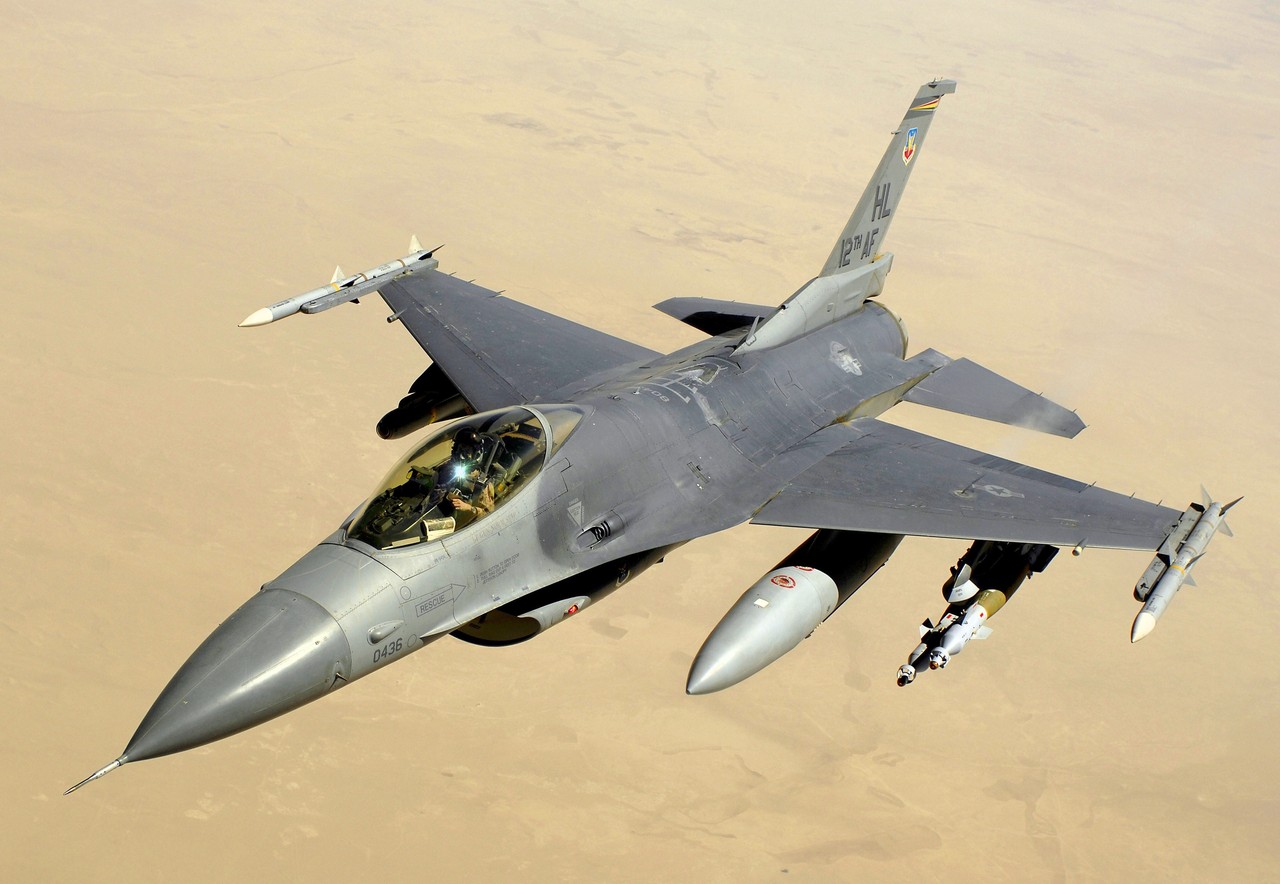
Service History and Global Impact
The F-16 Fighting Falcon achieved unprecedented international success, with deliveries to 26 nations worldwide making it one of the most widely exported fighter aircraft in history. Since entering USAF operational service on October 1, 1980, with the 34th Tactical Fighter Squadron at Hill Air Force Base in Utah, the F-16 has evolved from its original air superiority role into a versatile multirole platform. With over 4,600 aircraft produced since 1976, the Fighting Falcon has dominated the lightweight fighter market for nearly five decades.
Origins and the Lightweight Fighter Mafia
The F-16's development stemmed from a revolutionary concept championed by the "Lightweight Fighter Mafia," a group of military analysts and engineers who advocated for small, lightweight, low-cost fighters optimized for air superiority. This philosophy directly challenged the prevailing trend toward larger, more complex aircraft. Robert H. Widmer led the General Dynamics engineering team that transformed this vision into reality through the 1972 USAF Lightweight Fighter prototype program.
The first YF-16 prototype rolled out on December 13, 1973, and completed its maiden flight on February 2, 1974, at Edwards Air Force Base, California. Following a competitive evaluation against Northrop's YF-17, the F-16 was declared winner of the Air Combat Fighter competition in 1975. The first production F-16A flew on December 8, 1976, and was delivered to the USAF on January 6, 1979.
International Production and European Partnership
The F-16 program established a groundbreaking international manufacturing arrangement through the Multinational Fighter Program Group. In June 1975, Belgium ordered 116 aircraft, Denmark 58, the Netherlands 102, and Norway 72 F-16s. European co-production officially commenced on July 1, 1977, with Fokker in the Netherlands producing 184 aircraft and a Belgian facility manufacturing 164 units.
Production at General Dynamics' Fort Worth facility continued for 40 years until the final aircraft was delivered to the Iraqi Air Force on November 14, 2017. Lockheed Martin, which acquired the F-16 program when it purchased General Dynamics' aircraft division in 1993, resumed production in 2019 at its Greenville, South Carolina plant, with the first aircraft completing final assembly in 2023.
Engineering Excellence and Design Innovation
General Dynamics engineers designed the F-16 airframe to withstand 8,000 flight hours and 9-g maneuvers on full internal fuel, significantly exceeding the Lightweight Fighter program's requirements of 4,000 hours and 7.33-g capability. This conservative approach proved prescient as the aircraft's mission expanded far beyond its original air-to-air role. The F-16's revolutionary fly-by-wire flight control system and relaxed static stability configuration provided unprecedented maneuverability and pilot responsiveness.
Powerplant and Performance
The F-16 is powered by a single Pratt & Whitney F100-PW-200 turbofan engine producing 23,830 pounds of thrust with afterburner. This powerplant enables the Fighting Falcon to achieve a maximum speed of Mach 2.05 (1,345 mph) and reach a service ceiling of 55,000 feet. The aircraft's thrust-to-weight ratio exceeds 1:1, allowing vertical climbs and exceptional acceleration characteristics that have made it a favorite among pilots worldwide.
Operational Variants and Continued Evolution
The F-16C/D variant, which first flew on June 19, 1984, became the most numerous version with 2,206 aircraft produced. These improved models achieved initial operational capability in phases: Block 25-32 variants in 1981, Block 40/42 in 1989, and Block 50/52 in 1994. Each block incorporated progressive improvements in avionics, weapons systems, and structural enhancements.
Legacy and Museum Preservation
The U.S. Air Force Thunderbirds aerobatic demonstration team adopted the F-16 in 1982, replacing their T-38 Talons and showcasing the fighter's exceptional handling qualities to millions of spectators. One of the original Thunderbirds F-16s (serial number 81-0663) is now preserved at the 477th Fighter Group museum.
Notable museum examples include an F-16A at Hill Aerospace Museum in Utah, delivered in November 1980, and an F-16B at Pima Air & Space Museum. These preserved aircraft represent important milestones in the F-16's operational history and continue to educate visitors about this remarkable fighter's contributions to modern aviation.
Although originally scheduled for retirement around 2025 as the F-35 Lightning II assumes many of its roles, the F-16 continues in production with international orders from Morocco, Turkey, and Iraq ensuring the Fighting Falcon's legacy extends well into the 21st century.