
Production and Manufacturer History
The Brewster F2A Buffalo was designed and produced by the Brewster Aeronautical Corporation, a company that evolved from Brewster & Co., a carriage and wagon builder. By 1932, the firm had transitioned into automobile body and aircraft part manufacturing, establishing the Brewster Aeronautical Corporation as its aviation division. Operating from a factory in the Long Island City section of Queens, New York City, Brewster became a prime contractor for the U.S. Navy in the mid-1930s. Between 1938 and 1941, approximately 503 Buffaloes were built, consisting of 163 aircraft for the United States and roughly 340 for Allied and foreign orders. Despite its early promise, Brewster became notorious for mismanagement and production delays, leading to increased Navy supervision and the company's eventual dissolution by the end of World War II.
Design and Technical Specifications
Originating from a 1935 U.S. Navy requirement to replace the Grumman F3F biplane, the F2A was a modern, all-metal, mid-wing monoplane featuring stressed-skin construction, an enclosed cockpit, and retractable landing gear. The prototype, designated XF2A-1, first flew on December 2, 1937, and was selected for production in June 1938. To facilitate carrier operations, the aircraft was equipped with an arrestor hook, catapult fittings, and strengthened landing gear.
Powerplants varied by model, though all utilized Wright radial piston engines. The F2A-1 used the Wright R-1820-34 (950 hp), while the F2A-2 was upgraded to the Wright R-1820-40, producing 1,200 hp. The F2A-2 reached a maximum speed of 323 mph at 16,500 feet and had a service ceiling of 33,200 feet. Armament typically evolved from a mix of .50 and .30 caliber guns to a standard fit of four .50 caliber Browning M2 machine guns in later U.S. Navy variants.
Military Service
The Buffalo entered U.S. service in April 1939, with VF-3 becoming the first operational squadron aboard the USS Saratoga (CV-3). However, the aircraft's reputation diverged sharply by operator. In U.S. and British service, the Buffalo was badly outclassed by Japanese aircraft, such as the A6M Zero. During the Battle of Midway on June 4, 1942, Marine squadron VMF-221 operated 20 F2As and several Wildcats; the Buffaloes suffered heavy losses, including 13 aircraft, while attempting to intercept Japanese dive bombers and fighters. Consequently, the U.S. Navy withdrew the type from front-line service by September 1942.
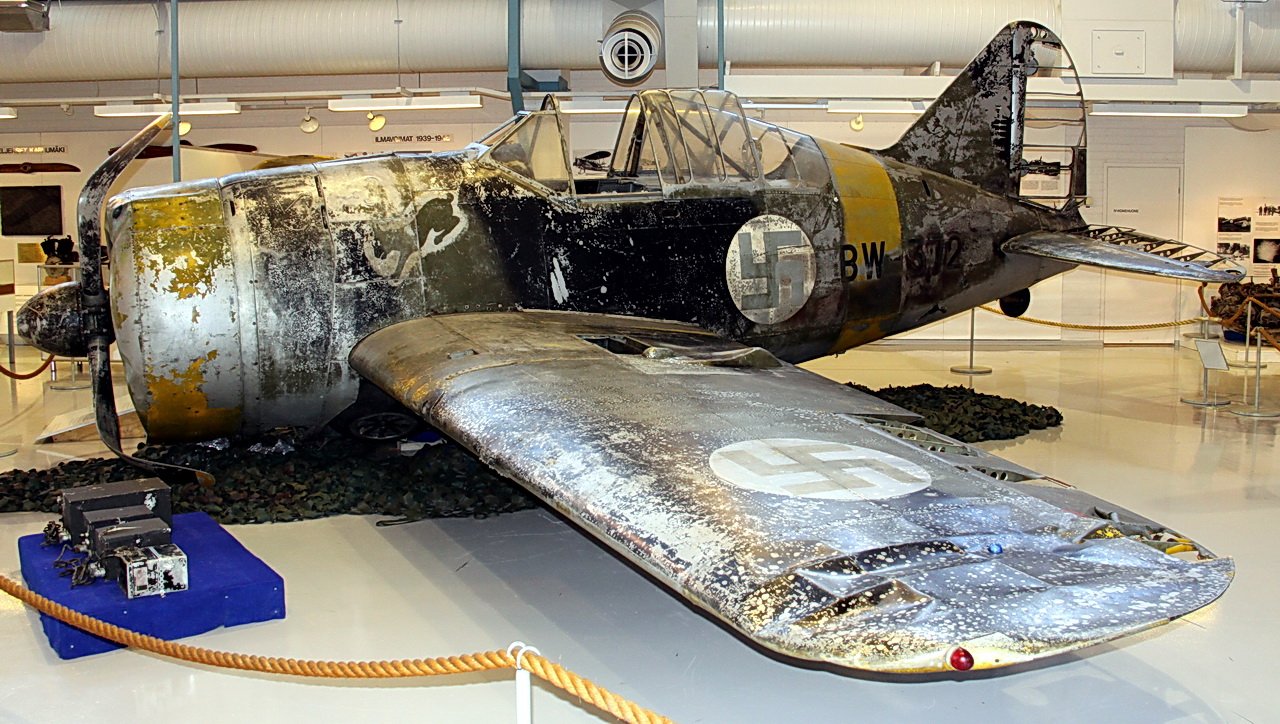
Conversely, the Finnish Air Force achieved remarkable success with the B-239 (a de-navalized F2A-1). During the Continuation War (1941–1944), Finnish pilots claimed 32 Soviet aircraft for every B-239 lost, producing 36 aces. Other operators included the RAF and RAAF in Malaya, Singapore, and Burma, as well as the Belgian and Dutch air forces, though most of these units suffered heavy losses against Japanese forces.
Legacy
No American-built F2As survived the war, though a recovered wreck of an F2A-3 was located at Midway by NOAA divers in 2012. A Finnish B-239 remains preserved in Finland. The Buffalo is remembered as a symbol of rapid technological obsolescence and as a cautionary tale of industrial mismanagement, while simultaneously being honored in Finland as a highly effective combat aircraft.