
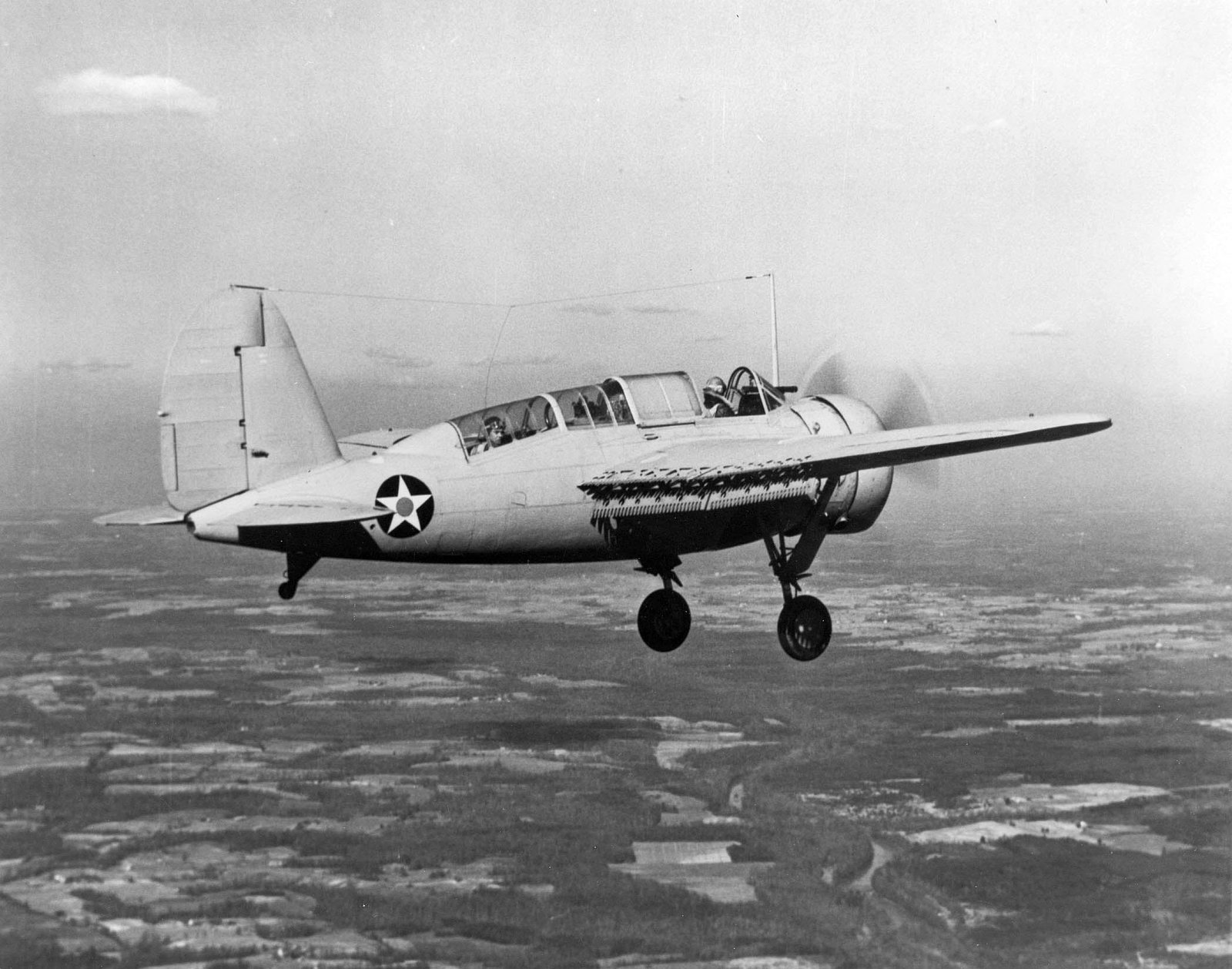
The Brewster SBN, originally designated as the SBA-1 and produced as the SBN-1, was a three-seat scout-bomber and torpedo bomber developed for the United States Navy. The aircraft was designed by R. (Ralph) A. M. Brown, who led early naval designs for the Brewster Aeronautical Corporation. The prototype, known as the XSBA-1 (BuNo 9726), first flew in 1936. Its design featured several modern advancements for the era, including an all-metal mid-wing monoplane configuration, enclosed cockpits for the crew, and retractable landing gear with geometry similar to the F2A Buffalo fighter. To facilitate dive-bombing, the aircraft was equipped with dive-brakes and perforated flaps, although its non-folding wings proved to be a disadvantage for carrier storage.
While Brewster developed the design, the company's facilities were overcommitted to other projects. Consequently, the U.S. Navy assigned production to its own Naval Aircraft Factory (NAF) in Philadelphia, Pennsylvania. NAF produced 30 SBN-1 aircraft (BuNos 1522–1551) between November 1940 and March 1942. Including the prototype, a total of 31 aircraft were built. The SBN-1 was powered by a single 9-cylinder, air-cooled Wright XR-1820-22 radial piston engine, which delivered 950 horsepower. This powerplant enabled a maximum speed of 254 mph, a service ceiling of 28,300 feet, and a range of 1,015 miles.
Despite its technical specifications, the SBN-1 was effectively obsolete upon entering fleet service. It saw limited front-line employment, serving with Bombing Squadron 3 (VB-3) aboard the USS Saratoga (CV-3) and Torpedo Squadron Eight (VT-8). Some aircraft were later used as trainers aboard the USS Hornet (CV-8). The aircraft never saw combat during World War II and was declared "limited standard" by August 1942, leading to its removal from service due to obsolescence and a lack of spare parts.
The SBN's legacy is tied to the broader failures of the Brewster Aeronautical Corporation, which suffered from corruption, labor disputes, and poor management. The company was eventually seized by the Navy and formally dissolved on April 5, 1946. No production SBN-1 aircraft survived; most were sold for scrap. The XSBA-1 prototype remained in use as a NACA test aircraft for aerodynamic fairings until 1945, but it also did not survive.