
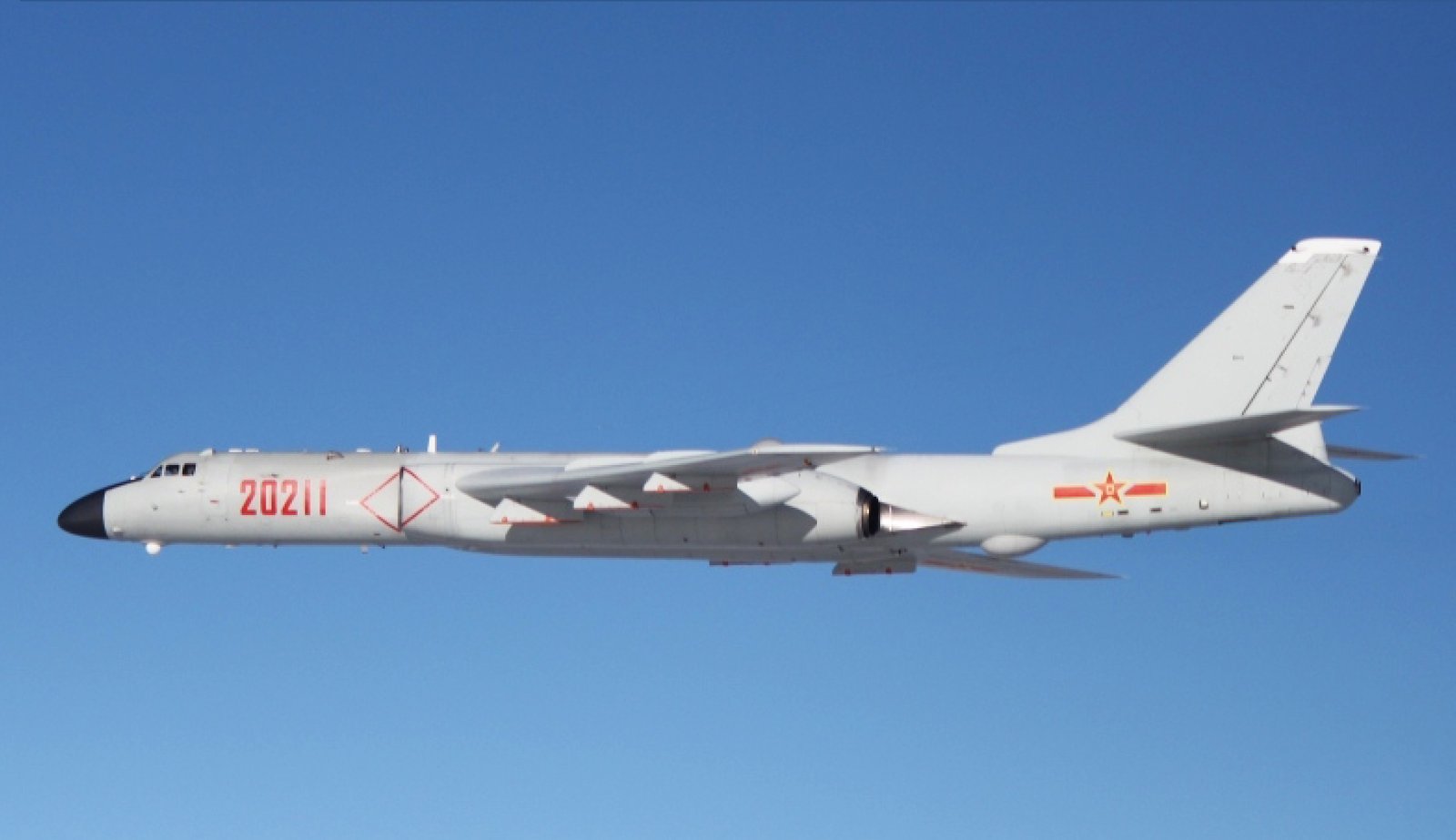
Production and Manufacturer History
The Xi'an H-6 is a license-built version of the Soviet Tupolev Tu-16 twin-jet bomber. While the first Chinese-assembled aircraft flew in 1959, domestic production at the Xi'an Aircraft Industrial Corporation (XAC) officially began in 1968. Manufacturing continued with various upgraded versions into the 1990s, and modernized variants such as the H-6K, H-6J, and H-6N remain in production today. Although official Chinese production totals are not public, Western reference works estimate that between 160 and 180 units were built, with 175 often cited as a representative figure. Production took place in the Yanliang District of Xi'an, Shaanxi, China. The manufacturer now operates as AVIC Xi'an Aircraft Industry Group Co. Ltd., a subsidiary of the state-owned Aviation Industry Corporation of China (AVIC).
Design and Technical Specifications
The base airframe was originally designed by the Tupolev Design Bureau under Andrei N. Tupolev. While the original design was a Soviet product, Xi'an Aircraft implemented significant localized redesigns over the decades to modernize the platform. Early models utilized two turbojet engines, whereas the modern H-6K variant is powered by two Russian D-30KP-2 turbofan engines. The aircraft is capable of reaching maximum speeds of approximately 650 mph and possesses a range of roughly 3,700 nautical miles. Its maximum bomb payload is estimated at 20,000 lb.
Military Service and Role
The H-6 has served as the backbone of the People's Liberation Army Air Force (PLAAF) and the People's Liberation Army Naval Air Force (PLANAF). Its roles have evolved from a strategic nuclear and conventional bomber to a maritime strike platform and an aerial refueling tanker (HY-6 and HY-6D). Notably, the H-6 provided China with its first air-delivered nuclear capability, with a nuclear test conducted on May 14, 1965. Modern variants like the H-6N are specifically assigned nuclear weapons, including JL-1 air-launched ballistic missiles, and are operated by the 106th Air Brigade at Neixiang. Beyond China, the aircraft was exported to Egypt, where it was retired by 2000, and Iraq, which operated four aircraft that were destroyed during the 1991 Persian Gulf War.
Legacy
Despite its 1950s origins, the H-6 remains a critical asset for China's regional power projection. Through continuous updates to avionics and the integration of long-range cruise missiles, it has maintained operational relevance for over five decades. Current estimates suggest China still operates at least 120 H-6 aircraft, serving as a bridge until the future H-20 stealth bomber is fully fielded.