
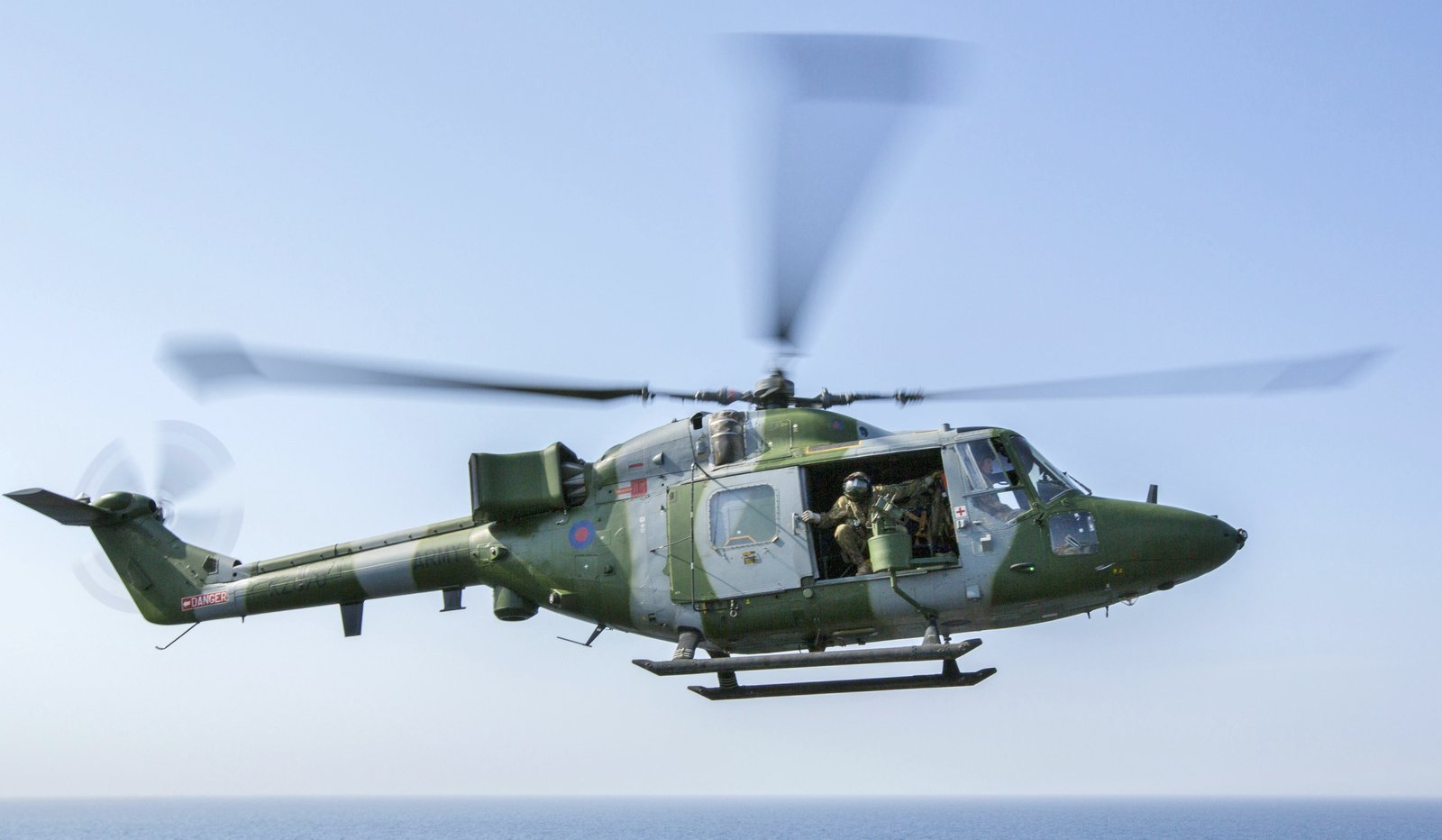
The Westland Lynx is a British-designed, twin-engine, multi-purpose military helicopter that originated from a development program between the 1960s and 1970s. Initially designated as the Westland WG.13, the aircraft was developed as an Anglo-French utility helicopter through cooperation with Aérospatiale, although the design and construction were led by Westland Helicopters at their factory in Yeovil, Somerset, UK. The prototype first flew on March 21, 1971, and the aircraft officially entered operational service in 1977 for both Army and Navy variants.
Technically, the Lynx is powered by two Rolls-Royce Gem turboshaft engines, each producing 835 kW. This high-performance configuration allowed the aircraft to set world speed records in 1972, achieving 321.74 km/h (199.9 mph) over 15 and 25 km distances, as well as a 100 km closed-circuit record. The airframe was designed for versatility, leading to specialized variants such as the Lynx AH.1, which entered service with the British Army Air Corps in 1979 for tactical transport and anti-tank roles utilizing eight TOW missiles. Naval variants, such as the HMA.8, were optimized for anti-submarine warfare and anti-ship missions, notably employing Sea Skua missiles.
Throughout its service history, the Lynx has been utilized by the armed forces of more than a dozen nations, including the German Navy and the Royal Netherlands Navy (specifically the Mk.25). It saw significant combat during the 1982 Falklands War, where three aircraft were lost aboard ships hit by Argentine attacks. In the 1991 Gulf War, the Lynx played a prominent role using Sea Skua missiles against the Iraqi Navy. Other notable operations include the rescue of 11 British soldiers during Operation Barras in Sierra Leone in 2000 and participation in the 2003 invasion of Iraq. On May 6, 2006, a Lynx from No. 847 Naval Air Squadron was shot down over Basra, Iraq, resulting in the deaths of all five personnel on board.
Production of the original Lynx family began in 1977, with approximately 450 units built as of 2009. While the precise final production year is not explicitly documented in available sources, production shifted toward the modernized AW159 Wildcat by the 21st century. The legacy of the Lynx continues through the AW159 Wildcat, which is intended to replace the Lynx in UK service.