
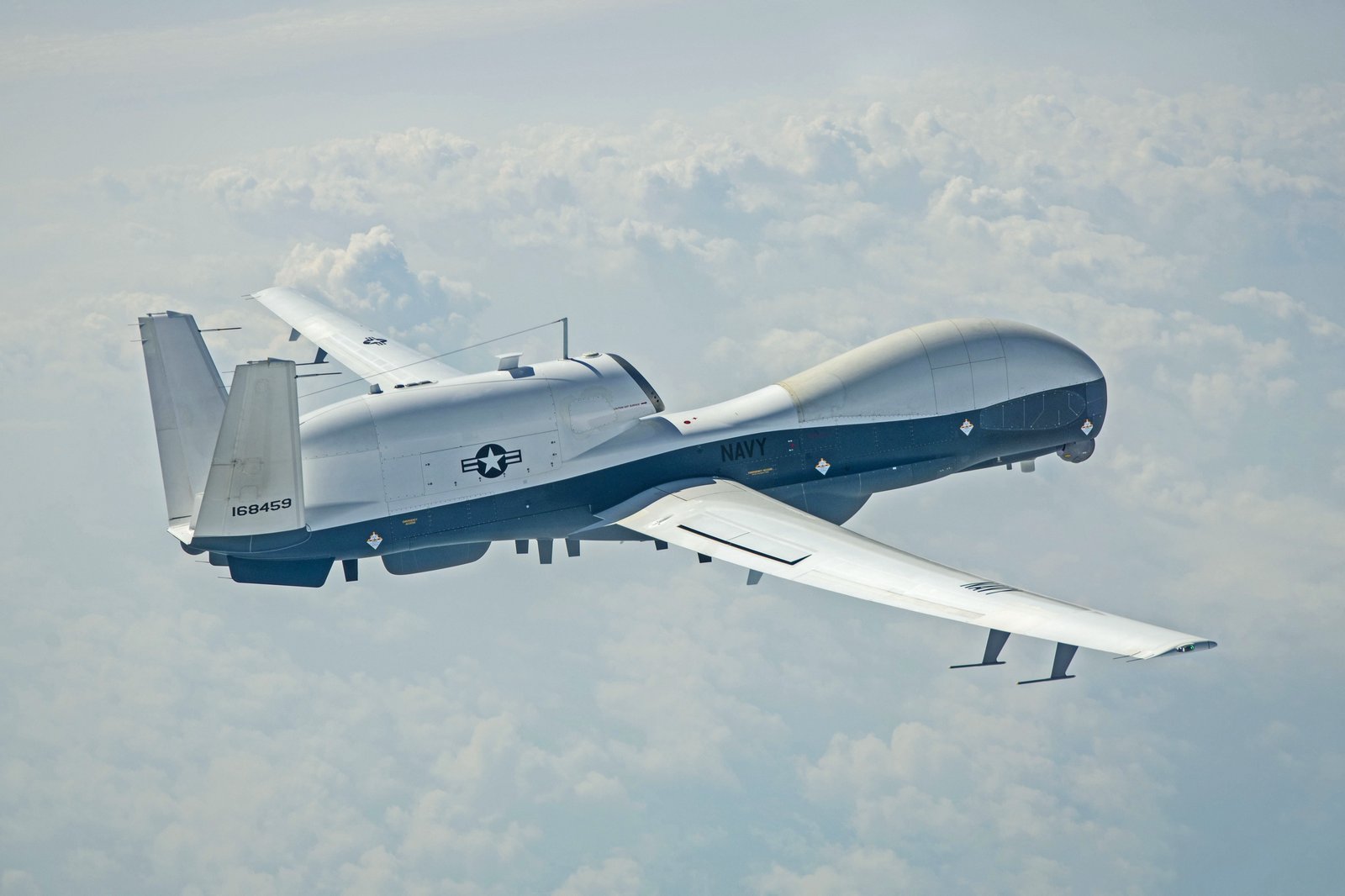
The Northrop Grumman MQ-4C Triton is a high-altitude, long-endurance (HALE) unmanned aircraft system developed under the Broad Area Maritime Surveillance (BAMS) program. Derived from the RQ-4 Global Hawk, the Triton was specifically optimized for maritime intelligence, surveillance, and reconnaissance (ISR), distinguishing it from its land-focused predecessors. The aircraft's first flight took place on May 22, 2013, at Palmdale, California.
Production of the MQ-4C began in the mid-2010s and continues into the present, with final assembly and flight testing conducted at Northrop Grumman's Palmdale, California facility. As of mid-2025, 20 production aircraft have been built for the U.S. Navy. While earlier BAMS concepts suggested a procurement of up to 68 aircraft, the current U.S. Navy program of record specifies a planned purchase of 27 aircraft. Additionally, the Royal Australian Air Force (RAAF) has begun receiving deliveries following flight testing of its first airframes.
Technically, the Triton is powered by a single Rolls-Royce AE 3007 high-bypass turbofan engine, producing between 6,495 and 8,917 lbf of thrust. The aircraft features a massive 131-foot wingspan, a length of 47.6 feet, and a gross weight of 32,250 lb. It is capable of operating at altitudes above 50,000 feet (with a service ceiling of 56,000 feet) for over 24 hours, boasting a range of 7,400 to 8,200 nautical miles and a maximum speed of 357 mph.
In military service, the U.S. Navy's Unmanned Patrol Squadron 19 (VUP-19), based at NAS Jacksonville, operates the platform with detachments in Guam. The aircraft has evolved through Integrated Functional Capability (IFC) baselines. The IFC-3 configuration provided early operational capability, while the IFC-4 multi-intelligence configuration enables the Triton to perform signals intelligence (SIGINT) and targeting, eventually replacing the manned EP-3E Orion. Although the Navy declared Initial Operational Capability (IOC) in 2018, a 2024 DoD Inspector General report noted that this occurred before the completion of Initial Operational Test and Evaluation (IOT&E). The U.S. Navy intends to deploy the Triton across five global orbits to maintain persistent maritime domain awareness.