
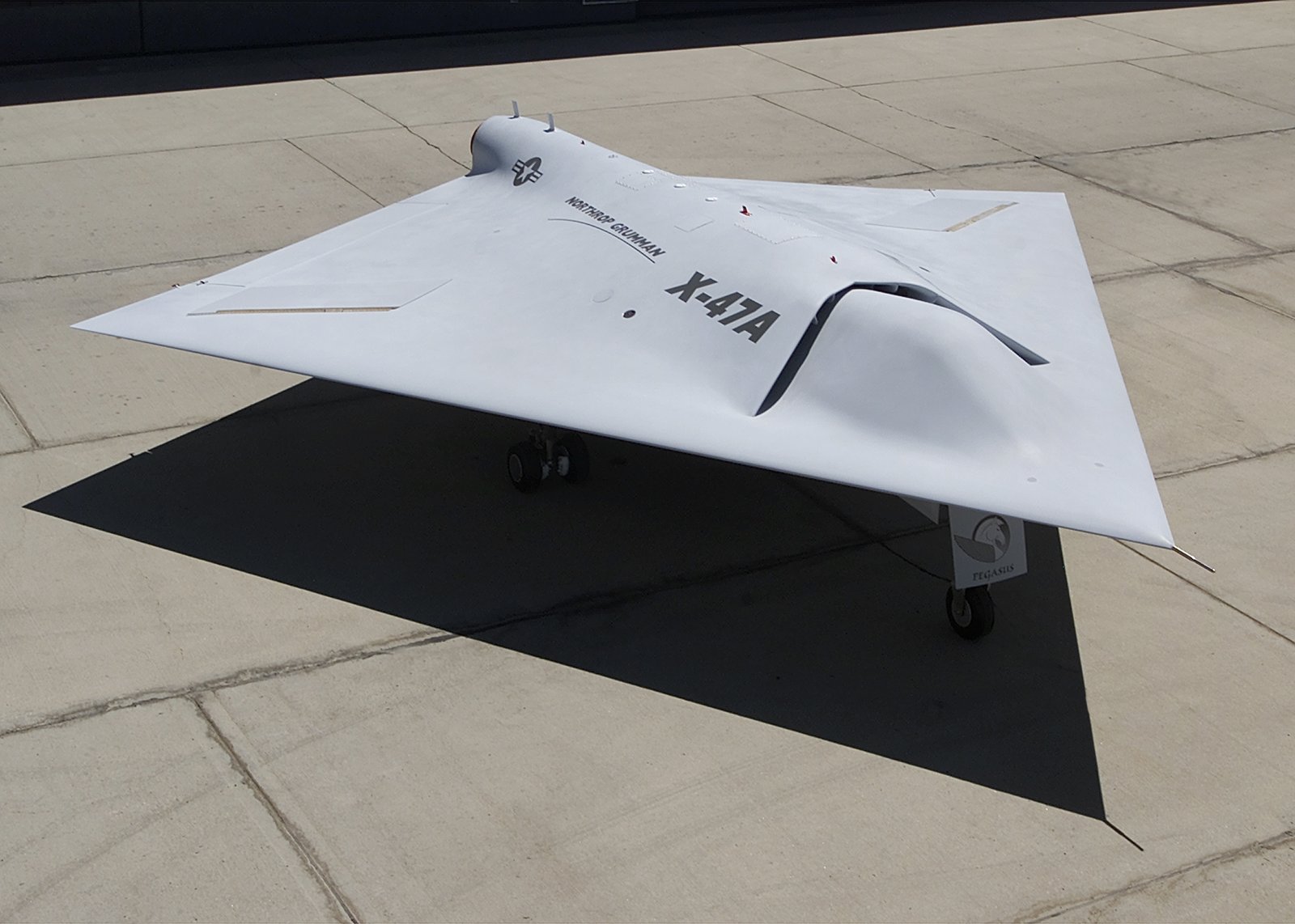
The Northrop Grumman X-47A Pegasus was a privately funded, subsonic unmanned combat air vehicle (UCAV) technology demonstrator developed to support the DARPA and U.S. Navy UCAV-N (Unmanned Combat Air Vehicle – Naval) effort. The program began as an internal Northrop Grumman initiative in 2000, aimed at rapidly prototyping a stealthy, carrier-capable aircraft. The X-47A was designed by the Air Combat Systems business area of Northrop Grumman Integrated Systems in El Segundo, California, while the airframe was fabricated by Scaled Composites in Mojave, California. Highlighting the goal of rapid development, Scaled Composites completed the airframe in just 12 months and 12 days, with the aircraft officially rolling out on July 30, 2001.
Designed as a "kite-shaped" or diamond planform flying wing, the X-47A utilized composite construction to reduce both weight and radar signature. This specific geometry was chosen to redirect radar energy, enhancing the aircraft's stealth characteristics. The vehicle was equipped with two internal weapons bays capable of holding 500-lb class bombs, although no weapons were released during its flight-test program. The X-47A was powered by a single Pratt & Whitney JT15D-5C non-afterburning turbofan engine, producing between 3,190 and 3,200 lbf of thrust.
The X-47A performed its first flight on February 23, 2003, at the U.S. Naval Air Warfare Center in China Lake, California. Throughout a flight-test program that ran from 2003 to 2006, the aircraft focused on autonomous navigation and low-speed flying qualities essential for aircraft carrier approaches. It specifically tested automatic carrier landing system capabilities and simulated arrestment. While the X-47A never entered operational combat service, it provided the technical foundation for the larger X-47B, which later achieved the first autonomous arrested landing on an aircraft carrier (USS George H.W. Bush) and the first autonomous in-flight refueling.
Technically, the X-47A measured 8.50 meters in length with a wingspan of 8.47 meters. It had an empty weight of approximately 3,835 to 3,836 lb and a maximum takeoff weight of up to 5,903 lb. The sole airframe produced is currently preserved and on display at the Patuxent River Naval Air Museum in Maryland.