
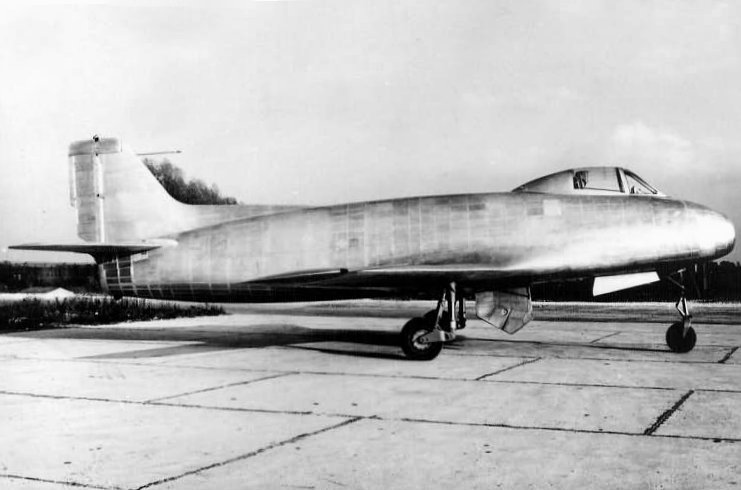
The Nord Aviation Nord 2200 was developed to satisfy a French Navy (Aéronavale) requirement issued on March 29, 1946, for a high-performance, shipboard jet interceptor. Designed as France's first indigenous attempt at a carrier-based jet fighter, the aircraft was built by Nord Aviation (formally Société nationale de constructions aéronautiques Nord). The prototype first flew on December 16, 1949, marking a significant step in the transition from piston-engine naval aviation to the jet era.
Technically, the Nord 2200 was a single-seat aircraft characterized by a low-mounted wing with a sweep of approximately 24°. Its aerodynamic design featured an oval nose intake that fed a single license-built Rolls-Royce Nene 102 turbojet, which produced 22.2 kN of thrust. To facilitate carrier operations, the aircraft was equipped with tricycle landing gear, an arrestor hook, and dive brakes. Notably, the design incorporated an all-moving horizontal stabilizer, which was an advanced feature for French aircraft of that period. The fuselage was constructed in three modular sections, allowing the entire rear portion to be removed for easier engine maintenance. For pilot safety, the aircraft included an armored cockpit and an ejection seat.
Although the prototype demonstrated good handling, its performance was insufficient to meet the original naval requirements. During testing, it reached a maximum speed of approximately 815 km/h (roughly 506 mph), which was considered too slow for contemporary naval fighter standards. The program also suffered a setback during the 1950 Paris Air Show when a fuel cap was left off, causing kerosene to be ingested into the intake and resulting in a serious fire. Despite subsequent repairs and trials involving rocket-assisted takeoff (RATO) units, the French Navy ultimately selected the de Havilland Sea Venom for production.
Only one Nord 2200 was ever built, and it never entered series production. The aircraft continued flight testing until June 1954, when it made its final flight. Following its retirement, the airframe was stripped of its equipment and utilized as a gunnery target. While no complete aircraft survives, partial remains of the airframe were recovered in the 1980s and are stored at the Musée de l’Air et de l’Espace (also known as the museum at Le Bourget or Musée aéronautique de Montblanc).