
Military Dominance
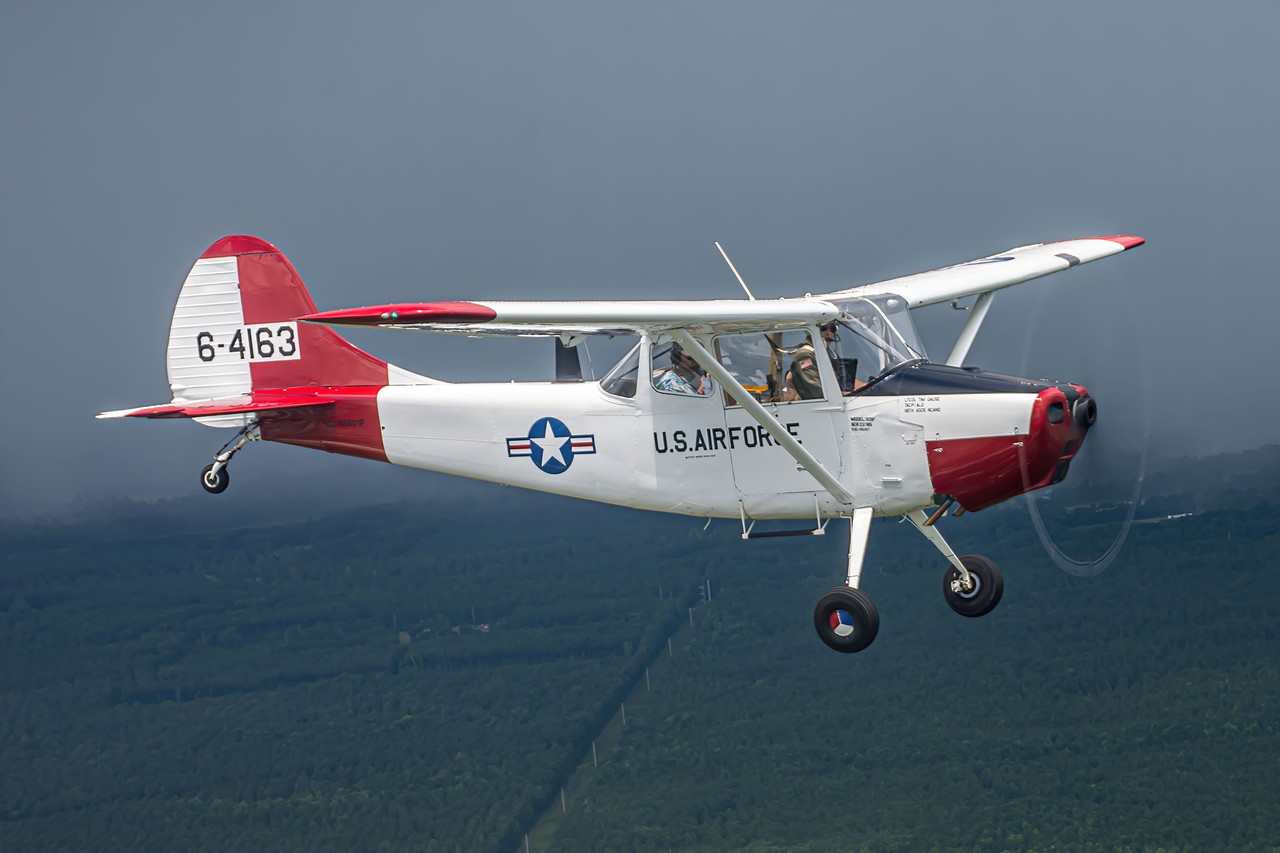
The O-1 Bird Dog achieved unprecedented success in military observation roles, with the U.S. Army alone accepting 3,105 aircraft. By October 1954, Cessna had delivered 2,486 units, making it the most numerous observation aircraft in American military service. The type's dominance extended beyond the United States—Japan's Air Self-Defense Force operated the aircraft from 1954 to 1978, while France employed Bird Dogs during the Algerian conflict beginning in 1957.
Combat Service
The Bird Dog earned its reputation during two major conflicts. In Korea, small numbers provided crucial observation and liaison services from 1950 to 1953. However, Vietnam marked the aircraft's finest hour, where U.S. Air Force forward air controllers flew O-1s extensively from 1964 to 1971. These missions proved exceptionally dangerous, with Bird Dog pilots flying low and slow to mark targets for faster strike aircraft. The aircraft's ability to operate from crude forward airstrips made it invaluable for close support operations.
The military developed numerous variants to meet specific mission requirements. The original L-19A (redesignated O-1A in 1962) formed the backbone of the fleet with 2,486 built. The U.S. Marine Corps operated the O-1B variant, while 307 TL-19D trainers entered service in 1956 with constant-speed propellers. The O-1C featured increased power, and the L-19E (later O-1E) operated at higher gross weights for extended missions.
Cessna Aircraft Company
Founded in 1927 by aviation pioneer Clyde Cessna in Wichita, Kansas, Cessna Aircraft Company had established itself as a leading light aircraft manufacturer by the time it won the Bird Dog contract. The company's Model A of 1929 demonstrated the high-wing configuration that would become its trademark. World War II military contracts expanded Cessna's capabilities, positioning it perfectly for the post-war military aviation boom.
Textron Inc. acquired Cessna in 1992, later merging it with Beechcraft to form Textron Aviation in 2014. Despite briefly halting piston aircraft production in 2022, the company resumed manufacturing select models and remains a major general aviation manufacturer today.
Engineering Excellence
Cessna's engineering team designed the Model 305 to meet demanding 1949 U.S. Army-Air Force specifications calling for an all-metal observation aircraft capable of operating from short, unimproved fields. Drawing from the successful Model 170 and 195 designs, engineers created an aircraft optimized for rear visibility through a redesigned aft fuselage and transparent wing roof panels. Steel-spring landing gear reduced the tendency toward ground loops that plagued tail-wheel aircraft.
The design competition in March 1950 saw Cessna's prototype defeat entries from Piper, Temco, and Taylorcraft. The Bird Dog's victory marked a milestone as the first all-metal, high-wing, single-engine aircraft to enter U.S. Army service. Its strut-braced wing design provided exceptional strength while maintaining light weight, and the aircraft could be equipped with skis, floats, or bomb racks depending on mission requirements.
Continental Power
The Continental O-470-11 engine proved ideally suited to the Bird Dog's mission profile. This six-cylinder, horizontally opposed, air-cooled powerplant delivered 213 horsepower with exceptional reliability during forward operations. Continental Motors produced over 17,000 O-470 series engines between 1947 and the 1970s, with the series powering numerous aircraft types throughout its production run.
Flight Characteristics
Pilots praised the Bird Dog's forgiving handling and robust construction. The aircraft achieved a maximum speed of 130 mph with a service ceiling exceeding 20,000 feet and range approaching 1,000 kilometers. Its short-field performance proved exceptional, allowing operations from strips as short as 600 feet. The high-wing configuration provided excellent ground visibility crucial for observation missions, while the aircraft's stability made it an ideal platform for photography and reconnaissance work.
Production Legacy
Cessna's Wichita facility produced all 3,431 Bird Dogs, with Fuji Heavy Industries in Japan manufacturing approximately 22 additional units under license. Production peaked during the Korean War buildup, with the initial May 29, 1950 contract covering 418 L-19A aircraft. Manufacturing continued through 1962, establishing the Bird Dog as one of the most successful military utility aircraft ever produced.
Enduring Heritage
Today, an estimated 200 to 300 Bird Dogs remain airworthy worldwide, testament to the design's durability. Notable survivors include G-VNAM, a 1951 aircraft that accumulated over 10,000 hours in military service before joining the UK civilian register. The Smithsonian National Air and Space Museum preserves O-1A serial number A19780403000, which logged 10,333 hours with the U.S. Army Aviation School by 1971.
The Bird Dog's cultural impact extends beyond aviation museums. The 1988 film "Bat*21" featured the aircraft in its Vietnam War storyline, cementing its association with forward air control operations. Military aviation historians recognize the O-1 as the quintessential "soldier's best friend," an aircraft that brought reconnaissance, communication, and fire direction capabilities directly to ground commanders when they needed it most.