
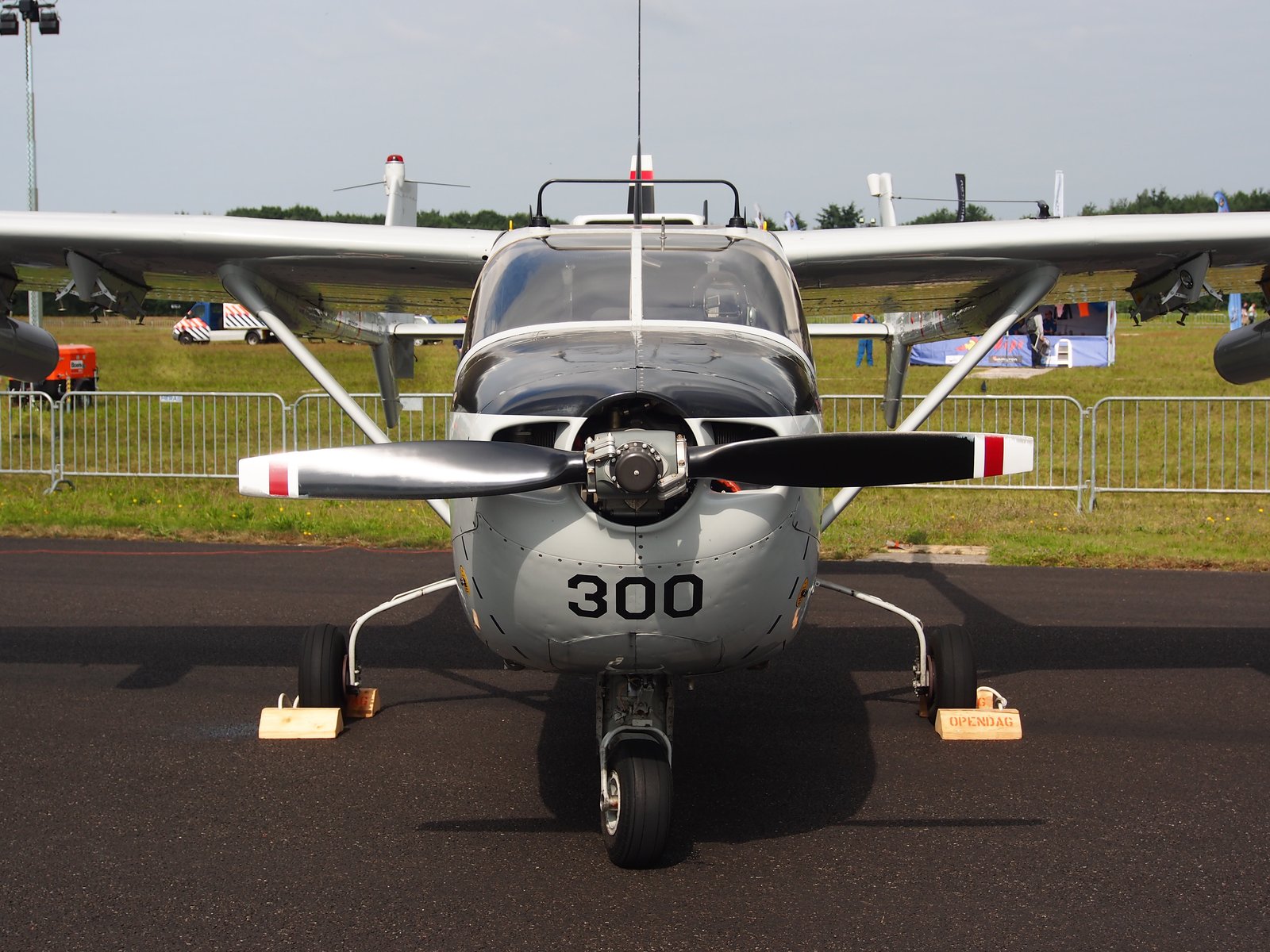
The Cessna O-2 Skymaster was developed as a militarized adaptation of the Cessna 337 Super Skymaster to replace the O-1 Bird Dog in Forward Air Control (FAC) roles. Produced by the Cessna Aircraft Company in Wichita, Kansas, the O-2 first flew in January 1967, with the first deliveries to the U.S. Air Force occurring in March of that year. While production figures vary across sources, estimates suggest between 513 and 544 airframes were built, with 532 acquired by the USAF by June 1970.
Designed for high visibility and operational safety, the O-2 utilized a unique "centerline thrust" push-pull engine layout, featuring one engine in the nose and another in the rear fuselage. This configuration eliminated asymmetric yaw during engine failure, allowing pilots qualified only for single-engine aircraft to operate the twin-engine platform. The aircraft was powered by two fuel-injected, air-cooled Continental IO-360 piston engines, each producing approximately 210 hp. To support its FAC and observation missions, the O-2 featured large side windows and a high-wing configuration for superior downward visibility.
During the Vietnam War, the O-2A variant served as a primary FAC platform, marking targets and coordinating close air support, while the O-2B variant was equipped with leaflet dispensers and loudspeakers for psychological operations (PSYOPS). These aircraft operated from bases such as Bien Hoa in South Vietnam and Nakhon Phanom in Thailand. The conflict took a heavy toll on the fleet, with USAF records indicating 178 O-2s were lost. Beyond the USAF, the O-2 saw service with the South Vietnamese Air Force, as well as military forces in Iran and El Salvador.
Following its primary combat role, the O-2 demonstrated remarkable longevity. The U.S. Navy utilized former USAF airframes for range control with Attack Squadron 122 and Strike Fighter Squadron 125 starting in 1983. The U.S. Army operated O-2As for test and evaluation at Yuma Proving Ground until October 2010. Additionally, the California Department of Forestry and Fire Protection (CAL FIRE) employed the type as tactical air attack aircraft from 1976 into the mid-1990s. Today, the O-2 is preserved in several institutions, including the Smithsonian National Air and Space Museum, which houses a battle-damaged O-2A that flew hundreds of sorties in Vietnam.