
Military Service Dominance
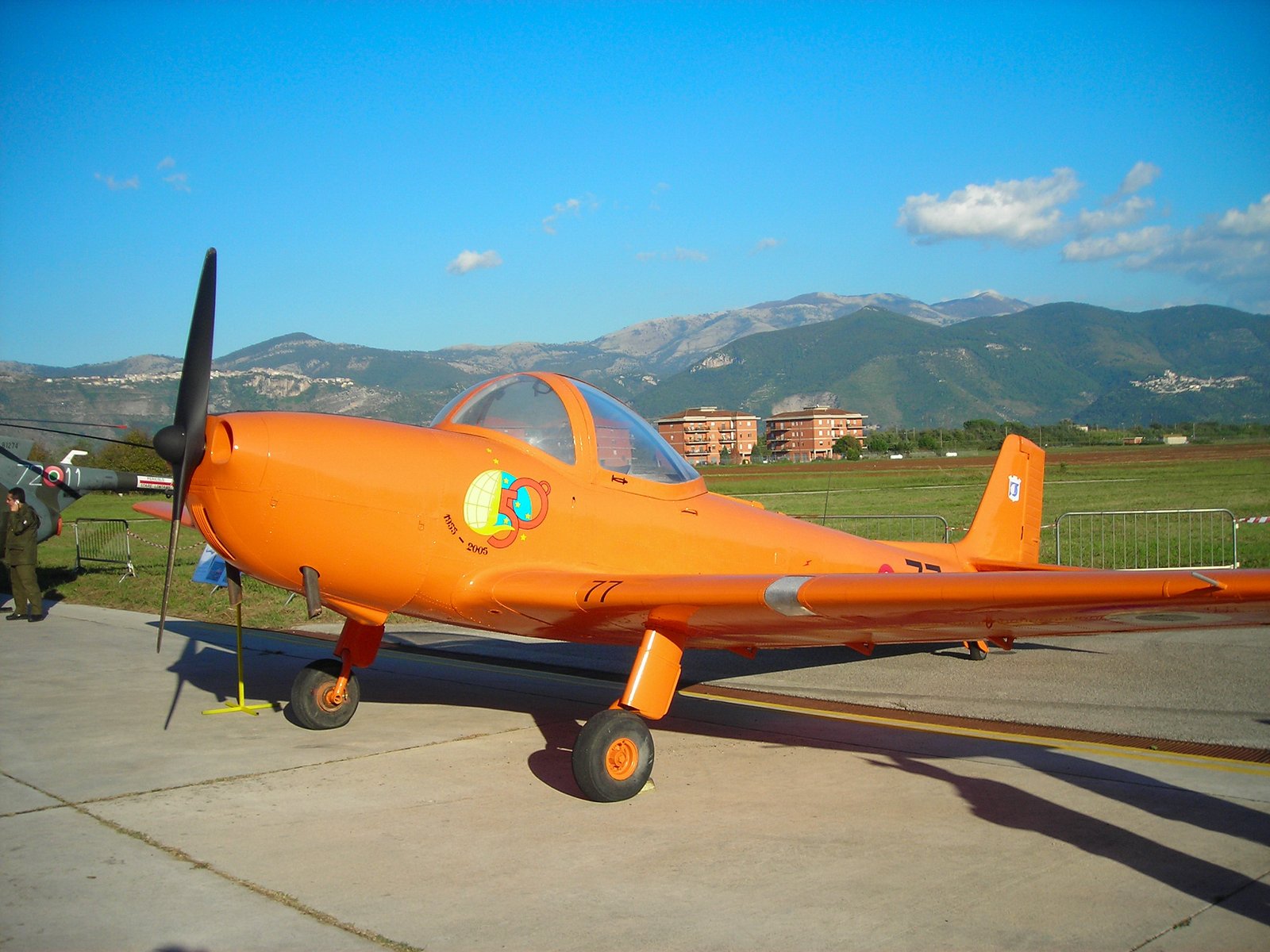
The P-148 became the backbone of Italian Air Force pilot training from 1951 through 1979, with 70 aircraft serving in primary flight training and pilot selection roles. The aircraft's reliability proved so valuable that when the Italian Air Force initially retired it in the 1960s during their transition to all-jet training programs, they brought it back into service in 1970 after recognizing the continued importance of piston-engine aircraft in pilot selection. Beyond Italy, the Somali Air Corps acquired surplus P-148s from the Italian Air Force to establish their own pilot training program.
Design Team and Development
Piaggio Aero engineers Casiraghi and D'Ascanio led the design team that created the P-148 as a purpose-built military trainer. Their objective was developing a practical, economical aircraft specifically for post-war Italian Air Force training requirements. The prototype's successful maiden flight on February 12, 1951, validated their all-metal cantilever monoplane design with fixed tailwheel landing gear, which balanced simplicity with modern construction techniques.
The Piaggio Legacy
Piaggio represents one of aviation's oldest manufacturers, having produced its first aircraft in 1915. Following World War II, the company underwent significant restructuring, with its main business dividing in 1966 into aviation-focused Piaggio Aero and the motor scooter manufacturer Vespa. Despite experiencing multiple bankruptcies and ownership changes over the decades, the company continues operating today, specializing in engine manufacturing and maintenance, repair, and overhaul services under licenses from major manufacturers including Rolls Royce, Honeywell, and Pratt & Whitney.
Engine and Technical Innovation
The heart of the P-148 was the American-built Lycoming O-435-A, a six-cylinder, horizontally-opposed, air-cooled piston engine delivering 140 kilowatts of power. This reliable powerplant drove a two-bladed Piaggio P.1031 metal constant-speed propeller, providing the aircraft with efficient performance characteristics suited to training operations. The engine choice reflected post-war European reliance on proven American aviation technology while maintaining Italian manufacturing for aircraft-specific components.
Pilot Training Excellence
Pilots appreciated the P-148's forgiving handling characteristics and practical performance envelope. The aircraft cruised at 127 mph at 3,000 feet, reached a service ceiling of 16,400 feet, and offered 4.5 hours of endurance with its 45-gallon fuel capacity. Its ability to climb to 1,000 meters in just 3 minutes and 40 seconds made it ideal for training maneuvers, while the side-by-side seating arrangement facilitated effective instructor-student communication during flight training.
Production and Evolution
Piaggio manufactured the P-148 exclusively in Italy from 1951 to 1979, with production focused primarily on Italian Air Force orders. The aircraft's successful design directly influenced the development of the more advanced P-149, which first flew on June 19, 1953. The P-149 featured retractable tricycle landing gear, four-seat capacity, and a more powerful 270-horsepower Lycoming GO-480 engine. While Piaggio built only 88 P-149s, the design proved successful enough that Focke-Wulf manufactured an additional 190 under license in West Germany as the FWP.149D, serving the German Air Force from 1957 to 1990.
Lasting Impact
The P-148's nearly three-decade service life with the Italian Air Force demonstrates the enduring value of well-engineered piston trainers even as jet aircraft dominated military aviation. Its mid-career revival in 1970 proved that fundamental flight training principles remained constant despite technological advancement. The aircraft's role in training generations of Italian military pilots, combined with its influence on the more internationally successful P-149 variant, establishes the P-148 as a significant chapter in post-war European aviation development. Today, the aircraft represents an important milestone in Italy's aviation heritage and Piaggio's long history of aircraft manufacturing innovation.