
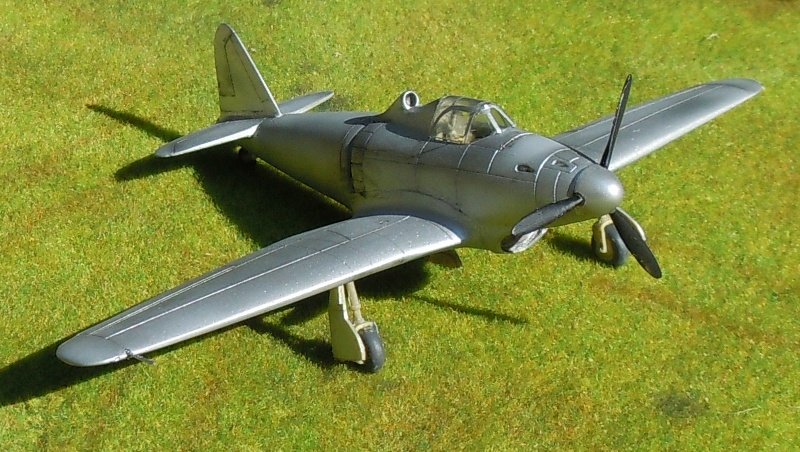
The Piaggio P.119 was an experimental single-seat fighter developed in Italy during the early 1940s. The project began in 1938, with a formal proposal submitted to the Regia Aeronautica on March 18, 1939. An order for a prototype was placed on June 2, 1941, and the aircraft was constructed at Piaggio’s Finale Ligure plant. The P.119 is historically significant for its unconventional layout; unlike most fighters of the era, it featured an 18-cylinder radial engine mounted in the center of the fuselage behind the cockpit. Power was transmitted to a 10 ft 10 in (3.3 m) three-blade variable-pitch propeller via a long driveshaft running beneath the pilot, a configuration similar to the American Bell P-39 Airacobra, though the P.119 used a radial engine rather than an inline one.
This design allowed for a clean aerodynamic nose and superior forward visibility, which in turn enabled a concentrated battery of weapons. The planned standard armament included a 20 mm Breda cannon firing through the propeller hub with 110 rounds, and four 12.7 mm nose-mounted machine guns with 500–550 rounds each. While design studies suggested the possibility of four additional wing-mounted machine guns or a 37 mm cannon for ground-attack roles, the flown prototype was limited in its equipment. During flight tests, it carried only two of the four intended 12.7 mm machine guns and lacked the hub cannon.
Technically, the P.119 featured an all-metal structure consisting of aluminum monocoque sections for the front and rear fuselage, with a tubular steel framework in the center to support the engine and wings. While originally intended to use the 1,700 hp Piaggio P.XXII engine, development delays meant the prototype was fitted with the 1,500 hp Piaggio P.XV radial. On December 19, 1942, test pilot Nicolò Lana conducted the first flight at Villanova d’Albenga. Performance tests indicated a maximum speed of 398 mph (640 km/h) at 22,310 ft (6,800 m) and a service ceiling of 41,011 ft (12,500 m).
Despite its speed, the P.119 suffered from significant vibration issues caused by the long driveshaft and severe engine-cooling problems that required cowl flaps to remain open, increasing drag. The project ended abruptly on August 2, 1943, when the prototype suffered a landing accident that caused it to nose over. Although the damage was minor, the Italian armistice of September 8, 1943, halted further repairs. The sole completed airframe (military serial MM 497) was subsequently abandoned and presumably scrapped, leaving no surviving examples today.