
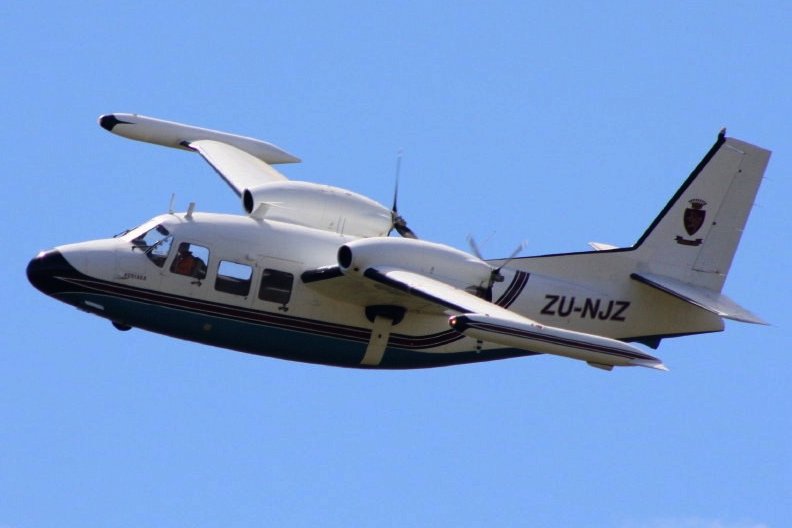
Evolution from Piston Power
The P.166DL3 represented the culmination of Piaggio's efforts to transform their successful piston-engine utility aircraft into a modern turboprop platform. Under the guidance of Dr. Alessandro Mazzoni, who had overseen the original P.166 development in the 1950s, the DL3 variant emerged as a purpose-built government and military aircraft. Test pilot Evasio Ferretti lifted the prototype off the runway on July 3, 1976, marking the beginning of a 15-year production run that would see 36 aircraft delivered to Italian operators.
Military and Government Service
The Italian Air Force became the primary operator of the P.166DL3, utilizing the aircraft's versatility for personnel transport, light cargo missions, and training operations. The Italian Coast Guard adapted the type for maritime patrol duties, equipping aircraft with nose-mounted radar systems, forward-looking infrared sensors, and powerful searchlights for nighttime operations. One notable Coast Guard aircraft, construction number 487 with military serial MM.25165, accumulated 2,371.45 flight hours and 1,874 landings during an 18-year career that began with its first flight on September 22, 1989.
The Italian Treasury Guard operated the DL3 for customs enforcement and border patrol missions, while Alitalia's flight training division used the type to prepare commercial pilots for multi-engine operations. Somalia acquired four P.166DL3 aircraft in 1980, including two standard utility variants and two maritime patrol versions designated P.166-DL3/MAR.
The Manufacturer's Journey
Piaggio's aircraft manufacturing heritage stretches back to the early 20th century, though the company underwent significant restructuring during the P.166's development years. In 1966, the original Industrie Aeronautiche e Meccaniche Rinaldo Piaggio S.p.A. split into separate divisions, with one focusing on the famous Vespa motor scooters and the other continuing aircraft production. The aviation division operated from facilities in Finale Ligure and Genoa until 1998, when it was renamed Piaggio Aero Industries, reflecting its evolution into a modern aerospace manufacturer.
Turboprop Transformation
The heart of the DL3's improved performance lay in its powerplant selection. Piaggio chose the Lycoming LTP-101 turboprop, a relatively new engine that had entered service in the 1970s. The standard configuration featured two AlliedSignal LTP-101-700 engines, each producing 448 kilowatts (600 shaft horsepower), though some variants used the slightly less powerful LTP-101-600 model generating 438 kilowatts. This turboprop installation represented a dramatic improvement over the original P.166's 340-horsepower piston engines, providing enhanced reliability, reduced maintenance requirements, and superior high-altitude performance.
Operational Characteristics
The P.166DL3's high-wing configuration and robust landing gear made it suitable for operations from semi-prepared airstrips, a capability that proved valuable for military and government missions in remote locations. The aircraft's maximum seating capacity of 11 occupants, including crew, allowed for efficient personnel transport while maintaining sufficient cargo space for equipment and supplies. The type's operational flexibility extended to maritime patrol missions, where the Coast Guard variant "Orca 7" demonstrated the aircraft's endurance and sensor-carrying capability during countless hours of coastal surveillance.
Limited Production Legacy
Production of the P.166DL3 concluded in 1991 after just 36 aircraft had been completed, making it one of the more exclusive variants in the broader P.166 family. The limited production run reflected the specialized nature of the aircraft's mission requirements and the relatively small market for turboprop utility aircraft in Italy during the 1980s. Today, at least one P.166DL3 survives as a museum exhibit: the former Coast Guard aircraft MM.25165 is displayed at Volandia, the Italian Aviation Museum and Park, where it stands as the only P.166DL3 in museum preservation.
The DL3's service record with Italian forces extended well into the 21st century, with some aircraft remaining active until 2007. This longevity demonstrated the soundness of Mazzoni's design philosophy and the reliability of the Lycoming turboprop installation, proving that the P.166 concept retained its utility four decades after the original prototype's first flight in 1957.