
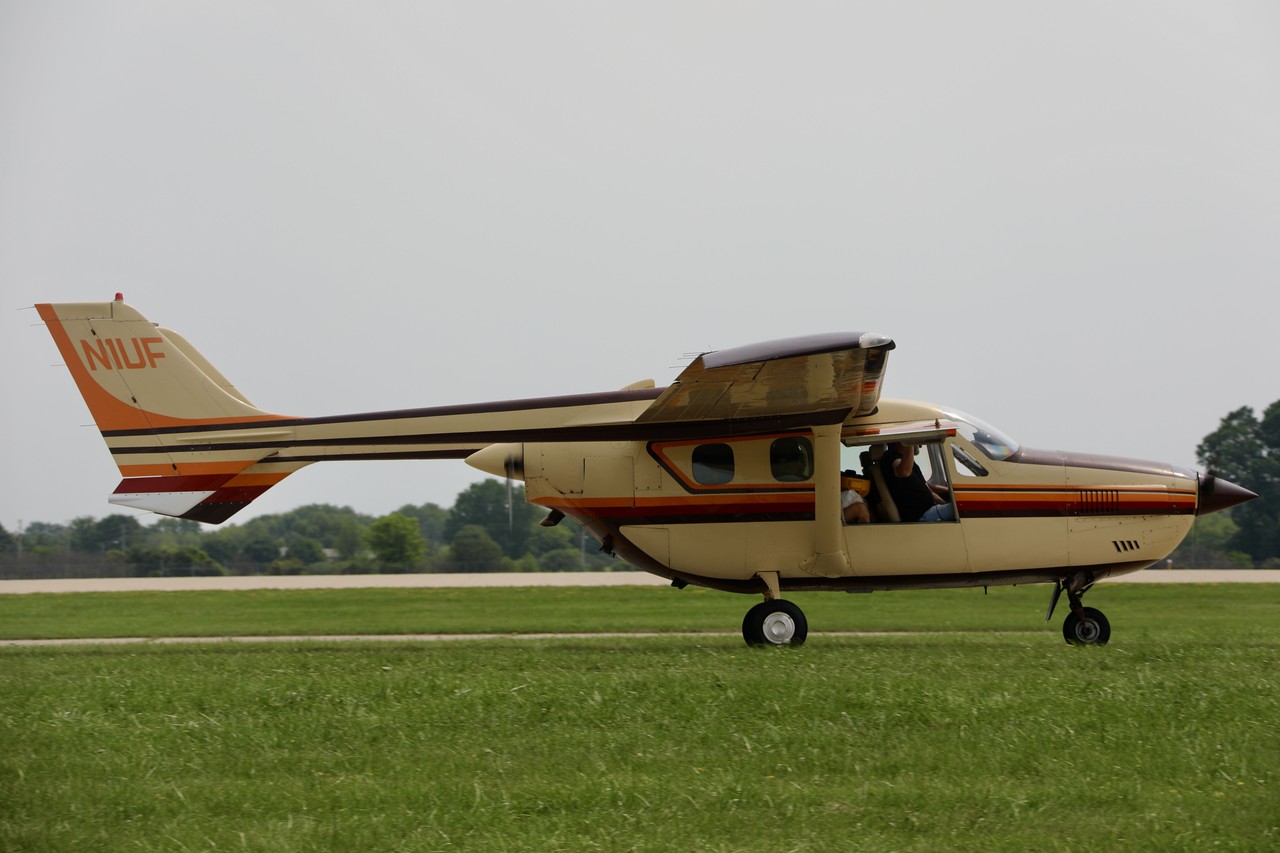
Revolutionary Design Philosophy
The P337 Pressurized Skymaster represented Cessna's bold answer to the inherent dangers of conventional twin-engine aircraft. Traditional twins like the Cessna 310 suffered from asymmetric thrust during engine failures, creating critical airspeeds below which the aircraft became uncontrollable. By mounting engines in tandem along the aircraft's centerline—one as a front-mounted tractor, the other as a rear-mounted pusher—Cessna eliminated this deadly characteristic entirely.
Development and Evolution
Cessna's engineering team began development in the late 1950s, with the original Model 336 making its maiden flight on February 28, 1961. The design evolved through the retractable-gear Model 337 Super Skymaster introduced in February 1965, culminating in the pressurized P337G variant that entered production in 1973. The P337H model followed for the 1978 model year, incorporating refinements including a redesigned nose cowling, modified rear air intake, and increased wing incidence angle.
Production History
Cessna manufactured the P337 series at their primary facility in Wichita, Kansas, with concurrent licensed production by Reims Aviation in France beginning in 1969. The French operation, managed by former World War II fighter ace Pierre Clostermann, produced over 6,000 Cessna aircraft by 1982. Total Skymaster family production reached 2,993 aircraft across all variants, with more than 400 pressurized P337 models completed. Specific P337H production totaled 64 aircraft: 26 in 1978, 24 in 1979, and 15 in 1980. U.S. production ceased in 1982, though Reims continued limited manufacturing of specialized variants.
Engine and Performance
The P337H utilized two Continental TSIO-360-C turbocharged engines, each producing 225 horsepower compared to the 210-horsepower IO-360 engines in non-pressurized variants. The turbocharging proved essential for high-altitude operations where the aircraft's pressurization system provided maximum benefit. This powerplant combination enabled cruise speeds of 230 knots and service ceilings above 25,000 feet with a range approaching 1,200 nautical miles.
The unique engine arrangement eliminated propeller interference while maintaining the safety benefits of centerline thrust. However, the Continental TSIO-360 engines developed a reputation for demanding maintenance schedules, particularly regarding their turbocharging systems.
Military Heritage
While the P337 itself remained a civilian aircraft, the Skymaster family gained prominence through extensive military service. The U.S. Air Force operated 513 O-2 Skymaster variants during the Vietnam War from 1967 to 1975, primarily for forward air control missions. These aircraft directed combat strikes, conducted visual reconnaissance, and performed psychological operations including leaflet drops and loudspeaker missions. The O-2A served in observation roles while the O-2B specialized in psychological operations.
The Manufacturer Legacy
Cessna Aircraft Company, founded by Clyde Cessna in 1927, had established itself as a dominant force in general aviation by the 1960s through popular models like the 172 and 310. The company's 1960 partnership with France's Max Holste Company created Reims Aviation, extending Cessna's global reach. Textron acquired Cessna in 1992, operating today as Textron Aviation. Reims Aviation achieved independence in 1989 but entered receivership in 2013.
Operational Characteristics
The P337's cabin pressurization system distinguished it from most light twins, enabling comfortable flight at altitudes where weather and turbulence posed fewer challenges. The aircraft typically seated six to nine occupants with one or two crew members. Its 4,200-pound gross weight and flexible interior configuration made it attractive to business operators requiring reliable high-altitude transportation.
Pilots appreciated the aircraft's forgiving engine-out characteristics but noted the complexity of managing two separate engine systems and the demanding maintenance requirements of the turbocharged powerplants.
Modifications and Conversions
Jack Riley's Riley International developed popular STOL modification packages during the 1970s and 1990s before the company's 1996 bankruptcy transferred the supplemental type certificates to Kasper Industries. Spectrum Aircraft Corporation offered turboprop conversions in the mid-1980s with their SA-550 modification, though few were completed.
Current Status
Dozens of P337 aircraft remain active today, supported by Skymaster International and an dedicated community of owners and mechanics. The type's unique design continues to attract aviation enthusiasts who value its safety characteristics and distinctive appearance. While never achieving the production numbers of conventional twins, the P337 Pressurized Skymaster remains significant as the most successful push-pull light twin ever manufactured, proving that innovative thinking could overcome traditional design limitations in general aviation.