
Commercial Success and Market Impact
The Short 360 entered commercial service in November 1982 with Suburban Airlines, operating under the Allegheny Commuter consortium, and quickly established itself as a workhorse of regional aviation. The aircraft's timing proved fortuitous, coinciding with the rapid expansion of commuter services following US airline deregulation. Its robust high-wing design and sturdy landing gear enabled operations from rough airstrips and constrained airports where larger aircraft could not venture, making it invaluable for connecting smaller communities to major transportation hubs.
Design Evolution and Engineering
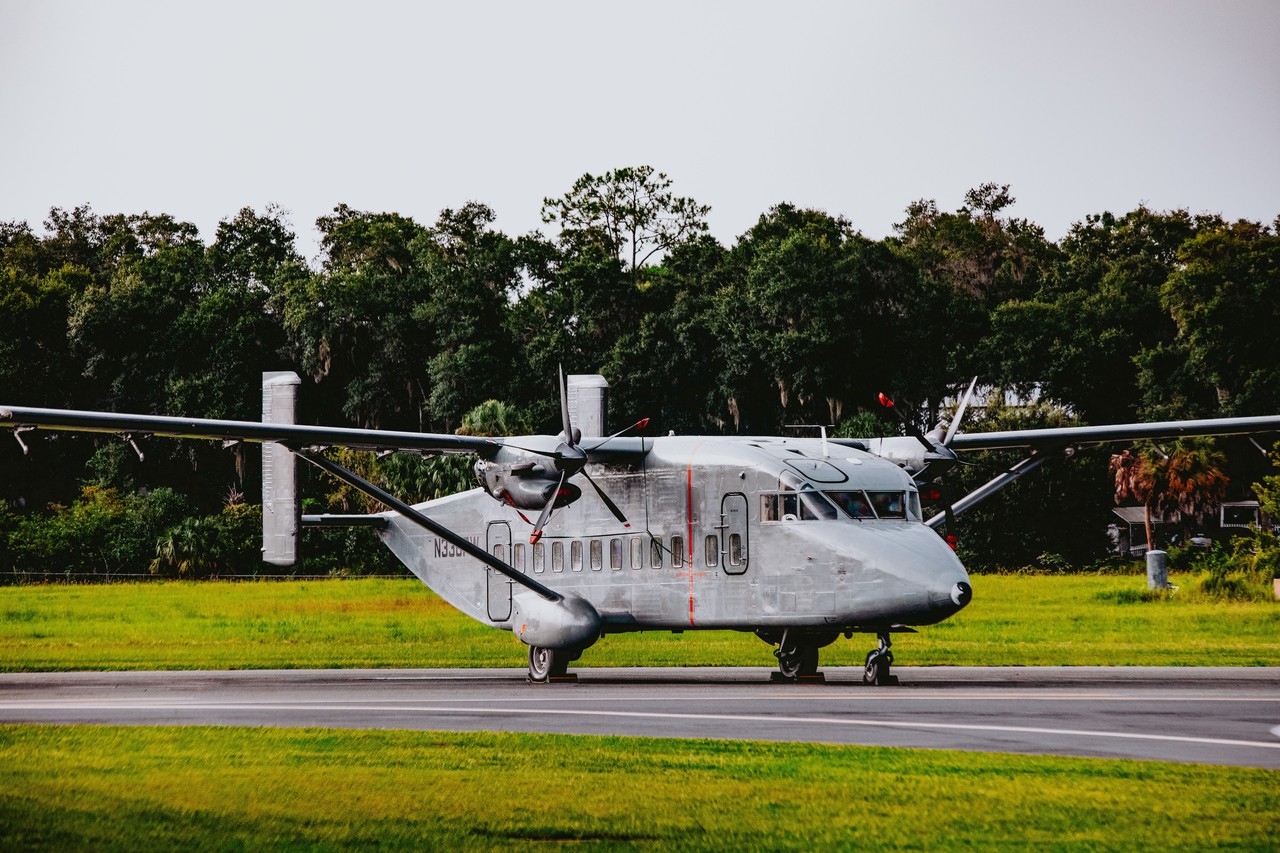
Short Brothers developed the 360 specifically to address operator demands for greater passenger capacity than the 30-33 seat Short 330. The design team achieved this through a three-foot fuselage plug that extended overall length to 70.6 feet, accommodating six additional passengers. The most visually distinctive modification was the redesigned aft fuselage featuring a tapered profile and swept single vertical tail, which improved aerodynamic efficiency while reducing drag compared to the twin-tail configuration of its predecessor.
The aircraft incorporated longer wings and expanded luggage compartments to enhance operational versatility. Initial 360-100 models utilized PT6A-65-AR engines producing 1,424 shaft horsepower each, driving five-bladed propellers. The 1987 introduction of the 360/300 variant brought more powerful PT6A-67R engines and distinctive six-blade propellers, further improving performance characteristics.
Military Applications
The United States Army recognized the aircraft's utility, adopting military variants designated as the C-23 Sherpa series from 1984 to 1990. The C-23B+ developed from the 360 airframe featured modifications including an aft loading ramp for cargo operations. Some military variants incorporated a twin-fin tail configuration replacing the standard single vertical stabilizer, designated as the C-23C Sherpa. The Venezuelan Air Force also operated the type, though specific service details remain limited.
Short Brothers Legacy
Short Brothers brought decades of experience in utility aircraft design to the 360 program, building upon successful previous designs including the Skyvan and Short 330. The Northern Irish manufacturer had established a reputation for producing rugged, reliable aircraft capable of operating in challenging environments. The company's focus on practical, operator-friendly designs made their aircraft popular with regional carriers seeking dependable service.
Performance and Operational Characteristics
Pilots found the Short 360 predictable and forgiving, with excellent short-field performance capabilities. The aircraft cruised at 243 miles per hour with a service ceiling of 11,500 feet and maximum range of 656 miles. Maximum takeoff weight reached 25,700 pounds, providing substantial payload flexibility for mixed passenger and cargo operations. The high-wing configuration offered superior ground clearance and simplified ground handling procedures.
The cockpit accommodated a two-person crew, with flight controls designed for single-pilot operation under appropriate regulatory conditions. Pilots appreciated the aircraft's stability in turbulent conditions and its ability to maintain scheduled operations in weather that grounded more sensitive aircraft types.
Variants and Specialization
Short Brothers developed several variants to meet diverse market requirements. The 360 Advanced, introduced in 1985 and later redesignated as the 360-200, incorporated improved systems and updated interiors. The 360/300 of 1987 represented the most significant upgrade, featuring aerodynamic refinements, more powerful engines, and enhanced payload capabilities. A dedicated freighter variant, the 360-300F, could accommodate five standard cargo containers, serving operators requiring pure freight capacity.
Production End and Modern Status
Production concluded in 1991 after 165 deliveries, as market preferences shifted toward larger regional jets offering greater speed and passenger appeal. The aircraft found a second life in cargo operations, where its large cabin volume and rear loading capabilities proved advantageous. Many examples transitioned from passenger service to freight duties, particularly serving markets requiring dependable cargo capacity to smaller airports.
Today, surviving Short 360s continue operating primarily in cargo roles, testament to the type's fundamental durability and operational economy. The aircraft represents an important chapter in regional aviation history, bridging the gap between small commuter aircraft and modern regional jets while serving communities that larger aircraft could not reach.