
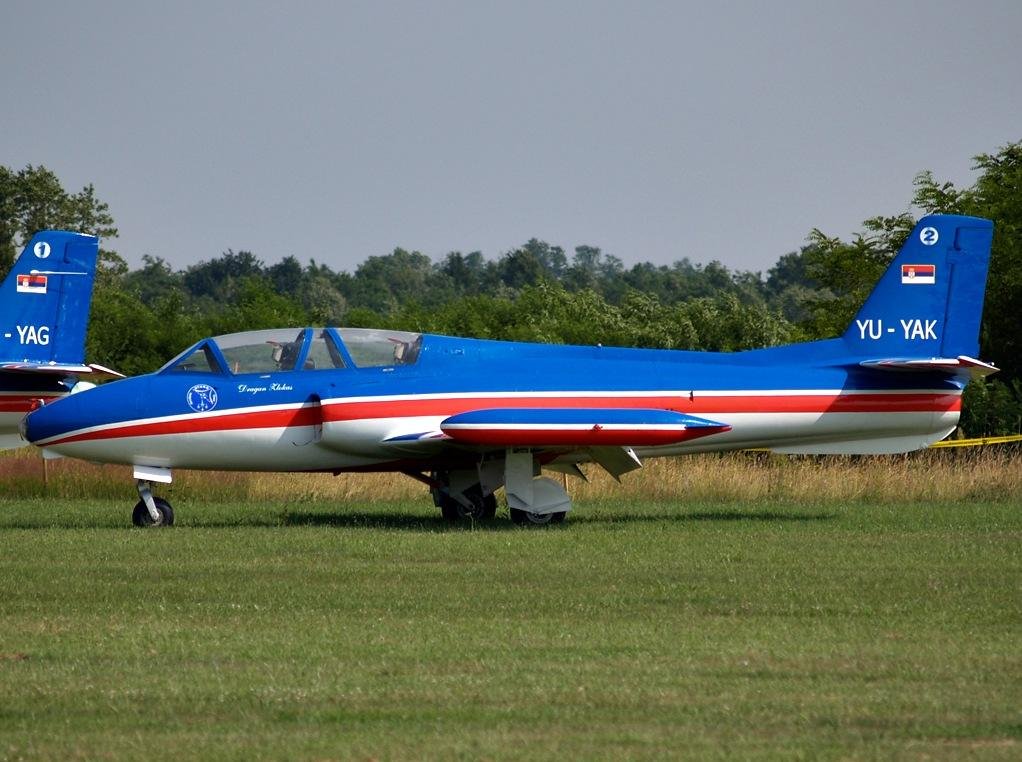
Service History
The G-2 Galeb dominated Yugoslav military pilot training from 1965 through the 1980s, with 132 aircraft serving in the Yugoslav Air Force. The aircraft proved so successful that Yugoslavia exported 116 examples to Libya, demonstrating the nation's emergence as a credible aircraft manufacturer. Operating under the military designation N-60, the Galeb trained generations of Yugoslav pilots while also serving in the light attack role when needed.
The aircraft's operational versatility became legendary among pilots, particularly its ability to operate from unpaved grass airstrips—a capability that distinguished it from many contemporary jet trainers. This rugged design philosophy reflected Yugoslav military requirements for dispersed operations and minimal ground support infrastructure.
Development and Design Innovation
The Galeb's development began in 1957 when the Yugoslav Air Force issued requirements for a domestically-produced jet trainer to replace American-supplied Lockheed T-33 Shooting Stars. The Aeronautical Technical Institute (VTI) led the design effort, creating Yugoslavia's first indigenous jet aircraft intended for mass production. While the earlier Ikarus 451M had achieved the distinction of being Yugoslavia's first jet-powered aircraft in 1952, it never progressed beyond prototype status.
Test pilot Captain Ljubomir Zekavica lifted the first Galeb prototype into the air on July 3, 1961, marking a watershed moment for Yugoslav aviation. The aircraft made its international debut at the 1963 Paris Air Show, where it garnered positive reception from aviation professionals worldwide. Production commenced in 1964, with the first operational G-2-A entering Yugoslav Air Force service on July 30, 1965.
The Manufacturer
SOKO, established in 1951 in Mostar, was Yugoslavia's state-owned aircraft manufacturer that transformed from a repair facility into a capable aircraft producer. The G-2 represented the company's second original design following the earlier Soko 522. Under the socialist economic system, SOKO operated as part of Yugoslavia's broader industrialization program, with the Galeb project receiving substantial state support.
The company's collaboration with British aerospace firms proved crucial to the Galeb's success. Rolls-Royce not only supplied the Viper turbojet engine but also sponsored the aircraft's development, while other British companies provided ejector seats and navigational equipment. This East-West technological cooperation was remarkable during the Cold War era, reflecting Yugoslavia's non-aligned status.
Engine and Technical Innovation
The heart of the Galeb was the British Rolls-Royce Viper turbojet, a reliable single-engine powerplant that provided the thrust needed for both training and light attack missions. The engine's proven reliability made it an ideal choice for a training aircraft where engine failures could prove catastrophic for inexperienced pilots.
Significant design changes occurred between the prototype and production versions. The initial Galeb 1 prototype featured three rubber fuel tanks mounted in the fuselage, while the production Galeb 2 employed a more sophisticated fuel system with two fuselage tanks holding 230 gallons and two wingtip tanks containing 51 gallons each. This configuration provided better weight distribution and increased fuel capacity.
Variants and Evolution
SOKO developed several Galeb variants to meet different operational requirements. The G-2-A served as the initial production model for both training and light attack roles. The G-2-A-E export variant equipped the Libyan Air Force, while the G-2-S focused purely on training duties without armament provisions.
The ambitious G-3 "Galeb-3" prototype appeared in 1970 with a more powerful Viper Mk 532 engine, modernized cockpit systems, increased maximum takeoff weight, and enhanced short-field performance. Despite these improvements, the G-3 never progressed to production, with SOKO instead focusing on other projects.
Production and Legacy
During its 20-year production run from 1965 to 1985, SOKO manufactured exactly 248 Galebs at the Mostar facility. The final aircraft entered Yugoslav Air Force service on January 6, 1981, though production for Libya continued until mid-1983. This production total represented a significant achievement for a relatively small nation's aerospace industry.
The Galeb's greatest legacy lay in its role as the foundation for the single-seat J-21 Jastreb ("Hawk") ground-attack aircraft. The Jastreb shared the Galeb's basic configuration while adapting it for dedicated ground-attack missions, extending the design's influence throughout Yugoslav military aviation.
Today, surviving Galebs serve primarily as museum displays and occasional airshow participants, representing a proud chapter in Yugoslav aerospace achievement. The aircraft demonstrated that smaller nations could successfully develop and manufacture military jet aircraft when supported by appropriate international partnerships and domestic industrial commitment.