
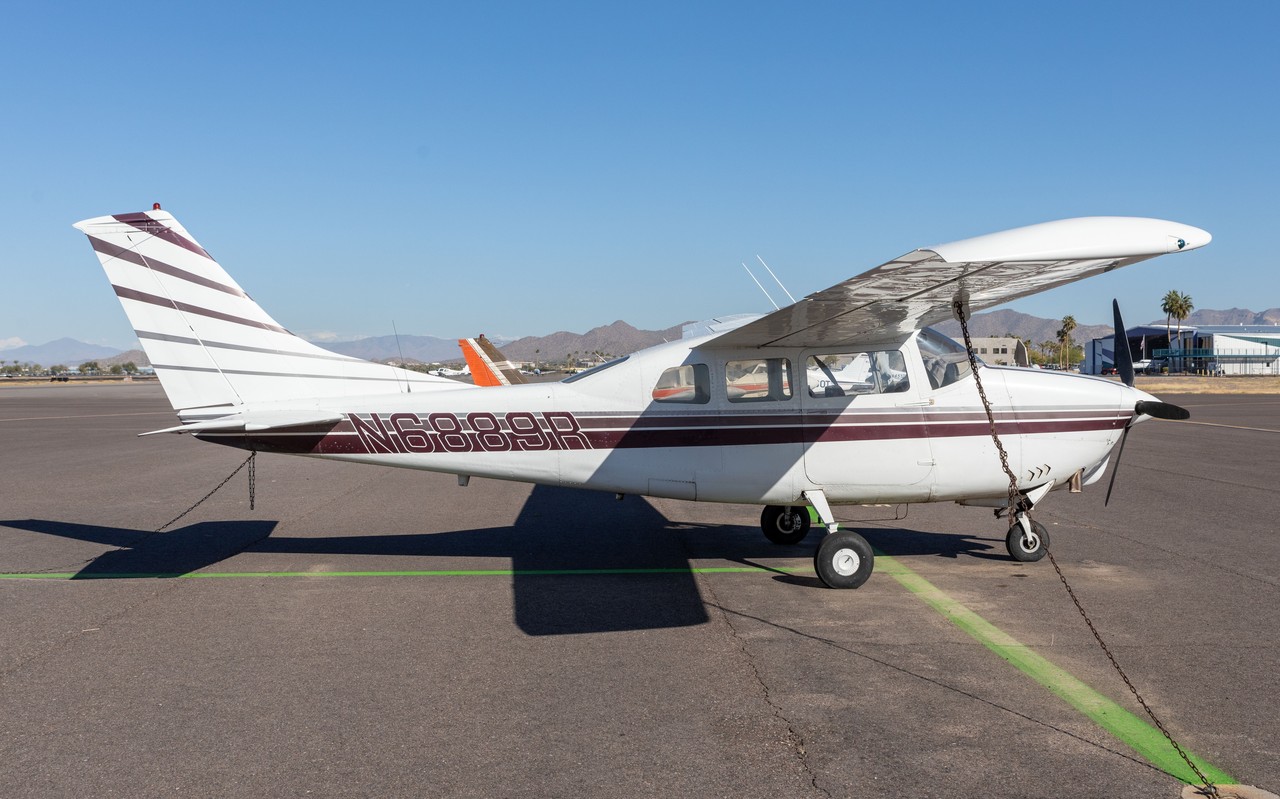
Service History
The T210 Turbo Centurion dominated the high-performance single-engine market from 1965 to 1986, becoming the preferred choice for serious cross-country flying. Turbocharged models outsold their normally aspirated counterparts two-to-one, demonstrating pilots' preference for high-altitude capability. The aircraft excelled in instrument flight rules (IFR) operations, mountain flying, and long-distance personal transportation, with its 90-gallon fuel capacity providing nearly 1,000 nautical miles of range.
The Manufacturer
Cessna Aircraft Company, founded by Clyde Cessna in 1927, had established itself as the dominant force in single-engine aviation by the 1960s. The company experienced tremendous growth following World War II, during which it served as a major producer of high-wing trainers. General Dynamics acquired Cessna in 1985, followed by Textron Inc. in 1992. While Cessna halted production of piston singles like the 210 in 1986 due to economic conditions, the company resumed manufacturing other piston models in 1996, though the 210 line was never restarted. Today, Textron's Cessna division continues operations, focusing on business jets and turboprops.
Design and Development
The 210 series emerged from Cessna's engineering team led by Dwight Wallace and Tom Laben, who evolved the design from the proven 182 and 180 airframes. The first 210 prototype flew on January 22, 1957, with production certification achieved in late 1959. The designers' objective was creating an aircraft that could compete with the Beechcraft Bonanza while offering superior speed, altitude performance, and six-place seating capacity without the complexity of twin-engine aircraft.
Key innovations included fuselage-retracting landing gear rather than wing-mounted systems, fuel injection, and a distinctive swept tail. The introduction of turbocharging in 1965 with the T210F model transformed the aircraft's capabilities, enabling reliable high-altitude flight. Cantilever wings appeared in 1967, and the 1979 N-model became the first single-engine aircraft certified for flight in known icing conditions.
Engine and Technical Details
The T210 was powered by Continental Motors' TSIO-520 series turbocharged, air-cooled, fuel-injected flat-six engines. The evolution began with the TSIO-520-C producing 285 horsepower in the 1965 T210F, progressing to the TSIO-520-R generating 310 horsepower by the 1977 M-model. The final T210R variant in 1986 featured a 325-horsepower engine. These powerplants incorporated intercoolers for reliability and could maintain full 36.5 inches of manifold pressure up to 17,000 feet critical altitude.
Time between overhaul (TBO) intervals increased to 1,600 hours by 1984, reflecting improved reliability. Early models experienced accessory failure issues, addressed by the addition of dual vacuum pumps in 1982. The robust high-altitude performance enabled the aircraft to achieve its 200-knot cruise speeds and 28,500-foot service ceiling.
Pilot Perspective
Pilots praised the T210 for its ability to carry six full-sized adults within gross weight limits while maintaining excellent performance. The aircraft transformed personal aviation by offering twin-engine-like capabilities in a single-engine package, making high-altitude IFR flight accessible to pilots without the complexity of multi-engine operations. Maximum gross weight increased from 3,900 pounds in early models to 4,100 pounds in the final T210R.
Significant model improvements included the 1972 L-model's electric hydraulic pump system and the popular 1979 N-model's known-ice certification, of which nearly 2,000 examples were built. The N-model also eliminated landing gear doors, reducing maintenance complexity.
Production and Legacy
Cessna manufactured approximately 9,240 total aircraft in the 210 series, including both normally aspirated and turbocharged variants, at its Wichita, Kansas facilities. Production ended in 1986 due to the general aviation market crash, with only a few T210R models completed in the final year. The T210 earned recognition as the "king of high-performance singles" and pioneered turbo-normalized single-engine flight.
Over 2,000 Cessna 210 and T210 aircraft remain airworthy today, testament to their enduring design and robust construction. The type continues to be prized by owners who value its combination of performance and reliability, with numerous supplemental type certificates (STCs) available for modern upgrades. The T210's legacy lies in democratizing high-altitude cross-country flight for general aviation, enabling safe operations above weather and terrain that previously required twin-engine aircraft.