
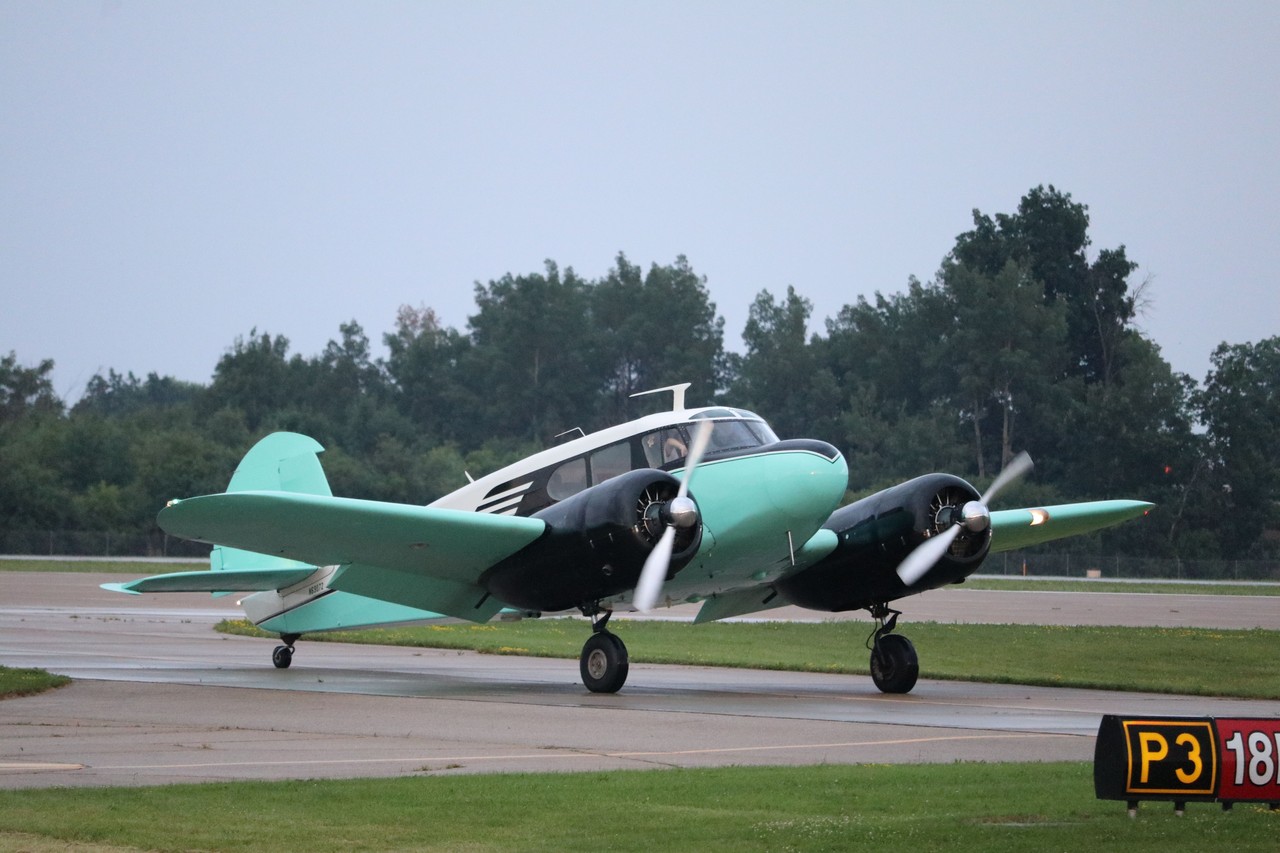
Military Dominance and Training Mission
The T-50 Bobcat transformed from a modest civilian transport into one of World War II's most essential training aircraft. Between 1940 and 1944, the U.S. Army ordered more than 3,500 Bobcats in various configurations, making it the backbone of American multi-engine pilot training. The aircraft earned its military importance on July 19, 1940, when the Army placed its first order for 33 AT-8 trainers, with the initial delivery occurring in December 1940.
The Royal Canadian Air Force obtained 640 T-50s, designated as "Cranes," which served extensively in the British Commonwealth Air Training Plan. These aircraft trained thousands of Commonwealth pilots in multi-engine operations, proving invaluable to the Allied war effort. The U.S. Navy also operated 67 aircraft under the designation JRC-1, demonstrating the type's versatility across all military services.
Military Variants and Specifications
Cessna developed multiple military variants to meet specific training requirements. The AT-8 featured more powerful 290-horsepower Lycoming R-680 engines and distinctive cockpit roof windows for enhanced visibility during training flights. The more numerous AT-17 retained the civilian model's 245-horsepower Jacobs R-755-9 engines while adding extra cockpit windows for instructor observation.
Later variants included the AT-17A with 223 aircraft built featuring metal propellers and reduced weight, and the AT-17B with 466 examples incorporating equipment changes and wooden propellers to conserve strategic materials. In 1943, transport variants were redesignated under the UC-78 series, with 1,354 UC-78s, 1,806 UC-78Bs, and 327 UC-78Cs produced for liaison and light transport duties.
Cessna Aircraft Company
The T-50's success established Cessna as a major aircraft manufacturer and transformed the company from a small Kansas operation into a significant defense contractor. Founded by aviation pioneer Clyde Cessna, the company produced a remarkable 5,422 Bobcats in just five years, representing one of the most successful programs in Cessna's early history. This production surge provided the financial foundation for Cessna's post-war expansion and development of new aircraft designs.
Today, Cessna continues as part of Textron Aviation, maintaining its position as a leading general aviation manufacturer. The success of the T-50 program demonstrated Cessna's ability to scale production rapidly and deliver reliable aircraft under wartime conditions, establishing the company's reputation for dependable training and utility aircraft.
Technical Innovation and Design
The T-50 represented several firsts for Cessna, serving as the company's initial twin-engine design and first aircraft equipped with retractable landing gear. The aircraft received Approved Type Certificate 722 on March 24, 1940, validating its design for both civilian and military operations. Its twin Jacobs R-755-9 seven-cylinder, air-cooled radial engines provided reliable power and simplified maintenance compared to more complex powerplants.
Measuring 32 feet 9 inches in length with an empty weight of 3,500 pounds, the Bobcat could operate at a maximum weight of 5,700 pounds. This configuration allowed for flexible loading arrangements, whether carrying passengers, cargo, or specialized training equipment. The aircraft's conventional control layout and forgiving flight characteristics made it ideal for transitioning single-engine pilots to multi-engine operations.
Post-War Commercial Service
After 1945, hundreds of surplus Bobcats entered civilian service, finding new roles in commercial aviation and private ownership. Bonanza Airlines exemplified this transition, with founder Ed Converse acquiring three military-surplus Bobcats in 1946 to serve the Las Vegas to Reno route. These aircraft provided reliable scheduled service until 1949, when Bonanza upgraded to Douglas DC-3 equipment to meet growing passenger demand.
One documented example, construction number 5199, was sold to Richard Benson in Hamilton, New York, receiving civil registration N60453 in September 1945. Under Benson's ownership, this aircraft returned to the T-50's original intended role as a training aircraft and small airliner, operating in the New York area until 1956. Approximately 63 commercial T-50s were built specifically for civilian operators, supplementing the military surplus aircraft in post-war service.
Legacy and Preservation
The Bobcat's influence extended beyond its immediate wartime service, establishing design principles that influenced Cessna's future twin-engine aircraft development. Although Cessna didn't introduce a new twin-engine design until the Model 310's first flight on January 3, 1953, the lessons learned from T-50 production and operation informed subsequent aircraft development. The 310 and its derivatives became highly successful in the post-war aviation market.
Today, surviving Bobcats serve as important historical artifacts, representing a crucial period in American aviation training and manufacturing. Museums and private collectors maintain airworthy examples, preserving the legacy of an aircraft that trained thousands of pilots and helped establish one of America's most enduring aircraft manufacturers.