
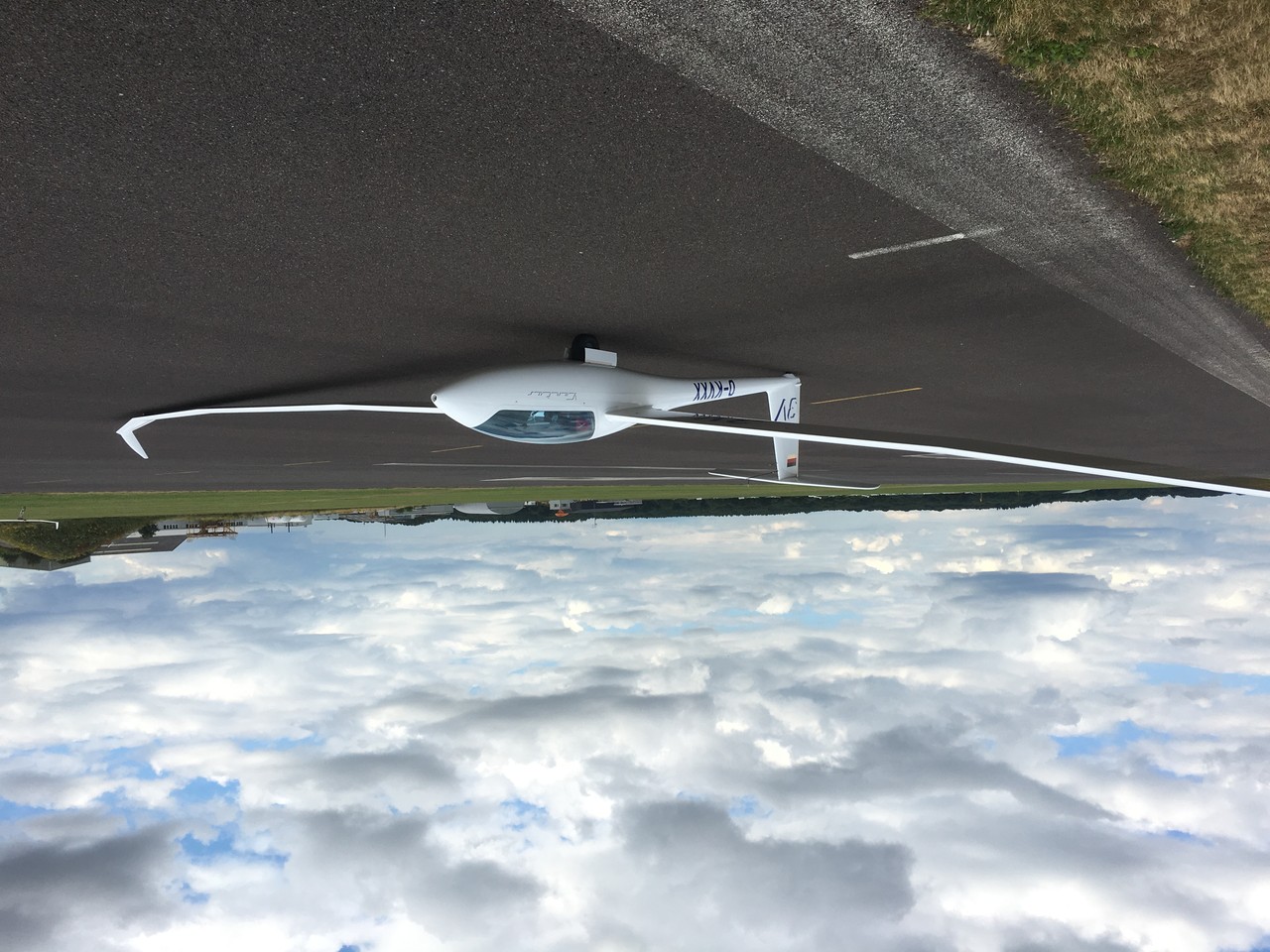
Revolutionary Electric Propulsion
The Ventus 3F's defining characteristic lies in its Front Electric Sustainer system, which adds 50 kg to the aircraft's empty weight while providing unprecedented operational flexibility. The two-blade propeller folds neatly against the nose when not in use, maintaining the aircraft's sleek aerodynamic profile essential for competitive gliding performance. This electric propulsion system allows pilots to extend flights, reach distant thermal sources, or return to airports when atmospheric conditions deteriorate.
Advanced Aerodynamic Design
Schempp-Hirth engineers completely redesigned the wing for the Ventus-3 series, departing from the successful Ventus-2 configuration. The new multi-dihedral swept planform incorporates conventional winglets and represents a significant advancement in sailplane aerodynamics. The all-composite construction includes integrated flaps, airbrakes, and retractable landing gear, while six ballast tanks in the wings hold 178 liters of water ballast, plus an optional 7.8-liter fin tank for fine-tuning the aircraft's center of gravity.
Development and Certification Journey
The Ventus-3 program began with its announcement at the AERO Friedrichshafen exhibition in April 2015, where Schempp-Hirth displayed a full-scale mockup. The prototype achieved first flight on January 29, 2016, at Flugplatz Hahnweide near the factory in Kirchheim unter Teck. The powered Ventus-3F variant followed nearly two years later with its maiden flight in December 2017, reflecting the additional complexity of integrating the electric propulsion system.
European Aviation Safety Agency certification came through EASA Type Certificate EASA.A.627, with New Zealand granting type acceptance on September 13, 2023. This regulatory approval opened international markets for the aircraft, particularly in countries with active soaring communities.
The Schempp-Hirth Legacy
Schempp-Hirth Flugzeugbau GmbH built its reputation under the leadership of Klaus Holighaus from 1964 to 1994, during which the company established itself as a premier sailplane manufacturer. The original Ventus, introduced in 1980, achieved 613 production aircraft and remained competitive at World Championship level as recently as 2017, demonstrating the enduring quality of the company's designs.
The Ventus-2, launched in 1995, continued this success story and became the foundation for the third-generation aircraft. Located in Kirchheim unter Teck, Germany, Schempp-Hirth continues operating as an independent sailplane manufacturer, competing with other German companies like Alexander Schleicher and DG Flugzeugbau in the high-performance glider market.
Comprehensive Variant Family
The Ventus-3 series encompasses four distinct variants to meet different operational requirements. The Ventus-3G serves as the pure glider version for pilots preferring unpowered flight, while the Ventus-3M features a 45-kW Binder Solo 2625-01 engine for self-launching capability. The Ventus-3T incorporates a 15-kW Oehler-Turbo Solo 2350 turbo sustainer, and the Ventus-3F utilizes the Front Electric Sustainer system.
Serial numbers include suffix designations indicating fuselage size: 'S' for the Sport configuration with a smaller cockpit, or 'P' for the Performance variant offering additional pilot accommodation. This sizing flexibility allows the aircraft to accommodate pilots of varying physical dimensions while maintaining optimal performance characteristics.
Competition and Recreational Performance
As an 18-meter class sailplane, the Ventus 3F competes directly with aircraft like the Lange Antares, ASG 29, and DG-1000 in both recreational soaring and competition environments. The maximum speed of 280 km/h (174 mph) provides excellent cross-country performance, while the sophisticated ballast system enables pilots to optimize wing loading for varying atmospheric conditions.
The retractable landing gear and robust construction suit the aircraft for operations from both prepared airfields and grass strips common in European soaring. Competition pilots particularly value the electric sustainer's ability to reach start points efficiently and provide insurance against off-field landings in challenging conditions.
Production Success and Market Position
By February 2023, Schempp-Hirth had manufactured 200 Ventus-3 aircraft across all variants, representing strong market acceptance for the new design. The production rate reflects both the aircraft's premium positioning and the specialized nature of the high-performance sailplane market, where annual global production numbers typically measure in dozens rather than hundreds of units.
The Ventus 3F's electric propulsion system positions it at the forefront of sustainable aviation technology, appealing to environmentally conscious pilots while providing practical operational advantages. As battery technology continues improving, electric sustainer systems like the FES represent the likely future direction for powered sailplanes, making the Ventus 3F a significant milestone in gliding aircraft development.