
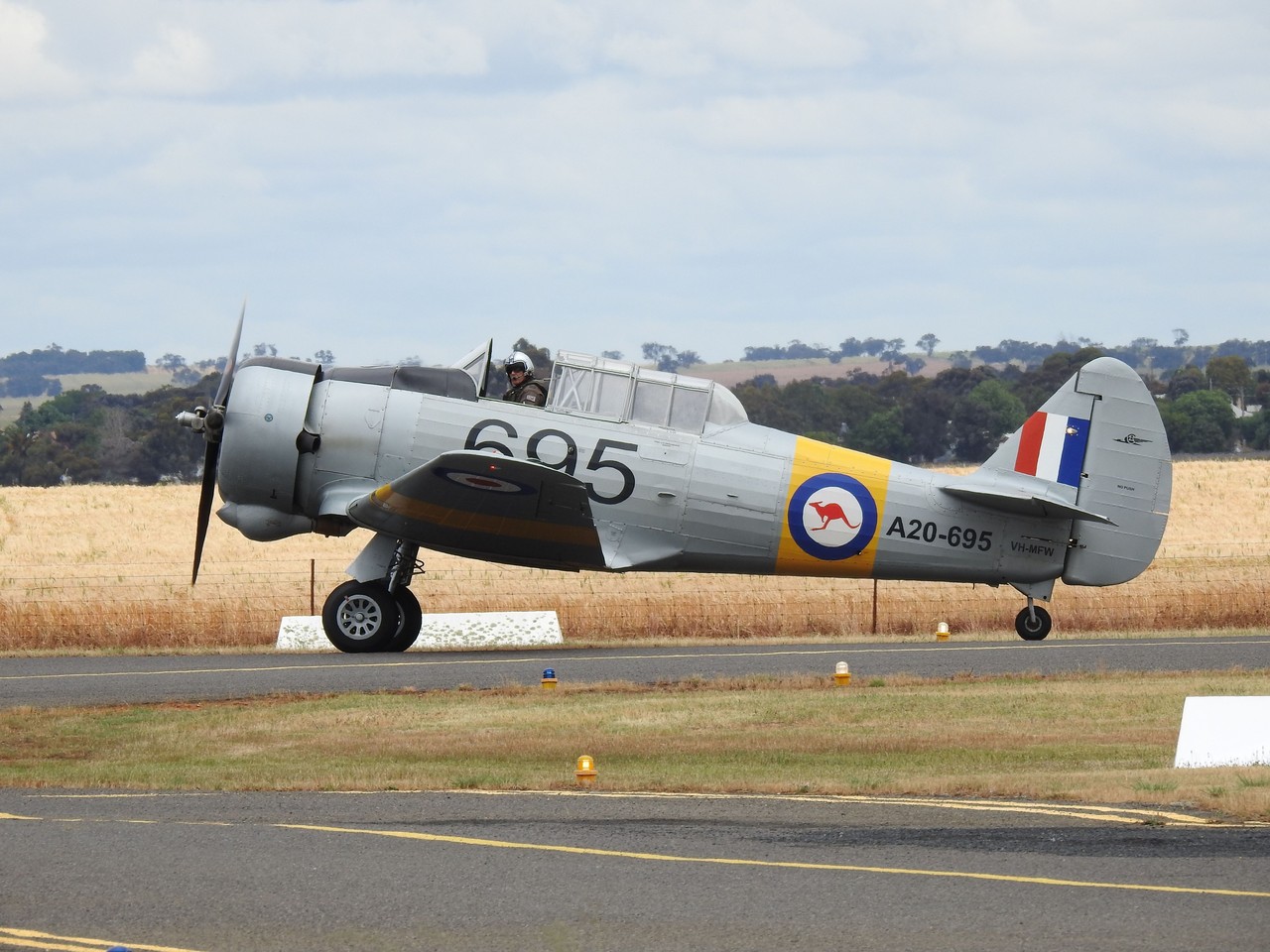
Development and Design
The Wirraway emerged from a 1936 delegation led by Lawrence Wackett to North American Aviation, seeking a suitable design for local Australian production. Rather than selecting British aircraft designs, Wackett recommended licensing the North American NA-33, an advanced trainer variant of the NA-16 series. This decision sparked political controversy for the Lyons government, though supply difficulties from Britain eventually vindicated the choice. The name "Wirraway," meaning "challenge" in Aboriginal language, was selected in April 1938.
Commonwealth Aircraft Corporation adapted the American design with several enhancements, including retractable landing gear, an enclosed sliding canopy, and provisions for local engine production. Test pilot Hubert Boss-Walker conducted the first production aircraft's maiden flight in March 1939, launching what would become Australia's most significant wartime aircraft manufacturing program.
Production and Manufacturing
CAC produced exactly 755 Wirraways across seven production batches between July 1939 and June 1946. The manufacturing program included contracts CA-1, CA-3, CA-5, CA-7, CA-8, CA-9, and CA-16, with batch sizes ranging from the initial CA-1 series to the largest CA-8 batch of 200 aircraft. The final variant, designated CA-16 Mark III, incorporated improved performance capabilities, enhanced bomb-carrying capacity, and dive brakes, with 135 examples completing the production run.
A critical element of the Wirraway program was CAC's decision to license-produce the Pratt & Whitney R-1340 Wasp engine at their Lidcombe, New South Wales facility. This nine-cylinder radial engine, generating 600 horsepower, drove a three-bladed constant-speed variable-pitch de Havilland propeller measuring 10 feet in diameter. Local engine production addressed wartime supply shortages and established Australian manufacturing independence in both airframes and powerplants.
Wartime Service
The Royal Australian Air Force acquired 738 Wirraways, initially deploying them as advanced trainers under the Empire Air Training Scheme. However, wartime aircraft shortages forced the type into combat roles for which it was never intended. During the desperate early months of the Pacific War in 1942, Wirraways were pressed into service as fighters against Japanese forces in Malaya and New Guinea, suffering terrible losses when confronting superior aircraft like the Mitsubishi Zero.
Despite its limitations as a fighter, the Wirraway proved more effective in army cooperation and reconnaissance roles throughout the New Guinea campaign. The aircraft's rugged construction and reliable powerplant made it suitable for operations from primitive airstrips, though its maximum speed of 191 mph and modest armament capabilities remained significant handicaps against modern enemy fighters.
The Royal Australian Navy later acquired 17 Wirraways between 1948 and 1953, operating them with 723 and 724 Squadrons at HMAS Albatross near Nowra. Naval service continued until 1957, with one aircraft lost in a crash on June 18, 1953. The remaining naval Wirraways were subsequently sold to Lund Aviation Inc. of New York.
Technical Specifications
Measuring 27 feet 10 inches in length with a height of 8 feet 8 inches, the Wirraway had a loaded weight of 6,595 pounds. Its operational range reached 720 miles, making it suitable for extended training flights and patrol missions. The tandem cockpit arrangement provided excellent visibility for both instructor and student, while the enclosed canopy offered protection from the elements during extended flights.
Later production variants incorporated dive brakes and enhanced bomb-carrying capabilities, reflecting attempts to develop the basic trainer into a more capable combat aircraft. However, plans for dedicated dive-bomber variants designated CA-10 and CA-20 were ultimately cancelled as more suitable aircraft became available.
Legacy and Preservation
The Wirraway remained in RAAF service until 1958, when it was replaced by the indigenously designed CAC Winjeel. Beyond its operational service, the aircraft's true significance lies in establishing Australia's aircraft manufacturing industry during a critical period. The production program provided essential experience in large-scale aircraft assembly, engine manufacturing, and supply chain management that would prove invaluable for subsequent Australian aviation projects.
While no Wirraways are confirmed to remain in flying condition today, several examples are preserved in Australian museums, including specimens in the Museums Victoria collection and historical displays at the Fleet Air Arm Museum in Nowra. These preserved aircraft serve as reminders of Australia's rapid transition from aircraft importer to manufacturer during the Second World War, when domestic production capabilities meant the difference between vulnerability and self-reliance in national defense.