
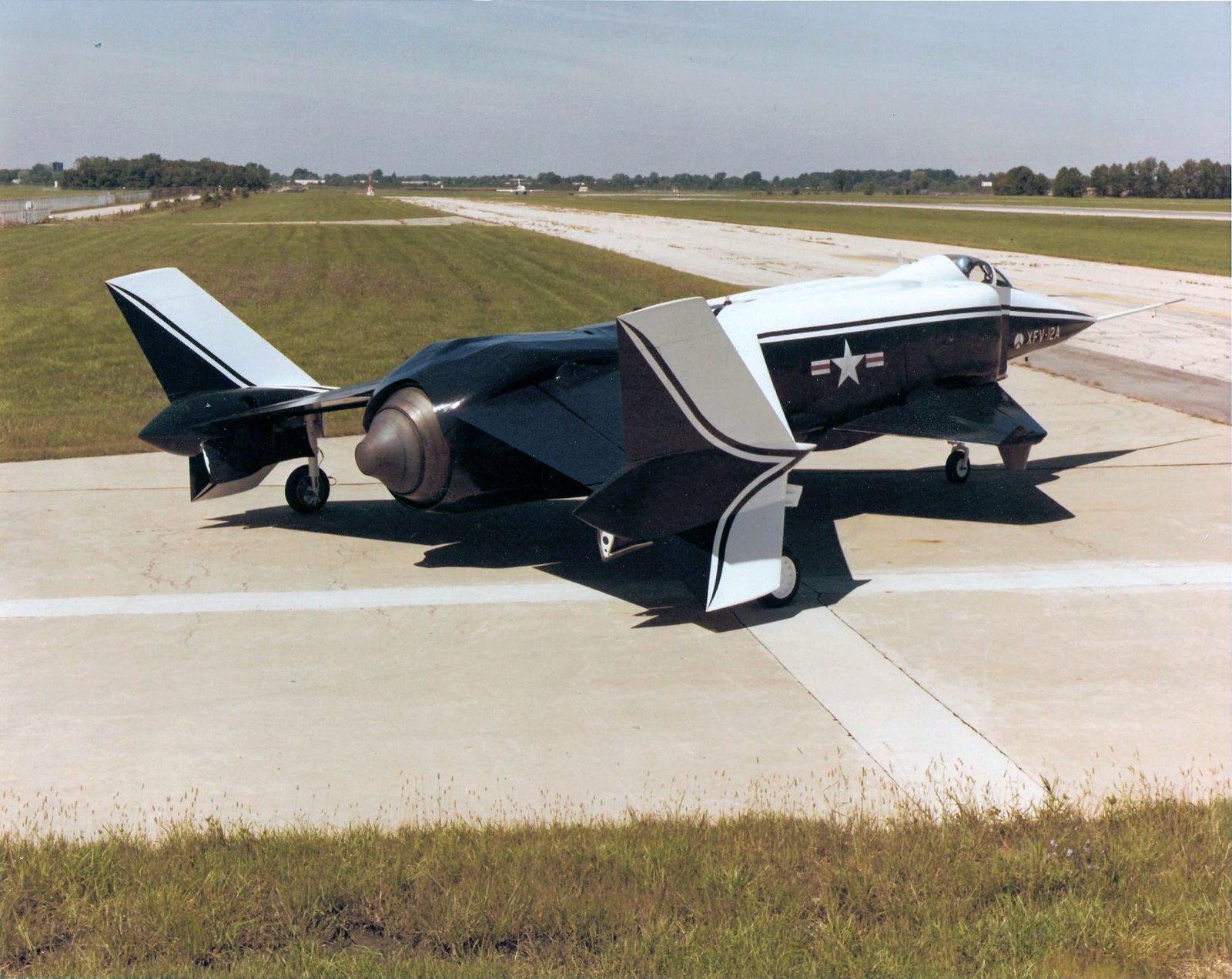
The Rockwell International XFV-12 was developed in response to a 1972 U.S. Navy request for proposals (RFP) seeking a supersonic V/STOL fighter capable of operating from Sea Control Ships (SCS). In May 1972, Rockwell was awarded a $47 million contract to produce two prototypes. The aircraft was intended to serve as a fleet air defense fighter, combining high-speed performance with the ability to take off and land vertically or over very short distances. To reduce development costs, Rockwell integrated existing components, utilizing a nose based on the Douglas A-4 Skyhawk and air intakes derived from the McDonnell Douglas F-4 Phantom II.
Technically, the XFV-12 was powered by a single Pratt & Whitney F401-PW-400 afterburning turbofan, which produced nearly 30,000 lbf of thrust in afterburner. The aircraft's most distinctive feature was its ejector-lift system; engine exhaust was routed through ducts to flaps in the main wing and large canards, where it was intended to entrain ambient air to increase vertical lift. Design goals were highly ambitious, targeting a maximum speed of Mach 2.2 to 2.4 and a combat radius of approximately 925 km. The intended armament included a 20 mm M61 Vulcan cannon with 639 rounds and a flexible missile loadout of up to four AIM-7 Sparrow or AIM-9 Sidewinder missiles.
Despite these goals, the project faced severe technical hurdles. The first prototype was completed in 1977, but the ejector system failed to provide the necessary thrust augmentation due to ducting losses and poor efficiency. Consequently, the XFV-12 never progressed beyond ground runs and tethered hover tests, never achieving a free, untethered flight. While a second airframe was started, it was dismantled at the factory and never completed. The U.S. Navy officially cancelled the program in 1981.
Following the program's termination, the cockpit and forward fuselage of the sole prototype were transferred to NASA's Plum Brook Station in Sandusky, Ohio. Around 2012, students from the EHOVE Career Center began restoring the fuselage for museum display. The XFV-12 remains a significant case study in aerospace engineering, illustrating the practical difficulties of complex ducted-flow lift systems compared to the more successful direct-lift approaches used in aircraft like the Harrier or F-35B.