
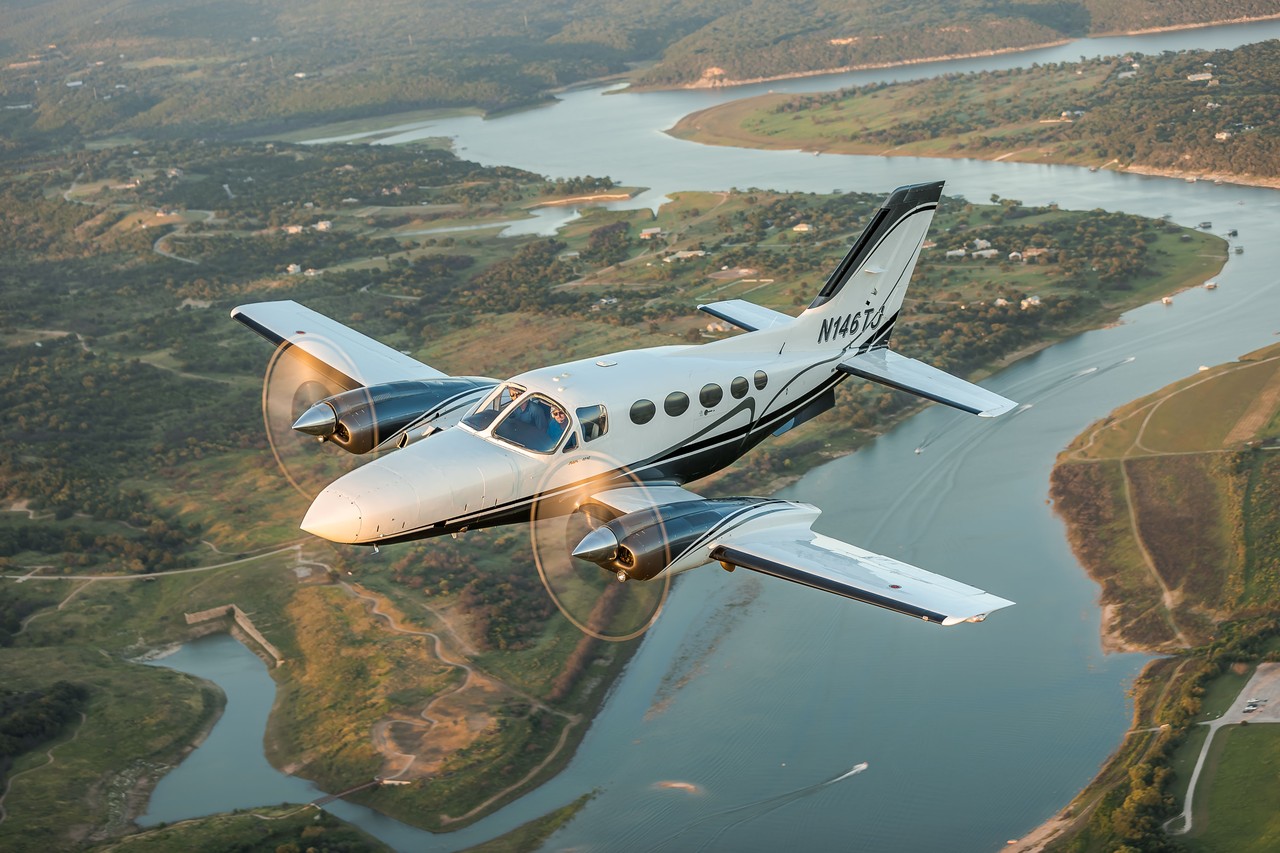
Market Dominance
The Cessna 421 immediately captured the pressurized twin market, selling 200 units in its first year of 1968. This represented a significant achievement for what was then an emerging market segment between conventional piston twins and expensive turboprops. The aircraft filled a crucial gap for corporate operators who needed high-altitude performance and passenger comfort without the operating costs of turbine power. By production's end in 1985, Cessna had delivered 1,901 Golden Eagles across four major variants.
The Manufacturer
Cessna Aircraft Company, founded by Clyde Cessna in 1927, had established itself as general aviation's dominant force by the 1960s. The company experienced tremendous growth during the post-World War II boom, particularly expanding its pressurized twin lineup during the prosperous 1960s and 1970s. Cessna's engineering philosophy focused on providing airline-like capabilities to business operators who couldn't justify turboprop acquisition and operating expenses. General Dynamics acquired Cessna in 1985, the same year 421 production ended due to declining sales. Textron purchased the company in 1992 and continues operating the Cessna brand today, though focusing on business jets and turboprops rather than piston twins.
Design Evolution
Cessna's engineering team developed the 421 as a pressurized evolution of the earlier 411, sharing type certification with the 401, 402, 411, 414, and 425 models. The initial design incorporated "Stabila-Tip" wingtip fuel tanks similar to those used on the Cessna 310, providing 170 gallons of fuel capacity. However, the most significant advancement came in 1976 with the 421C variant, which introduced wet wing fuel storage increasing capacity to 213-270 gallons and raising gross weight to 7,450 pounds.
The 421C also featured trailing-link landing gear beginning in 1981, improving ground handling characteristics. These modifications represented substantial improvements over earlier variants, with the 421C accounting for 859 of the total 1,901 aircraft produced. The design progression through four variants - 200 original 421s, 158 421As, 699 421Bs, and 859 421Cs - demonstrated Cessna's commitment to continuous improvement throughout the 18-year production run.
Engine and Performance
Two wing-mounted Continental GTSIO-520 engines powered all 421 variants, each producing 375 horsepower through geared, turbocharged, fuel-injected six-cylinder opposed configurations. The engine variants progressed from GTSIO-520-D in the original 421 to -H in the 421B (type approved April 28, 1970) and finally -L and -N versions in the 421C (type approved October 28, 1975). Continental's geared design provided smooth operation essential for pressurized cabin comfort, while turbocharging enabled the high-altitude performance that justified the aircraft's premium price.
Three-bladed constant-speed propellers with full feathering capability completed the powerplant installation. The combination delivered impressive performance figures: maximum speed of 297 mph, cruise speed of 277 mph, and initial climb rate of 1,940 feet per minute. Most importantly for business operations, the 421 achieved a service ceiling of 30,000 feet with cabin pressurization, allowing flights above most weather while maintaining sea-level cabin altitude.
Operational Characteristics
The 421 served primarily private owners, corporate flight departments, and small charter operators seeking airline-like capabilities in a pilot-flown aircraft. Typical configurations accommodated six to eight occupants including one or two pilots, though the 421B Executive Commuter variant offered removable seating for cargo operations. Range varied from 1,099 to 1,377 nautical miles depending on variant and fuel load, making the aircraft suitable for transcontinental business trips with one fuel stop.
Operators appreciated the 421's ability to cruise in the flight levels typically reserved for airliners and turboprops, avoiding turbulence and adverse weather that affected lower-flying piston twins. The stall speed of 85 mph provided reasonable approach speeds for business airports, while the electro-mechanical retractable landing gear proved reliable in regular service.
Production Legacy
Cessna manufactured all 421s at its Wichita, Kansas facilities alongside other 400-series aircraft. Production ended in 1985 as the general aviation market collapsed and liability concerns made piston twin manufacturing economically challenging. The timing coincided with General Dynamics' acquisition of Cessna and the company's strategic shift toward turbine aircraft.
Hundreds of 421s remain airworthy today, valued by owner-pilots for their combination of performance, pressurization, and reliability. Some operators have converted their aircraft to turboprop power using modifications that essentially create Cessna 425 equivalents, extending operational life and improving performance. While no specific examples reside in major aviation museums, the 421's significance lies in democratizing pressurized high-altitude flight during general aviation's golden era of the 1970s and early 1980s.